Mason Mountain WMA
Phone: (325) 347-5037
Address:
PO Box 1140
Mason, TX 76856
Contact:
Mark Mitchell
Dates Open:
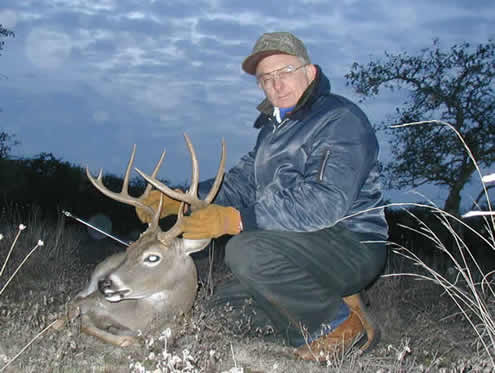
Mason Mountain Wildlife Management Area (WMA) is not open to unsupervised visitation. Visitation is limited to Hunting activities on the South Dove Unit (200-acres) demonstration site of the WMA. Hunters may hunt with a Special Permit selected by the Texas Public Drawn Hunts System. And during open dove season for the Central Region of Texas, dove hunters may hunt with an Annual Public Hunting Permit (APH).
Description
Located in the Llano Uplift, Mason Mountain Wildlife Management Area (WMA) was a working exotic game ranch from the mid-1980s until the Texas Parks and Wildlife Department (TPWD) acquired the tract in 1997. At the time of TPWD acquisition, there were more than 15 species of exotic antelope and deer. Today Scimitar-horned Oryx and Gemsbok Oryx, two species of exotic wildlife, provide research, demonstration and hunting opportunities. Along with these exotic species, native wildlife occurring on the WMA includes white-tailed deer, bobwhite quail, javelina, wild turkey, mourning dove, fox squirrel, bobcat, raccoon, skunk, armadillo, ringtail "cat", rabbit, gray fox and many species of reptiles and migratory birds.
The resources of Mason Mountain WMA are dedicated to ecology research of the Central Mineral Region in the Texas Hill Country and its application to wildlife management on private lands.
In the Texas Hill Country, the traditional landowner who operates a working livestock ranch is becoming less common. More and more properties are becoming "recreational ranches" with the main goal to provide outdoor activities like hunting, bird watching and photography. In many of those privately owned ranch properties, cattle, sheep and goats have been replaced with exotic ungulates. It is the goal of Mason Mountain WMA to encourage those landowners who are going to stock exotic wildlife to do so in a responsible manner that is less competitive with native species. This means utilizing species that can be contained within their property boundaries, using species whose numbers can be controlled and using those species that may occupy a foraging niche that is underutilized by existing native wildlife.
The WMA is situated on the boundary between the Central Mineral Region and the Edwards Plateau and a variety of wildlife habitats are represented. About two-thirds of the Area consists of granite-derived soils supporting a community of post oak and blackjack oak. The remainder of the Area is dominated by live oak and Texas oak on limestone-derived soils. The topography of the Area is rough with steep canyons, caliche hills and granite outcrops. An 8-foot fence to facilitate scientific investigations encloses and subdivides the WMA into three units. To properly manage the habitat, deer populations are maintained at approximately one deer per 12 to 15 acres which is substantially lower than in much of the Hill Country.
In addition to TPWD research activities, many universities utilize the WMA as an outdoor classroom and study site for undergraduate and graduate projects. The varied geology of the property offers a unique opportunity to observe and study wildlife and their use of the different habitats, soil types and environments that exist throughout the Texas Hill Country and Central Mineral Region.
Mason Mountain WMA was acquired as a donation from a private individual and is funded under the Pittman-Robertson Act using Federal Aid in Wildlife Restoration Program funds.
Public use of the majority of the WMA is limited to research, education, public hunting through the Texas Public Drawn Hunts System and demonstration of wildlife management practices. Portions of the WMA are open for dove hunting through the Annual Public Hunting Permit. In addition, 200 acres of Mason Mountain are available to the public to see wildlife management techniques implemented. These practices include native plantings for wildlife, brush control, structures for cavity-nesting birds and prescribed fire.
Terrain & ADA Access
All-terrain vehicles (ORVs) are not permitted on the WMA, except for use by hunters with mobility disabilities or a person directly assisting hunters with mobility disabilities. Proof of mobility disability in the form of a disabled parking placard or disabled vehicle license plate is required. ATV, OHV or ORV use is limited to designated roads or trails only. ATV users must be compliant with the safety requirements for ATV use as set by the Texas Department of Public Safety (ATV only).
- The WMA has restricted access
- There are no restroom facilities
- Bring your own drinking water
- We welcome all public users during open access periods. If you have a hearing, vision, or mobility disability and require an accommodation, please call the site directly to learn more.
- The parking area is unimproved and may be muddy depending on weather conditions.
- There are no improved trails. Public may be required to navigate tall grass and rocky inclines to reach hunting blinds.