
Guadalupe Delta WMA
Phone: (361) 552-6637
Address:
13815 S Hwy 35
Port Lavaca, TX 77979
Contact:
Kevin Kriegel
Dates Open:
Some areas of the Guadalupe Delta Wildlife Management Area (WMA) are open daily for fishing, biking, hiking and wildlife viewing activities. For hunting activities and WMA tour dates, contact the WMA manager. Visitors 17 years of age and older must have an Annual Public Hunting (APH) or Limited Public Use (LPU) Permits to enter the WMA.
Description
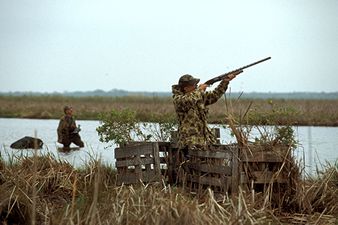
Duck hunting at the Guadalupe Delta WMA.
Photo by Earl Nottingham.
In the late 1970s, the Guadalupe delta area was identified by the US Fish and Wildlife Service and Texas Parks and Wildlife as a wetlands area that needed to be preserved to protect the wildlife habitat. Guadalupe Delta Wildlife Management Area (WMA) consists of four units, Mission Lake Unit (4,447.62 acres), Hynes Bay Unit (1007.72 acres), Guadalupe River Unit (1138 acres) and the San Antonio Unit (818 acres). The Guadalupe Delta WMA units are located in Calhoun, Victoria and Refugio Counties within the delta of the Guadalupe River along the Texas coast between Houston and Corpus Christi. The units of the Guadalupe Delta are freshwater marshes subject to flooding from the Guadalupe River and its adjacent bayous. Riparian areas along the many small bayous form "corridor forests" of pecan, black willow, cedar, American elm, hackberry and green ash and provide excellent forage area for neotropical songbirds. Hundreds of White-faced Ibis seasonally forage in the marshes of the WMA. White-tailed Hawks commonly forage over the WMA during the non-breeding season. Single Peregrine Falcons are observed several times each year foraging over the WMA. Lands in the Guadalupe Delta WMA have traditionally provided important habitat for wetland dependent wildlife, especially migratory waterfowl.
Public hunting is allowed for waterfowl and migratory shore birds, alligators and other wetland wildlife. Check the Annual Public Hunting Lands Map Booklet PDF and the Drawn Hunt Catalog for information on hunting opportunities for the current year.
Habitat Type
The Guadalupe Delta WMA habitat is a complex ecosystem. There are natural coastal marshes, human made wetlands and the deltaic estuary of the Guadalupe River and the Gulf of Mexico.
A deltaic estuary is coastal bodies of brackish water made by a river meeting the sea. At the end of the river, fast moving water deposits sediment that forms low-lying land, called a delta. The fresh water draining from the land mixes with slower tidal seawater. Sea tides create sand bars that hold the brackish water in the water bodies called an estuary.
The volume of freshwater the Guadalupe River discharges, along with the shallowness of adjacent bays, contributes to low salinity in those bay systems as compared to other bay systems in Texas.
Rare/Endangered Species
State and federal threatened and endangered species on the Guadalupe Delta WMA are Brown Pelican, Reddish Egret, White-faced Ibis, Wood Stork, Bald Eagle, White-tailed Hawk, Peregrine Falcon and Whooping Crane.
Terrian & ADA Access
There are no improved trails. Public may have to walk through tall grass and wet soil to reach hunting blinds.
- There aren't any restroom facilities.
- Bring your own drinking water.
- A Texas Department of Transportation viewing platform on Texas 35 adjacent to the WMA is wheelchair accessible.
- Camping is not allowed, but commercial facilities are available in nearby Tivoli, Port Lavaca and Victoria.
- During hunting season, boats must be hand launched and only electric motors are allowed. Use of airboats within the WMA is prohibited. No trailers are allowed.