Work Session
Wednesday, March 25, 2026
9:00 a.m. CDT
Paul L. Foster, Commission Chair
David Yoskowitz, Ph.D., Executive Director
Texas Parks and Wildlife Department
Commission Hearing Room
4200 Smith School Road, Austin, TX 78744
Agenda
Approval of the Previous Minutes from the Commission Work Session held January 21, 2026
- Update on the Texas Parks and Wildlife Department’s Progress in Implementing the Texas Parks and Wildlife Department Land and Water Resources Conservation and Recreation Plan – David Yoskowitz, Ph.D.
- Internal Affairs Update
- Land and Water Resources Conservation and Recreation Plan Update
- Post Oak Ridge State Park
- Public Hunting Access
- Statewide Rainbow Trout Program Evaluation
- Advisory Committee Rules – Request Permission to Publish Proposed Changes in the Texas Register – Craig Bonds
- Financial Overview – Reggie Pegues
- Briefing – Strategic Plan Update – Michael Goldsmith
- Internal Audit Update – Brandy Meeks
- Proposed Amendments to Rules on Proof of Residency Requirements – Recommended Adoption of Proposed Changes – James Murphy (Action Item No. 1)
- Harmful or Potentially Harmful Fish, Shellfish, and Aquatic Plants – Special Provisions for Dotted Duckweed – Recommended Adoption of Proposed Changes – Michael Tennant (Action Item No. 2)
- 2026-2027 Statewide Hunting and Migratory Game Bird Proclamation – Recommended Adoption of Proposed Changes – Shaun Oldenburger, Blaise Korzekwa (Action Item No. 3)
- Special Take Authorization for Disease Management – Recommended Adoption of Proposed Changes – Kory Gann (Action Item No. 4)
- Mountain Lion Harvest Reporting – Request Permission to Publish Proposed Changes in the Texas Register – Jonah Evans
- Wildlife Rehabilitation Rules – Request Permission to Publish Proposed Changes in the Texas Register – Richard Heilbrun
- Land Acquisition – Aransas County – Approximately 0.8 Acres at Rockport State Park Region 2 Headquarters – Request Permission to Begin the Public Notice and Input Process – Jacob Aston (Work Session and Executive Session)
- Land Acquisition – Blanco County – Approximately 4 Acres at Blanco State Park – Request Permission to Begin the Public Notice and Input Process – Jacob Aston (Work Session and Executive Session)
- Land Acquisition – Parker County – Approximately 50 Acres at Lake Mineral Wells State Park and Trailway – Jacob Aston (Work Session and Executive Session) (Action Item No. 5)
- Land Acquisition – Comal County – Approximately 30 Acres at Honey Creek State Natural Area – Request Permission to Begin the Public Notice and Input Process – Stan David (Work Session and Executive Session)
- Land Acquisition – Stephens County – Approximately 2,850 Acres – Stan David (Work Session and Executive Session) (Action Item No. 6)
- Land Acquisition – Austin County – Approximately 230 Acres at Stephen F. Austin State Park – Request Permission to Begin the Public Notice and Input Process – Stan David (Work Session and Executive Session)
- Land Acquisition – Matagorda County – Approximately 825 Acres at Matagorda Peninsula Coastal Management Area – Request Permission to Begin the Public Notice and Input Process – Stan David (Work Session and Executive Session)
- Request for Pipeline Easement – Jefferson County – Approximately 13 Acres at J.D. Murphree Wildlife Management Area – Whitney Gann, Ph.D. (Work Session and Executive Session) (Action Item No. 7)
- Request for Pipeline Easement – Anderson County – Approximately 0.6 Acres at Trinity River Wildlife Management Area – Request Permission to Begin the Public Notice and Input Process – Whitney Gann, Ph.D. (Work Session and Executive Session)
- Request for Pipeline Easement – Nacogdoches County – Approximately 8.6 Acres at Alazan Bayou Wildlife Management Area – Request Permission to Begin the Public Notice and Input Process – Whitney Gann, Ph.D. (Work Session and Executive Session)
- Centennial Parks Conservation Fund Projects – Rodney Franklin (Executive Session Only)
- Litigation Update – James Murphy (Executive Session Only)
Land and Water Plan
Financial
Natural Resources
Land Conservation
Executive Session
Agenda Items
Work Session Agenda Item 1
Presenter: David Yoskowitz, Ph.D.
Update on the Texas Parks and Wildlife Department’s Progress in Implementing the Texas Parks and Wildlife Department Land and Water Resources Conservation and Recreation Plan
I. Executive Summary: Executive Director David Yoskowitz, Ph.D. will briefly update the Texas Parks and Wildlife Commission (Commission) on the status of Texas Parks and Wildlife Department’s (TPWD) efforts to implement the Land and Water Resources Conservation and Recreation Plan (plan).
II. Discussion: In 2001, the 77th Texas Legislature directed that TPWD develop a Land and Water Resources Conservation and Recreation Plan (Texas Parks and Wildlife Code section 11.104). In 2002, the Commission adopted the first plan. A revised plan was adopted by the Commission in January 2005. In November 2009, the Commission approved a new plan, effective January 1, 2010, that included broad input from stakeholders and the general public. Minor revisions continue to be made to the plan. Every five years, TPWD is statutorily required to evaluate its progress toward achieving the plan’s goal and objectives. In November 2023, the Commission approved the 2024 Land and Water Resources Conservation and Recreation Plan goals, objectives, strategies, and actions, which are available on TPWD’s website. Dr. Yoskowitz will update the Commission on TPWD’s recent progress in achieving the plan’s goals, objectives, and deliverables.
The plan consists of the following four goals:
- Practice, Encourage, and Enable Science-Based Stewardship of Natural and Cultural Resources
- Increase Access to and Participation in the Outdoors
- Educate, Inform, and Engage Texas Citizens in Support of Conservation and Recreation
- Employ Efficient, Sustainable, and Sound Business Practices
Work Session Agenda Item 2
Presenter: Craig Bonds
Advisory Committee Rules – Request Permission to Publish Proposed Changes in the Texas Register
I. Executive Summary: Staff seeks permission to publish proposed amendments to rules governing Texas Parks and Wildlife Department (TPWD) advisory committees in the Texas Register for public comment. The proposed amendments would extend the duration of the advisory committees and modify the name and purpose of one committee.
II. Discussion: Texas Parks and Wildlife Code section 11.0162 authorizes the Chair of the Texas Parks and Wildlife Commission (Commission) to appoint committees to advise the Commission on issues under its jurisdiction. Texas Government Code chapter 2110 requires state agencies to adopt rules regarding their advisory committees. Unless otherwise provided by statute, the rules must: (1) state the purpose of the committee; (2) describe the manner in which the committee will report to the agency; and (3) establish when the committee will automatically be abolished, unless the advisory committee has a specific duration established by statute.
In May of 2022, the Commission established an expiration date of July 1, 2026, for all TPWD advisory committees that are not statutorily prescribed. The proposed amendments establish a new expiration date of July 1, 2030, for those committees. The proposed amendments also realign the terms of current members for all advisory committees to facilitate the beginning of new terms on July 1, 2026. In addition, the proposed amendments would rename the Wildlife Diversity Advisory Committee to the Wildlife Conservation Advisory Committee and make other edits to more accurately reflect the committee’s programmatic purview and terminology.
Attachment – 1
Work Session Agenda Item 2
Exhibit A
ADVISORY COMMITTEE RULES
PROPOSAL PREAMBLE
1. Introduction.
The Texas Parks and Wildlife Department (the department) proposes amendments to 31 TAC §§51.601, 51.606-51.615, 51.631, and 51.671-51.673, concerning Advisory Committees.
The proposed amendments would establish an expiration date of July 1, 2030, for the following advisory committees: White-tailed Deer Advisory Committee (WTDAC), Migratory Game Bird Advisory Committee (MGBAC), Upland Game Bird Advisory Committee (UGBAC), Private Lands Advisory Committee (PLAC), Bighorn Sheep Advisory Committee (BSAC), Wildlife Diversity Advisory Committee (WDAC), Mule Deer Advisory Committee (MDAC), Urban Outreach Advisory Committee (UOAC), Accessibility Advisory Committee (AAC), Boating and Waterways Advisory Committee (BWAC), Freshwater Fisheries Advisory Committee (FFAC), State Parks Advisory Committee (SPAC), Coastal Resources Advisory Committee (CRAC), and Oyster Advisory Committee (OAC). The proposed amendment to §51.601, concerning General Requirements, also realigns the terms of current advisory committee members to facilitate the beginning of new terms on July 1, 2026.
Unless extended, these advisory committees will expire by rule on July 1, 2026. The department believes that these advisory committees continue to perform a valuable service for the department. Therefore, the department wishes to continue these advisory committees.
Parks and Wildlife Code, §11.0162, authorizes the Chairman of the Texas Parks and Wildlife Commission (the Commission) to "appoint committees to advise the commission on issues under its jurisdiction." Government Code, Chapter 2110, requires that rules be adopted regarding each state agency advisory committee. Unless otherwise provided by specific statute, the rules must (1) state the purpose of the committee; (2) describe the manner in which the committee will report to the agency; and (3) establish the date on which the committee will automatically be abolished, unless the advisory committee has a specific duration established by statute.
The proposed amendment to §51.611, concerning Wildlife Diversity Advisory Committee (WDAC), renames the committee and makes conforming changes to references accordingly, which is necessary to avoid potential confusion.
2. Fiscal Note.
Robert Macdonald, Regulations Coordinator, has determined that for each of the first five years the amendments are in effect, there will be no fiscal implications to state or local government as a result of enforcing or administering the rules.
3. Public Benefit/Cost Note.
Mr. Macdonald also has determined that for each of the first five years the rules as proposed are in effect:
(A) The public benefit anticipated as a result of enforcing or administering the rules as proposed will be to ensure proper management and effective use of department advisory committees.
(B) There will be no adverse economic effect on persons required to comply with the amendments as proposed.
(C) The department has determined that small or micro-businesses and rural communities will not be affected by the proposed rules. Accordingly, the department has not prepared a regulatory flexibility analysis under Government Code, Chapter 2006.
(D) The department has not filed a local impact statement with the Texas Workforce Commission as required by the Administrative Procedures Act, §2001.022, as the agency has determined that the rules as proposed will not impact local economies.
(E) The department has determined that Government Code, §2001.0225 (Regulatory Analysis of Major Environmental Rules), does not apply to the proposed rules.
(F) The department has determined that there will not be a taking of private real property, as defined by Government Code, Chapter 2007, as a result of the proposed rules.
(G) In compliance with the requirements of Government Code, §2001.0241, the department has prepared the following Government Growth Impact Statement (GGIS). The rule as proposed, if adopted, will:
(1) neither create nor eliminate a government program;
(2) not result in an increase or decrease in the number of full-time equivalent employee needs;
(3) not result in a need for additional General Revenue funding;
(4) not affect the amount of any fee;
(5) not create a new regulation;
(6) not expand, limit, or repeal an existing regulation;
(7) neither increase nor decrease the number of individuals subject to regulation; and
(8) neither positively nor negatively affect the state’s economy.
4. Request for Public Comment.
Comments on the proposed rules may be submitted to Robert Macdonald, Texas Parks and Wildlife Department, 4200 Smith School Road, Austin, Texas 78744; (512) 389-4775; by email at robert.macdonald@tpwd.state.tx.us, or via the department website at https://tpwd.texas.gov/.
5. Statutory Authority.
The amendments are proposed under the authority of Parks and Wildlife Code, §11.0162 and Government Code, §2110.005 and §2110.008.
The proposed amendments affect Parks and Wildlife Code, §11.0162 and Government Code, §2110.005 and §2110.008.
6. Rule Text.
§51.601. General Requirements.
(a) – (e) (No change.)
(f) Term of members. Unless expressly provided in this subchapter or other law, the term of advisory committee members shall be as follows:
(1) The term of each member of an agency advisory committee who was appointed prior to January 1, 2026[2022] will expire on July 1, 2026[2022].
(2) The term of each member of an agency advisory committee member appointed on or after January 1, 2026[2022] will expire July 1, 2030[2026].
(g) – (m) (No change.)
§51.606. White-tailed Deer Advisory Committee (WTDAC).
(a) – (c) (No change.)
(d) The WTDAC shall expire on July 1, 2030[2026].
§51.607. Migratory Game Bird Advisory Committee (MGBAC).
(a) – (c) (No change.)
(d) The MGBAB shall expire on July 1, 2030[2026].
§51.608. Upland Game Bird Advisory Committee (UGBAC).
(a) – (c) (No change.)
(d) The UGBAC shall expire on July 1, 2030[2026].
§51.609. Private Lands Advisory Committee (PLAC).
(a) – (c) (No change.)
(d) The PLAC shall expire on July 1, 2030[2026].
§51.610. Bighorn Sheep Advisory Committee (BSAC).
(a) – (c) (No change.)
(d) The BSAC shall expire on July 1, 2030[2026].
§51.611. Wildlife Conservation[Diversity] Advisory Committee (WCAC)[(WDAC)].
(a) The WCAC[WDAC] shall advise the department on matters pertaining to management, research, and outreach activities related to furbearers, nongame, and rare species in the State of Texas, including the following:
(1) development and implementation of the wildlife conservation-[diversity]related projects, grants, and policy;
(2) wildlife [diversity] conservation and regulations; and
(3) technical guidance and outreach[education and communications] with various constituent groups and individuals interested in wildlife conservation[diversity] in the state of Texas.
(b) The composition of the WCAC[WDAC] shall represent landowner and conservation organizations in Texas.
(c) The WCAC[WDAC] shall comply with the requirements of §51.601 of this title (relating to General Requirements).
(d) The WCAC[WDAC] shall expire on July 1, 2030[2026].
§51.612. Mule Deer Advisory Committee (MDAC).
(a) – (c) (No change.)
(d) The MDAC shall expire on July 1, 2030[2026].
§51.613. Urban Outreach Advisory Committee (UOAC).
(a) – (c) (No change.)
(d) The UOAC shall expire on July 1, 2030[2026].
§51.614. Accessibility Advisory Committee (AAC).
(a) – (c) (No change.)
(d) The AAC shall expire on July 1, 2030[2026].
§51.615. Boating and Waterways Advisory Committee (BWAC).
(a) – (c) (No change.)
(d) The BWAC shall expire on July 1, 2030[2026].
§51.631. Freshwater Fisheries Advisory Committee (FFAC).
(a) – (c) (No change.)
(d) The FFAC shall expire on July 1, 2030[2026].
§51.671. State Parks Advisory Committee (SPAC).
(a) – (b) (No change.)
(c) The SPAC shall expire on July 1, 2030[2026].
§51.672. Coastal Resources Advisory Committee (CRAC).
(a) – (c) (No change.)
(d) The CRAC shall expire on July 1, 2030[2026].
§51.673. Oyster Advisory Committee (OAC).
(a) – (c) (No change.)
(d) The OAC shall expire on July 1, 2030[2026].
This agency hereby certifies that the proposal has been reviewed by legal counsel and found to be within the agency’s authority to adopt.
Issued in Austin, Texas, on
Work Session Agenda Item 3
Presenter: Reggie Pegues
Financial Overview
I. Executive Summary: Staff will present a financial overview of the Texas Parks and Wildlife Department (TPWD).
II. Discussion: Staff will update the Texas Parks and Wildlife Commission on state park, boat registration and titling, and license fee revenues collected by TPWD for year-to-date Fiscal Year (FY) 2026. Staff will also summarize recent budget adjustments for FY 2026.
Work Session Agenda Item 4
Presenter: Michael Goldsmith
Briefing – Strategic Plan Update
I. Executive Summary: Staff will summarize the development of the Texas Parks and Wildlife Department (TPWD) Legislative Strategic Plan for Fiscal Years (FY) 2027-2031.
II. Discussion: Staff will describe updates to the TPWD Legislative Strategic Plan for FY 2027-2031, internally titled Natural Agenda, as prescribed by the Legislative Budget Board and the Governor’s Office.
Work Session Agenda Item 5
Presenter: Brandy Meeks
Internal Audit Update
I. Executive Summary: Staff will update the Texas Parks and Wildlife Commission (Commission) on Internal Audit activities and projects that have taken place since the last Commission Meeting.
II. Discussion: Staff will present an update on the Texas Parks and Wildlife Department Fiscal Year (FY) 2025 and FY 2026 Internal Audit Plans, as well as an update on external audits and assessments.
Work Session Agenda Item 10
Presenter: Jonah Evans
Mountain Lion Harvest Reporting – Request Permission to Publish Proposed Changes in the Texas Register
I. Executive Summary: Staff seeks permission to publish proposed amendments to rules governing mountain lions in the Texas Register for public comment. The proposed amendments would establish harvest reporting requirements for mountain lions. They would also remove the exclusion for mountain lions from scientific permits for research and apply current caging standards for large felids to mountain lions.
II. Discussion: Under Texas Parks and Wildlife Code section 67.002, Texas Parks and Wildlife Department (TPWD) is required to develop and administer management programs for nongame wildlife, which may include conducting scientific investigations and surveys of nongame species for better protection and conservation. In November 2025, the Mountain Lion Research and Monitoring Plan was presented to the Texas Parks and Wildlife Commission (Commission). The plan outlined the importance of accurate harvest data for development of a population monitoring program and the challenges with the current voluntary system, as voluntary methods for collecting mountain lion harvest data are now known to be ineffective for population estimation purposes. A mandatory reporting system can provide sufficient data with county-level reports collected via the TPWD website or a simple smartphone-based reporting application, and precise location data and property names are not necessary for population estimation purposes. To complete the reporting process, a premolar and small tissue sample must be submitted within 60 days of harvest for sex and age confirmation. Staff recommends that the Commission adopt a mandatory harvest reporting requirement for mountain lions to enable accurate population estimation.
In addition, TPWD regulations in Texas Administrative Code chapter 69, subchapter J require entities to obtain a scientific permit when handling all species of native wildlife for research, excluding mountain lions, and to provide certain data in a report to TPWD. Staff recommends removing this exclusion to be consistent with other nongame species and to ensure data collected from research projects can be used by TPWD. Since subchapter J also encompasses zoological and educational display permits, staff recommends applying existing large felid caging standards to captive mountain lions to ensure their health and safety and consistency with current regulations for other large felids.
Attachments – 2
Work Session Agenda Item 10
Exhibit A
NONGAME WILDLIFE RULES
MOUNTAIN LIONS
PROPOSAL PREAMBLE
1. Introduction.
The Texas Parks and Wildlife Department proposes an amendment to 31 TAC §65.950, concerning Mountain Lions. The proposed amendment would create a mandatory harvest reporting system for mountain lions in Texas, which is a critical component of the department’s ongoing attempts to better monitor mountain lion populations. In 2022, the Chairman of the Commission directed the formation of a Mountain Lion Stakeholder Working Group consisting of landowners, livestock producers, private land managers, trappers, and natural resource professionals. The group was charged with making recommendations for the development of a mountain lion management plan. There was broad consensus that the current approach to data collection (voluntary reporting) is inadequate, because voluntary reports represent an unknown proportion of the total harvest, and that better data on mountain lion populations and demographics is necessary to make meaningful population assessments, guide research efforts, and inform agency actions, if any are necessary. Staff has continued dialogue with stakeholders over the last three years while canvassing management and regulatory strategies in other states, and has developed an integrated population model (IPM) that utilizes various population parameters (births, deaths, and movements in and out of local populations) to assess populations and develop more accurate estimates. Effective population monitoring requires data from multiple population parameters to allow a larger picture to coalesce. Birth rates and movements in and out of a population typically vary within limited and predictable ranges which can be quantified. The variation is primarily due environmental conditions such as drought or food availability. Death rates from human causes, however, tend to fluctuate unpredictably and therefore should regularly be assessed for population estimates to be accurate. Because the primary source of mountain lion mortality in Texas, on the basis of all past studies in Texas and data from other states where hunting is permitted, appears to be people, a reliable annual estimate of total harvest is one of if not the most important pieces of information needed for the model to function optimally.
Because the functionality and utility of the IPM depend upon accurate, timely data, particularly with respect to mountain lion mortality and mortality rates, staff have concluded that the best avenue to acquiring meaningful scientific data on mountain lion populations is to require some sort of mandatory harvest reporting program, which would provide the department with accurate, highly useful data collected at county-level scale (because the population inferences for mountain lions must be made at broad spatial extents due to the species’ large home ranges).
The proposed amendment would create new subsection (e) to require a person who takes a mountain lion to report the take within 24 hours via the department’s website or mobile application. The report would provide basic information necessary for the department to supply data for the IPM, such as the date, county of harvest, and method of take, and do so in very close to real time (the more closely the data tracks actual events, the finer the resolution of the model). The department hastens to note that the automated report neither requests nor records location data at any level more precise than county level, nor does it request property names or other identifying information. The department notes that the functionality of the mobile application does not require network connectivity at the time a reporting requirement is executed; a person complies with reporting requirements by entering required data on a device, which records the date and time of the report. The information is then transmitted to the department when connectivity is established. The proposed new subsection also would require the submission of a biological sample from each mountain lion harvested, to consist of a premolar and a small patch of dry tissue, which allows the department to conduct definitive laboratory analysis unique to the harvested animal. For that reason, the rule also stipulates that biological samples be segregated on a per-animal basis, to avoid data corruption. Finally, the proposed amendment would provide an option for the department to conduct sample collection rather than the person who killed the mountain lion. The department notes that in either case, there is no cost to the person who killed the mountain lion.
2. Fiscal Note.
Robert Macdonald, Regulations Coordinator, has determined that for each of the first five years that the rule as proposed is in effect, there will be fiscal implications to the department as a result of administering or enforcing the rule as proposed of approximately $26,000, consisting of the cost of pre-paid mailers and the laboratory analysis of biological samples. The department generously estimates that no more than 250 mountain lions are killed each year; thus, at $4 per mailer, the cost of pre-paid mailers should be approximately $1,000 per year. The cost of laboratory analysis (tooth age analysis, genetic analysis) is estimated to be less than $100 per sample; thus, the department estimates the cost to the department to be approximately $25,000 per year.
There will be no fiscal implications to other units of state or local government.
3. Public Benefit/Cost Note.
Mr. Macdonald also has determined that that for each of the first five years that the rule as proposed is in effect:
(A) The public benefit anticipated as a result of enforcing or administering the proposed rule will be a better understanding of nongame species, the management of which is crucial to healthy, balanced, and functional wildlife systems.
(B) The rule as proposed will not result in adverse economic impacts to persons required to comply.
(C) Under provisions of Government Code, Chapter 2006, a state agency must prepare an economic impact statement and a regulatory flexibility analysis for a rule that may have an adverse economic effect on small businesses, micro-businesses, and rural communities. As required by Government Code, §2006.002(g), in April 2008, the Office of the Attorney General issued guidelines to assist state agencies in determining a proposed rule’s potential adverse economic impact on small businesses. Those guidelines state that an agency need only consider a proposed rule’s "direct adverse economic impacts" to small businesses and micro-businesses to determine if any further analysis is required. For that purpose, the department considers "direct economic impact" to mean a requirement that would directly impose recordkeeping or reporting requirements; impose taxes or fees; result in lost sales or profits; adversely affect market competition; or require the purchase or modification of equipment or services. The department has determined that the proposed rule will not result in a direct economic costs to small businesses and micro-businesses.
The department has determined that the rule as proposed will not affect rural communities, as it does not directly regulate any rural community.
(D) The department has not drafted a local employment impact statement under the Administrative Procedures Act, §2001.022, as the agency has determined that the rule as proposed will not impact local economies.
(E) The department has determined that Government Code, §2001.0225 (Regulatory Analysis of Major Environmental Rules), does not apply to the proposed rule.
(F) The department has determined that there will not be a taking of private real property, as defined by Government Code, Chapter 2007, as a result of the proposed rule.
(G) In compliance with the requirements of Government Code, §2001.0221, the department has prepared the following Government Growth Impact Statement (GGIS). The rule as proposed, if adopted, will:
(1) not create a government program;
(2) not result in an increase or decrease in the number of full-time equivalent employee needs;
(3) not result in a need for additional General Revenue funding;
(4) not affect the amount of any fee;
(5) create a new regulation (to require reporting of mountain lion harvest);
(6) expand an existing regulation;
(7) neither increase nor decrease the number of individuals subject to regulation; and
(8) not positively or adversely affect the state’s economy.
4. Request for Public Comment.
Comments on the proposed rule may be submitted to Jonah Evans, Texas Parks and Wildlife Department, 4200 Smith School Road, Austin, Texas 78744; (830) 431-1491; email: jonah.evans@tpwd.texas.gov or via the department website at https://tpwd.texas.gov/.
5. Statutory Authority.
The new rule is proposed under the authority of Parks and Wildlife Code, §67.004, which requires the commission by regulation to establish any limits on the taking, possession, propagation, transportation, importation, exportation, sale, or offering for sale of nongame fish or wildlife that the department considers necessary to manage the species.
The proposed new rule affects Parks and Wildlife Code, Chapter 67.
6. Rule Text.
§65.950. Mountain Lions (Puma concolor).
(a) – (d) (No change.)
(e) A person who takes a mountain lion in this state must report the take via the department’s website or mobile application within 24 hours.
(1) A report is not valid unless it contains, at a minimum, the following:
(i) species of harvest;
(ii) date of harvest, if known;
(iii) county of harvest;
(iv) method of take; and
(v) measure of effort (the amount of time devoted to the take activity resulting in harvest).
(2) Within 60 days of reporting take as required by this subsection, the person who harvested the mountain lion shall submit a biological sample to the department, using a pre-paid mailer provided by the department, consisting of the identification number for the mountain lion assigned by the department’s app or website, accompanied by:
(A) at least one complete, unbroken premolar (a permanent tooth located between the canines and the molars); and
(B) a patch of dry tissue of at least 5mm by 5mm in size.
(C) A separate mailer must be used for each mountain lion (i.e., one mailer shall not be used to submit biological samples from more than one mountain lion).
(3) In lieu of compliance with the provisions of paragraph (2) of this subsection, a person who kills a mountain lion may contact the department upon harvest and schedule a sample collection by department personnel. The provisions of this paragraph cease to apply seven days from the time the harvest has been reported as required by this subsection.
This agency hereby certifies that the proposal has been reviewed by legal counsel and found to be within the agency’s authority to adopt.
Issued in Austin, Texas, on
Work Session Agenda Item 10
Exhibit B
SCIENTIFIC, EDUCATIONAL, AND ZOOLOGICAL PERMIT RULES
PROPOSAL PREAMBLE
1. Introduction.
The Texas Parks and Wildlife Department proposes amendments to 31 TAC §69.302, concerning General Rules and §69.305, concerning Facility Standards.
The proposed amendment to §69.302 would remove subsection (i), which would potentially result in the department gaining additional data regarding mountain lion populations in Texas. Under current rule, no permit under the subchapter is required for persons who capture or take mountain lions for scientific, educational, or zoological purposes. Generally speaking, entities engaged in bona fide research, education, and zoological activities already voluntarily obtain a permit for the activity; however, there could be exceptions. Although the prospective data to be obtained is likely limited, it is or could be valuable to the department’s understanding and management of mountain lion populations in the state.
The proposed amendment to §69.305 would add mountain lions to the applicability of the caging standards prescribed by that section.
2. Fiscal Note.
Robert Macdonald, Regulations Coordinator, has determined that for each of the first five years that the rules as proposed are in effect, there will be no fiscal implications to state or local government as a result of administering or enforcing the rules as proposed.
3. Public Benefit/Cost Note.
Mr. Macdonald also has determined that that for each of the first five years that the rules as proposed are in effect:
(A) The public benefit anticipated as a result of enforcing or administering the proposed rules will be the potential for additional data with which to better understand nongame species, the management of which is crucial to healthy, balanced, and functional wildlife systems.
(B) The rules as proposed will result in adverse economic impacts to persons required to comply, consisting of the cost of the appropriate fee (zoological collection ($158), scientific research ($53), or educational display ($53)) the cost of appropriate caging for mountain lions, which the department estimates at between $4,000 and $7,000 per enclosure.
(C) Under provisions of Government Code, Chapter 2006, a state agency must prepare an economic impact statement and a regulatory flexibility analysis for a rule that may have an adverse economic effect on small businesses, micro-businesses, and rural communities. As required by Government Code, §2006.002(g), in April 2008, the Office of the Attorney General issued guidelines to assist state agencies in determining a proposed rule’s potential adverse economic impact on small businesses. Those guidelines state that an agency need only consider a proposed rule’s "direct adverse economic impacts" to small businesses and micro-businesses to determine if any further analysis is required. For that purpose, the department considers "direct economic impact" to mean a requirement that would directly impose recordkeeping or reporting requirements; impose taxes or fees; result in lost sales or profits; adversely affect market competition; or require the purchase or modification of equipment or services. The department has determined that the proposed rule could result in a direct economic costs to small businesses and microbusinesses, primarily in the form of a permit fee, if the business utilizes mountain lions for scientific, educational, or zoological purposes. The department notes that for zoological collection permits, those who already hold such a permit would not incur an additional cost for permit amendment. Additionally, most if not all entities with engaged in activities regulated under Parks and Wildlife Code, Chapter 43, Subchapter A non-profit entities and are therefore explicitly exempt from the requirements of Government Code, Chapter 2006 that are applicable to small businesses and microbusinesses. The department also notes that it is unaware of any business that consists solely, significantly, or to a lesser degree on the collection/display of mountain lions as a component of a business model.
The department considered several alternatives to the rule as proposed.
One alternative was to maintain the status quo. This alternative was rejected because staff have been directed by the Parks and Wildlife Commission to gather better data on mountain lion populations, and specifically, data from external scientific research activities. Any data is valuable, although the department notes that it is not aware of anyone currently holding live mountain lions for a purpose regulated by the subchapter that would be capable of providing useful data.
Another alternative was to identify persons who may be engaged in the regulated activities and request voluntary submission of data. This alternative was rejected because such an effort would be time-consuming and expensive relative to yield, if any, and as noted, the department is not aware of anyone currently holding live mountain lions for a purpose regulated by the subchapter.
The department has determined that the rules as proposed will not affect rural communities, as it does not directly regulate any rural community.
(D) The department has not drafted a local employment impact statement under the Administrative Procedures Act, §2001.022, as the agency has determined that the rules as proposed will not impact local economies.
(E) The department has determined that Government Code, §2001.0225 (Regulatory Analysis of Major Environmental Rules), does not apply to the proposed rules.
(F) The department has determined that there will not be a taking of private real property, as defined by Government Code, Chapter 2007, as a result of the proposed rules.
(G) In compliance with the requirements of Government Code, §2001.0221, the department has prepared the following Government Growth Impact Statement (GGIS). The rules as proposed, if adopted, will:
(1) not create a government program;
(2) not result in an increase or decrease in the number of full-time equivalent employee needs;
(3) not result in a need for additional General Revenue funding;
(4) not affect the amount of any fee;
(5) not create a new regulation;
(6) will expand an existing regulation (by requiring persons who engage in zoological collection, scientific research, or educational display of mountain lions to obtain a permit for those purposes, as applicable);
(7) not decrease the number of individuals subject to regulation, but could increase the number by less than an estimate 20 persons at most; and
(8) not positively or adversely affect the state’s economy.
4. Request for Public Comment.
Comments on the proposed rules may be submitted to Jonah Evans, Texas Parks and Wildlife Department, 4200 Smith School Road, Austin, Texas 78744; (830) 431-1491; email: jonah.evans@tpwd.texas.gov or via the department website at https://tpwd.texas.gov/.
5. Statutory Authority.
The amendments are proposed under the authority of Parks and Wildlife Code, Chapter 43, Subchapter C, which requires the commission to adopt rules to govern the collecting, holding, possession, propagation, release, display, or transport of protected wildlife for scientific research, educational display, zoological collection, or rehabilitation.
The proposed amendments affect Parks and Wildlife Code, Chapter 43, Subchapter C.
6. Rule Text.
§69.302. General Rules.
(a) – (h) (No change.)
[(i) The provisions of this subchapter do not apply to mountain lions after September 1, 1997.]
§69.305. Facility Standards.
(a) (No change.)
(b) The minimum cage sizes for mammals and reptiles shall be as follows. An enclosure for mammals shall add 30% of the minimum cage requirement for each additional mammal contained in the enclosure. For each:
(1) – (4) (No change.)
(5) jaguar, mountain lion — 200 square feet x 8 feet in height;
(6) — (11) (No change.)
(c) – (g) (No change.)
This agency hereby certifies that the proposal has been reviewed by legal counsel and found to be within the agency’s authority to adopt.
Issued in Austin, Texas, on
Work Session Agenda Item 11
Presenter: Richard Heilbrun
Wildlife Rehabilitation Rules – Request Permission to Publish Proposed Changes in the Texas Register
I. Executive Summary: Staff seeks permission to publish proposed amendments to rules governing wildlife rehabilitation in the Texas Register for public comment. The proposed amendments would function collectively to reflect the complexity, training, and oversight needed to perform highly complex rehabilitation activities.
II. Discussion: Under Texas Parks and Wildlife Code chapter 43, subchapter C, the Texas Parks and Wildlife Commission (Commission) is required to adopt rules governing the collecting, holding, possession, propagation, release, display, or transport of protected wildlife for scientific research, educational display, zoological collection, or rehabilitation. In 2021, Texas Parks and Wildlife Department (TPWD) conducted an extensive revision of wildlife rehabilitation rules to address longstanding concerns regarding programmatic inefficiency, noncompliance, and abuse. Because those revisions were quite significant, TPWD anticipated that additional revisions in the near term would be necessary to address unforeseen issues, eliminate conflicts, and make improvements. Staff has determined that the eligibility, training, testing, experience, and application requirements to become a wildlife rehabilitator under current regulations do not sufficiently reflect the knowledge and experience needed to safely possess or provide treatment for protected wildlife, supervise other individuals, and to conduct certain authorized activities. Therefore, the proposed amendments would strengthen and improve the delivery of wildlife rehabilitation activities in Texas by generally doing the following:
- Revise eligibility, application, training, and testing requirements to become a wildlife rehabilitator or a sub-permittee;
- Simplify reporting requirements for permittees not authorized to possess white-tailed deer;
- Adjust supervisory permissions of permittees by creating different types of authorizations based on years of experience as a wildlife rehabilitator;
- Require documentation of an ongoing relationship with a veterinarian that may advise the rehabilitator;
- Clarify that the permit holder is responsible for all activities authorized under their permit;
- Establish new rules for non-releasable animals and improve the biosecurity and safety of educational events; and
- Report certain diseases to TPWD.
Attachment – 1
Work Session Agenda Item 11
Exhibit A
WILDLIFE REHABILITATION PERMIT RULES
PROPOSAL PREAMBLE
1. Introduction.
The Texas Parks and Wildlife Department (the department) proposes the repeal of 31 TAC §69.47 and amendments to §§69.43 – 69.46, 69.48, 69.49, and 69.52, concerning Wildlife Rehabilitation Permits.
In 2021, the department conducted an extensive revision of wildlife rehabilitation rules to address longstanding concerns regarding programmatic inefficiency, noncompliance, and abuse (such as the persistent problem of permits being used to keep wildlife as pets or curiosities, which is not only undesirable, but unlawful). Because those revisions were quite significant, the department anticipated that additional revisions in the near term would be necessary in order to address unforeseen issues, eliminate conflicts, and make improvements. The proposed amendments would function, collectively, to reorganize the subchapter, address problematic processes, and improve administrative efficiencies with the goal of strengthening and improving the delivery of wildlife rehabilitation activities in Texas.
The proposed amendment to §69.43, concerning Definitions, would add definitions for “animal control authority,” “large wildlife rehabilitation center,” “licensed veterinarian,” and wildlife health crisis.” The proposed amendment would define “animal control authority” as “The local governmental entity responsible for regulating and/or enforcing laws applicable to the possession, control, welfare, and disposition of animals.” The department has received numerous requests from various law enforcement and first-responder entities for assistance in identifying places and locations where persons may be holding wildlife, because first-responders find it helpful to know about the possibility of encountering captive wildlife in the course of their duties, and because there may be local ordinances and laws that apply to such situations. Therefore, the rules as proposed would require permittees to notify the local animal control authority of the existence and location of facilities and an unambiguous definition of that term is necessary to facilitate compliance and enforcement.
The rules as proposed would make regulatory distinctions based on the intensity and magnitude of rehabilitation efforts. Wildlife rehabilitation activities can vary greatly in scale and pace; some rehabilitators have very narrow areas of specialization and others operate what amount to trauma centers that can have significant staff and treat many animals per day or year. The proposed amendment to §69.45, concerning Permit Required, would acknowledge these scales by defining “Large Wildlife Rehabilitation Center” as “a registered facility that has received at least 3,000 animals in each of the preceding three years and employs the permittee on a full or part-time basis to conduct activities for which a permit under this subchapter is required,” which is necessary to tailor regulatory provisions accordingly.
The department has determined that it is necessary to define “licensed veterinarian” as “a person licensed by the Texas Board of Veterinary Medical Examiners to practice veterinary medicine in Texas,” which is necessary to ensure that all persons providing veterinary medical services to wildlife rehabilitators are lawfully able to do so by the state of Texas and are professionally accountable in the state of Texas.
The proposed amendment also would define “wildlife health crisis” as “a circumstance or set of circumstances that threaten wildlife populations, biodiversity, ecosystem stability, or animal or human health, including through zoonotic pathogen spillover.” The definition is necessary because the term is employed in current rule and the standard applied by the department to such situations should be clear with respect to the threshold for department responses to disease emergence, such as that posed by New World Screwworm, that threatens public wildlife resources and potentially, livestock, pets, and humans.
Finally, the proposed amendment would correct and relocate current (12) to preserve meaning and alphabetical order.
The proposed amendment to §69.44, concerning General Provisions, would consist of several actions. The department has determined that the section is unwieldy and thematically inconsistent; therefore, the proposed amendment would rearrange existing provisions according to shared applicability and relocate some provisions to other sections as noted.
The proposed amendment would relocate current subsections (e) — (l), (n), (q), and (r) to subsection (a) and redesignate those provisions as paragraphs, which is intended to group generally applicable provisions in one place. Current subsections (e) and (f) would become new paragraph (3)(A) and (B) under subsection (a); the contents of current subsection (c) would be retained but become new subsection(a)(4); current subsection (g) would become new paragraph (5); current subsection (j) would become new subsection (a)(7); current subsection (n) would become new subsection (a)(8); current subsection (q) would become new subsection (a)(9); and current subsection (r) would become new subsection (a)(10). The changes are purely organizational and nonsubstantive.
The proposed amendment to §69.44 would retain the provisions of current subsection (d) as new subsection (b)(2) and add new paragraph (1), which would require subpermittees to be at least 18 years of age and to have passed an elementary, department-administered examination with a score of 100 percent. The department has encountered situations in which persons listed as subpermittees are clearly too young and/or unqualified to be conducting or assisting in permitted activities; therefore, the department believes a standard is appropriate. The department believes it is reasonable to require that all subpermittees be at least 18 years of age and to have demonstrated a basic understanding of wildlife rehabilitation.
The proposed amendment would combine the provisions of current subsections (h) and (i) and place them in proposed new subsection (c) concerning Display to the Public.
The proposed amendment to §69.44 would also create new subsection (d) to address the possession of non-releasable wildlife. Wildlife is by definition animal life that is meant to live in a state of nature and not in a state of domestication. In the natural world, animals that cannot survive don’t. In many cases, wildlife brought to wildlife rehabilitators cannot be restored to a state of health that would allow survival in the wild and thus cannot be returned to the wild (“non-releasable”), which dictates euthanasia unless there is a compelling argument for allowing the animal to be kept for use for education, socializing other wildlife of the same species, or some other specialized use that benefits the species or human understanding of wildlife. Current rule requires non-releasable wildlife to be euthanized except as provided for approved educational, fostering, or socialization purposes, or transfer to zoological, scientific, or educational permit holders; however, the department continues to be concerned about situations in which wildlife is being retained in contravention of these understandings, in effect, becoming pets or curiosities, and in some cases the department has reason to suspect that persons have obtained wildlife rehabilitation permits solely for such purposes, which defeats the entire purpose of the concept of wildlife rehabilitation. The department believes that the highest and best reality for wildlife is to live in the wild as part of and contributors to native ecosystems and that wildlife incapable of survival in the wild should be euthanized unless it can be used to benefit the species or human understanding of biology because the animal cannot live as nature intended. The department also wishes to avoid any possibility of inadvertently creating a legal pathway for the intentional acquisition of wildlife for personal use or enjoyment. For these reasons, the department proposes new provisions, in addition to the current provisions, that would require non-releasable wildlife to be kept at the permittee’s registered facility and explicitly prohibit public display except as provided for educational purposes. The proposed amendment also would require non-releasable wildlife approved for educational display to be restrained at all times and would prohibit any touching or handling by the public at any time. The department reasons that explicit provisions carrying criminal penalties for violation are useful to emphasize that wildlife resources are owned by the people of the state and are not to be treated as pets, curiosity pieces, or commodities. For similar reasons, the current requirement restricting the possession of non-releasables to persons with at least three years as a permitted rehabilitator would be altered to increase the period of experience to five years. The proposed amendment would also relocate current §69.45(b) in new subsection (g).
The proposed amendment to §69.45, concerning Permit Required, would retitle the section to acknowledge the addition of new provisions to create four categories of wildlife rehabilitation permit, based on level of complexity, and to enhance quality control measures for satellite facilities.
The department has long experienced administrative difficulties associated with the various and disparate levels of operational complexity within the regulated community. As noted previously in this preamble, the universe of wildlife rehabilitation in Texas is very diverse, ranging from permittees who are highly specialized and work with a very small number of animals at a single facility to permittees who supervise large numbers of subpermittees and volunteers that treat a wide variety of animals at numerous satellite facilities. The one-size-fits-all nature of the current regulatory structure is problematic, particularly from the perspective of disease management, reporting and recordkeeping, and effective monitoring and tracking of the activities of subpermittees and volunteers. The department acknowledges the legitimate usefulness of satellite facilities, subpermittees, and volunteers, but is also concerned about both the abuse of those privileges (intentional and accidental) and the unwieldiness introduced by its complexity. There is an ongoing problem with the proliferation of subpermittees and volunteers under multiple permittees, permittees being listed as subpermittees under other permittees, geographical dispersion of satellite facilities, phantom facilities, and other, similar types of problems. Therefore, the department proposes to eliminate the current one-size-fits-all approach and replace it with a system of graduated permit types stratified by magnitude of subpermittee/volunteer/satellite facility activities.
The proposed amendment would create the Type A permit to address those rehabilitation activities that do not involve subpermittees or satellite facilities. This permit level would be the entry or default level of permit issuance but could also be utilized by permittees with very narrow and/or high specialized practices (for example, a rehabilitator that specializes only in rabbits). The Type B permit would address moderately more complex rehabilitation activities and would authorize up to five subpermittees, whose activities would be confined to the supervisory permittee’s registered facility (i.e., no satellite facilities). To qualify for issuance of a Type B permit, the applicant would be required to document a minimum of two years’ experience as a permitted wildlife rehabilitator in Texas. The department believes that two years of experience as a wildlife rehabilitator should be the minimum standard for supervision of other persons conducting wildlife rehabilitation activities as authorized under the subchapter. The Type C permit would address complex rehabilitation activities, authorize the permittee to supervise up to 10 subpermittees at up to five satellite facilities, and require the permittee to document at least five years of experience as a permitted wildlife rehabilitator in Texas as a condition of issuance. The department has determined that it is reasonable and logical to allow expansion of permit privileges in proportion to demonstrated responsible experience. Finally, the Type D permit would address very large wildlife rehabilitation activities conducted by permittees who are paid employees of an organization. A Type D permit would authorize any number of subpermittees at any number of satellite facilities, but would be conditioned on the permittee having at least five years documented experience as a permitted wildlife rehabilitator (in any state or states) and being a paid employee of a large wildlife rehabilitation center, as defined in the rules. The department reasons that very large wildlife rehabilitation operations operated or sanctioned by bona fide conservation/conservation-oriented organizations that employ experienced, demonstrably responsible permittees can be entrusted with significant latitude in conducting permitted activities.
The proposed amendment also would alter current subsection (c) to strengthen oversight provisions applicable to satellite facilities. The current rule requires supervisory permittees to visit satellite facilities no less frequently than once every 120 days to verify compliance with applicable provisions of the subchapter. The department has determined, on the basis of encountering several failures with respect to permittees ensuring that satellite facilities are compliant, that it is necessary to prohibit wildlife rehabilitation at any satellite facility unless the supervisory permittee has personally inspected the facility within the previous 120 days and documented in writing that the facility is being operated in compliance with the applicable provisions of the subchapter. In this way, the department intends to ensure that public resources are receiving appropriate care.
The proposed amendment would move current subsection (b) to §69.44 as noted previously in this preamble. Additionally, the proposed amendment would create new subsection (c) to prohibit any permittee from being listed as a subpermittee by another permittee. The department has encountered significant issues untangling webs of interconnected persons performing wildlife rehabilitation under multiple authorizations, which confounds department processes, most notably, the ability of the department to conduct epidemiological investigations in the event of a wildlife health crisis.
The proposed amendment also would relocate the provisions of current §69.44(q) as new subsection (f), reworded to acknowledge that amendment of permit provisions in the event of a declared wildlife health crisis would be effected by emergency rulemaking. Although other provisions of the rules allow the department to waive provisions of the subchapter in response to wildlife health crises, the department wishes to avoid any suggestion of engaging in ad hoc rulemaking in such situations and therefore seeks to make it abundantly clear that any amendments of permits in response to a health crisis will be done under the provisions of the Administrative Procedure Act and the Parks and Wildlife Code.
Finally, the proposed amendment would prohibit the possession of any animal under a wildlife rehabilitation permit for longer than 365 days unless recommended in writing by a licensed veterinarian and the department. As mentioned previously in this preamble, the intent of wildlife rehabilitation is the return of wildlife to native systems, with exceptions for certain non-releasables. The wildlife rehabilitation permit is not a pet permit, nor is it companion-animal permit. The department reasons that a year is sufficient time to restore most injured or sick wildlife to a state of health that would permit re-introduction to the wild, with the proviso that there could be legitimate reasons for additional time in extenuating circumstances.
The proposed amendment to §69.46, concerning Application for Permit, would impose specific experiential requirements for permit issuance. Current rules require only completion of a training course offered by a professional wildlife rehabilitation organization within three years of the application for a permit. The department has determined that this is inadequate and has resulted in issuance of permits to persons who seek a wildlife rehabilitation permit for purposes unrelated to bona fide wildlife rehabilitation (such as keeping wildlife as pets or conversation pieces, practices that historically have plagued the program), in addition to enabling permit issuance to persons who are not serious or are otherwise insufficiently committed to or experienced enough to ably practice wildlife rehabilitation. To remedy this situation, the proposed amendment would require applicants to document a minimum of 800 hours of wildlife rehabilitation experience at any level and to have been either a subpermittee in Texas or a permitted wildlife rehabilitator in any state for a minimum of two years. The department believes that persons meeting these requirements have demonstrated genuine commitment to the practice of wildlife rehabilitation. Proposed subsection (b) would exempt current permittees from the proposed new requirements, but would stipulate that any person who allows a permit to lapse and subsequently seeks a permit would have to meet the proposed new requirements. Additionally, new applicants would be required to provide evidence of at least 20 hours of training or coursework provided by an accredited professional organization or an entity approved by the department, which is intended to replace the current educational requirement of any training within the previous three years, which is vague. The department believes it is appropriate to quantify the amount of professional training and establish a credible standard in order to ensure that applicants have made a credible and efficacious investment in continuing education and training.
The proposed amendment to §69.46 also would eliminate the current requirement for a letter from a licensed veterinarian known to the applicant and replace that standard with the requirement of a letter from a licensed veterinarian affirming that the veterinarian will provide veterinary consultation services to the applicant if a permit is issued. The department reasons that the current standard is little more than proof that two people are acquainted, whereas the proposed amendment would require an affirmation of willingness to provide professional advice and/or services, which the department believes is a higher standard that will improve the quality of wildlife rehabilitation in the state. Finally, the proposed amendment would reduce the minimum required score on a department-administered wildlife rehabilitation test, from 100% to 80% on a more comprehensive exam. The department assesses that persons who are capable of meeting the enhanced standards of the proposed new provisions need not be held to the 100% standard.
The amendment to §69.48, concerning Permit Renewals, would comport the provisions of subsection (a) to accommodate the changes made elsewhere to replace quarterly reporting with annual reporting for certain permittees, and would amend subsection (b) to require at least eight hours of training annually, as well as a letter from licensed veterinarian attesting to the willingness to provide consulting services to the permittee. The department believes it is important for permitted wildlife rehabilitators to participate in continuing education furnished by recognized professional organizations and associations so as to be aware of and familiar with current developments and trends that improve the quality and efficacy of wildlife rehabilitation delivery. Similarly, as discussed earlier in this preamble, the department believes it is important to document access to veterinary professionals for specialized expertise necessary to inform successful outcomes. The proposed amendment also would alter subsection (c) to cite the department’s rules governing the process for denial of permit issuance or permit renewal.
The proposed amendment to §69.49, concerning General Facility Standards, would insert new subsection (b) to prohibit the registration of any facility located in a domestic residence that shares air handling equipment or access to water, housing or exercise space, or food in common with another domestic residence. The department seeks to eliminate wildlife rehabilitation activities in environments where the facilitation of disease propagation and spread is possible via cross-contamination or physical contact with sick wildlife, and to prevent wildlife rehabilitation activities in environments that are inappropriate in terms of noise and other disruptions that could interfere with or confound effective rehabilitation efforts (e.g., apartments, duplexes, townhomes, etc.).
The proposed amendment to §69.52, concerning Reports and Recordkeeping, would alter the title of the section to reflect notification requirements created by the proposed amendment in the form of possession of documentation of inspections of satellite facilities required under the proposed amendment to §69.45. The proposed amendment would also relax reporting requirements for all permittees that do not rehabilitate deer. In a previous rulemaking in response to the emergence of chronic wasting disease (CWD), the department imposed quarterly reporting requirements on all wildlife rehabilitators. The department has been persuaded that the quarterly reporting requirements can safely be restricted only to those permittees authorized to rehabilitate deer, and that there is negligible threat of CWD being spread from facilities not authorized to receive deer.
The proposed amendment would also require permittees to notify the appropriate local animal control authority, for reasons mentioned earlier in this preamble in the discussion of the proposed amendment to §69.43, concerning Definitions.
Finally, the proposed amendment would create new subsection (j) to require notification of the department upon learning of, discovering, or being informed that a reportable disease has been confirmed to exist in an animal or facility for which the permittee is responsible. The department believes it is axiomatic that the presence or detection of disease is something that should be reported immediately, so as to allow the department and any other involved entities the greatest amount of time to respond effectively.
2. Fiscal Note.
Richard Heilbrun, Wildlife Division Deputy Director, has determined that for each of the first five years that the rules are in effect, there will be no fiscal implications to state or local governments as a result of administering or enforcing the rules, because the rules will be administered and enforced by existing personnel using existing systems, equipment, and budget.
3. Public Benefit/Cost Note.
Mr. Heilbrun also has determined that for each of the first five years that the rules as proposed are in effect:
(A) The public benefit anticipated as a result of enforcing or administering the rule as proposed will be the implementation of rules that will increase the effectiveness and efficiency of wildlife rehabilitation in the state and enhance measures to ensure the biosecurity of wildlife rehabilitation activities in the state, thereby protecting native wildlife populations and natural systems, as well as having the benefit of protecting human and livestock health and safety.
There will be no direct adverse economic effects on persons required to comply with the rules as proposed. Although the rules as proposed would create additional requirements for permit issuance in the form of minimum standards of training and experience, the department reasons that those provisions do not affect current permittees except with respect to the requirement of eight hours of annual training in lieu of the non-specific standard in the current rules, which is “the completion of a training course.” The department has determined that virtually any approved training course will satisfy the eight-hour requirement imposed by the rules as proposed. Additionally, the department notes that because the proposed amendment to §65.49 prohibiting the registration of facilities with certain shared physical residential infrastructure, if adopted, would apply only to facilities registered after the effective date of the rules (i.e., not retroactively), there is no cost of compliance associated with the provision.
(B) Under the provisions of Government Code, Chapter 2006, a state agency must prepare an economic impact statement and a regulatory flexibility analysis for a rule that may have an adverse economic effect on small businesses, micro-businesses, and rural communities. As required by Government Code, §2006.002(g), the Office of the Attorney General has prepared guidelines to assist state agencies in determining a proposed rule’s potential adverse economic impact on small businesses. Those guidelines state that an agency need only consider a proposed rule’s “direct adverse economic impacts” to small businesses and micro-businesses to determine if any further analysis is required. For that purpose, the department considers “direct economic impact“ to mean a requirement that would directly impose recordkeeping or reporting requirements; impose taxes or fees; result in lost sales or profits; adversely affect market competition; or require the purchase or modification of equipment or services.
The department has determined that no small businesses, microbusinesses, or rural communities will be affected by the proposed rules, because it is unlawful to conduct wildlife rehabilitation on a for-profit or commercial basis in this state. Therefore, the department has not prepared the economic impact statement or regulatory flexibility analysis described in Government Code, Chapter 2006.
(C) The department has not drafted a local employment impact statement under the Administrative Procedures Act, §2001.022, as the agency has determined that the rules as proposed will not impact local economies.
(D) The department has determined that Government Code, §2001.0225 (Regulatory Analysis of Major Environmental Rules), does not apply to the proposed rules.
(E) The department has determined that there will not be a taking of private real property, as defined by Government Code, Chapter 2007, as a result of the proposed rules.
(F) In compliance with the requirements of Government Code, §2001.0221, the department has prepared the following Government Growth Impact Statement (GGIS). The rules as proposed, if adopted, will:
(1) not create a government program;
(2) not result in an increase or decrease in the number of full-time equivalent employee needs;
(3) not result in a need for additional General Revenue funding;
(4) not affect the amount of any fee;
(5) create a new regulation (requirement for permittee presence at registered facilities);
(6) expand existing regulations (stratification of permit privileges, quantification of experience requirements for permit issuance and renewal)
(7) limit an existing regulation (by prohibiting rehabilitation activities in shared residential environments);
(8) will repeal an existing regulation;
(9) neither increase nor decrease the number of individuals subject to regulation; and
(10) not positively or adversely affect the state’s economy.
4. Request for Public Comment.
Comments on the proposal may be submitted to Lindsay Garza (830) 261-2716, e-mail: Lindsay.garza@tpwd.texas.gov. Comments also may be submitted via the department’s website at http://www.tpwd.texas.gov/business/feedback/public_comment/.
5. Statutory Authority.
The amendments are proposed under Parks and Wildlife Code, §43.022, which requires the commission to adopt rules to govern the collecting, holding, possession, propagation, release, display, or transport of protected wildlife for scientific research, educational display, zoological collection, or rehabilitation and authorizes the department to issue a permit to a qualified person to collect, hold, possess, display, transport, release, or propagate protected wildlife for scientific research, educational display, zoological collection, or rehabilitation.
The proposed amendments affect Parks and Wildlife Code, Chapter 43, Subchapter C.
6. Rule Text.
§69.43. Definitions. The following words and terms, when used in this subchapter, shall have the following meanings, unless the context clearly indicates otherwise.
(1) Animal control authority—The local governmental entity responsible for regulating and/or enforcing laws applicable to the possession, control, welfare, and disposition of animals.
(2)[(1)] Education — Activities that encourage management and conservation of wildlife resources or that are intended to increase the public’s awareness and understanding of aspects of wildlife biology.
(3)[(2)] Final disposition — The terminal status of wildlife rehabilitation efforts due to transfer, retention, mortality, or euthanasia.
(4)[(3)] Fostering — Using a captive animal to rear young animals of the same species.
(5)[(4)] Holding — Retaining in captivity.
(6)[(5)] Human imprinting or human bonding — A dependency or fixation upon humans as parent substitutes or companions.
(7) Large Wildlife Rehabilitation Center — A registered facility that:
(A) has received at least 3,000 animals in each of the preceding three years; and
(B) employs the permittee on a full or part-time basis to conduct activities for which a permit under this subchapter is required.
(8) Licensed veterinarian – A person licensed by the Texas Board of Veterinary Medical Examiners to practice veterinary medicine in Texas.
(9)[(6)] Non-releasable animal — An animal which, after rehabilitation, is determined by the department to be unlikely to survive in the wild if released.
(10)[(7)] Propagate — To allow animals to produce offspring.
(11) Protected wildlife — As defined by Parks and Wildlife Code, Chapter 43, Subchapter C.
(12)[(8)] Rehabilitation — The temporary caring for injured, orphaned, or sick wildlife until such animals can be released to the wild.
(13) Reportable Disease — A disease identified as reportable on the National List of Reportable Animals Diseases maintained by the Animal and Plant Health Inspection Service under the United States Department of Agriculture, or that meets criteria listed under 4 TAC §45.2(a).
(14)[(9)] Satellite rehabilitation facility (satellite facility) — A facility registered with the department and operated by a subpermittee under the supervision of a permittee.
(15)[(10)] Socialize — Using a captive animal to teach wild behaviors to juvenile animals of the same species.
(16)[(11)] Subpermittee — A person authorized by a permittee to conduct activities governed by this subchapter.
(17) Wildlife health crisis—A circumstance or set of circumstances that threaten wildlife populations, biodiversity, ecosystem stability, or animal or human health, including through zoonotic pathogen spillover.
(18)[(12)] Protected["Wildlife Protected"] wildlife — as defined by Parks and Wildlife Code, Chapter 43, Subchapter C.
(19)[(13)] Supervisory permittee — A permittee who is responsible for the activities of subpermittees listed on the permittee’s permit and volunteers at the permittee’s or subpermittee’s facility or satellite facility, as applicable. Unless otherwise indicated, a reference to a permittee is a reference to the supervisory permittee.
(20)[(14)] Volunteer — An individual who is not a permittee or subpermittee and works with permitted wildlife in the presence of the permittee or subpermittee.
§69.44. General Provisions.
(a) General.
(1) Activities authorized by a permit issued under this subchapter shall be conducted only by the permittee and/or subpermittees named on the permit or volunteers in compliance with the requirements of this subchapter.
(2)[(b)] Except as provided in paragraph (4) of this subsection[subsection (c) of this section], activities authorized by a permit issued under this subchapter shall be conducted only at a rehabilitation facility or satellite facility registered with the department via an electronic application designated by the department for that purpose.
(3) Wildlife held under the authority of a permit issued under this subchapter:
(A) shall not be commingled with domestic pets, livestock, exotic livestock, exotic fowl, or non-indigenous wildlife; and
(B) may not be sold, bartered, or exchanged for any consideration. A permit issued under this subchapter shall not authorize a person, firm, or corporation to engage in the propagation or commercial sale of wildlife.
(4)[(c)] A permittee or subpermittee may possess sick or injured wildlife while not at a registered facility or satellite facility only for the amount of time necessary to stabilize and transport the wildlife to a registered facility or satellite facility.
(5) A permittee shall conduct rehabilitation in an environment which minimizes human contact and prevents human and domestic animal imprinting or bonding.
(6) A permittee shall not conduct activities governed under this subchapter on the same property as a fur-bearing animal propagation facility or deer breeding facility unless specifically authorized in writing by the department.
(7) All medical treatment, including vaccinations, shall be performed in consultation with a licensed veterinarian and in accordance with all applicable laws regarding extra-label use of medications and biologicals.
(8) The department may temporarily waive any provision of this subchapter during a wildlife health crisis.
(9) The department may designate a manual process in lieu of any electronic application requirement of this subchapter if for whatever reason the electronic application is unavailable.
(b)[(d)] Subpermittees and Volunteers.
(1) A subpermittee must:
(A) be at least 18 years of age; and
(B) have scored 100 percent on a department-administered wildlife rehabilitation examination within the previous five years.
(2) A volunteer may engage in permitted activities if:
(A)[(1)] the volunteer is identified on the daily volunteer log as required under §69.52 of this title (relating to Reports and Recordkeeping); and
(B)[(2)] the supervisory permittee or a subpermittee is present. At any time that the supervisory permittee or a subpermittee is not present, volunteer activity must be limited to feeding, watering, cleaning of cages and enclosures, and other custodial activities that involve only incidental contact with wildlife.
(c) Display to the Public.
(1) Except for permitted educational purposes, wildlife possessed under a rehabilitation permit shall not come in contact with anyone other than the permittee and/or subpermittees, volunteers, licensed veterinarians, or the staff of licensed veterinarians.
(2) A permittee shall not allow the viewing, exhibit, or display to the public of animals possessed under a rehabilitation permit unless specifically authorized by permit provision.
(d) Non-releasable wildlife.
(1) No person may conduct educational display activities involving non-releasable wildlife under Type A, B, or C permits unless the supervisory permittee is present during the activity. Non-releasable wildlife:
(A) must be housed at the supervisory permittee’s registered facility;
(B) shall not be displayed to the public except as provided in this subchapter for educational activities;
(C) shall not be touched or handled by the public at any time; and
(D) shall be restrained at all times during educational events in such a fashion as to prevent physical contact with the public; and
(E) shall be euthanized except as provided by this paragraph.
(2) Permission to retain non-releasable wildlife may be granted only to permittees who have at least five years’ experience as a permitted wildlife rehabilitator.
(3) The department may permit the retention of non-releasable wildlife for approved educational, fostering, or socialization purposes, or for transfer to zoological, scientific, or educational permittees. Requests must be made in writing to the department, and no transfer shall take place until the department has approved the request. A request to retain non-releasable wildlife under this subsection shall include a statement from a licensed veterinarian that the animal is non-releasable and the reasons why the animal is non-releasable. The department will not authorize the retention of an animal that because of a disease or condition poses a danger to humans, other animals, or itself.
(4) Permittees possessing non-releasable raptors shall band the raptors with markers supplied by the department.
[(e) Wildlife held under the authority of a permit issued under this subchapter may not be sold, bartered, or exchanged for any consideration. A permit issued under this subchapter shall not authorize a person, firm, or corporation to engage in the propagation or commercial sale of wildlife.]
[(f) Wildlife held under the authority of a permit issued under this subchapter shall not be commingled with domestic pets, livestock, exotic livestock, exotic fowl, or non-indigenous wildlife.]
[(g) A permittee shall conduct rehabilitation in an environment which minimizes human contact and prevents human and domestic animal imprinting or bonding.]
[(h) Except for permitted educational purposes, wildlife possessed under a rehabilitation permit shall not come in contact with anyone other than the permittee and/or subpermittees, volunteers, licensed veterinarians, or the staff of licensed veterinarians.]
[(i) A permittee shall not allow the viewing, exhibit, or display to the public of animals possessed under a rehabilitation permit unless specifically authorized by permit provision.]
[(j) A permittee shall not conduct activities governed under this subchapter on the same property as a fur-bearing animal propagation facility or deer breeding facility unless specifically authorized in writing by the department.]
[(k) Non-releasable wildlife shall be euthanized except as provided by this subsection.]
[(1) Permission to retain non-releasable wildlife may be granted only to permittees who have at least three years’ experience as a permitted wildlife rehabilitator.]
[(2) The department may permit the retention of non-releasable wildlife for approved educational, fostering, or socialization purposes, or for transfer to zoological, scientific, or educational permittees. Requests must be made in writing to the department and no transfer shall take place until the department has approved the request. A request to retain non-releasable wildlife under this subsection shall include a statement from a licensed veterinarian that the animal is non-releasable and the reasons why the animal is non-releasable. The department will not authorize the retention of an animal that because of a disease or condition poses a danger to humans, other animals, or itself.]
[(l) Permittees possessing non-releasable raptors shall band the raptors with markers supplied by the department.]
(e)[(m)] Deer. Wildlife rehabilitation of white-tailed deer and mule deer is restricted to fawns only. No permittee or subpermittee may accept or possess a white-tailed or mule deer that is in adult pelage (no spots). All white-tailed or mule deer received by a permittee shall immediately be identified by the attachment to the pinna of either ear of:
(1) a Radio Frequency Identification Device (RFID) button tag approved by the department; and
(2) a "dangle" type tag bearing the unique identifier assigned to the deer by the department.
(3) The RFID tag required by this subsection must have an associated 15-digit animal identification number conforming to the 840 standards of the United States Department of Agriculture, which number shall be reported to the department in accordance with the applicable provisions of §65.92 of this title (relating to Reports and Recordkeeping).
(4) It is an offense for any person to remove or allow the removal of a tag required by this subsection from a living white-tailed or mule deer.
(5) A permittee or subpermittee who transfers a white-tailed or mule deer shall notify the administrator of the wildlife rehabilitation program at least 24 hours but not more than 48 hours prior to and following the completion of the transfer.
(6) Deer must be released, transferred, or euthanized by the end of the calendar year in which they were born or at the time they grow adult pelage, whichever occurs first.
(7) The department may require any deer held under a permit issued under this subchapter to be tested for chronic wasting disease.
[(n) All medical treatment, including vaccinations, shall be performed in consultation with a licensed veterinarian and in accordance with all applicable laws regarding extra-label use of medications and biologicals.]
(f)[(o)] Disposition of Euthanized Wildlife. Euthanized wildlife and wildlife that has died while under the care of a permittee shall be:
(1) transferred to a person authorized by law to receive such wildlife;]
(2) disposed of in a Type 1 landfill; or
(3) interred or incinerated onsite in compliance with any applicable local, state, or federal law regarding animal carcass burial or disposal.
(4) Open-pit disposal and burn-pile incineration are prohibited.
(g)[(p)] Exceptions.
(1) Except as otherwise provided under Chapter 65, Subchapter B, of this title (relating to Disease Detection and Response), licensed veterinarians may hold, possess, and transport wildlife to provide emergency medical care or stabilization care until they are stabilized and able to be transferred, at which time the wildlife must be transferred to a permitted rehabilitator.
(2) This subchapter does not apply to department personnel, or transport by animal control officers or peace officers in the performance of official duties.
[(q) The department may temporarily waive any provision of this subchapter during a wildlife health crisis.]
[(r) The department may designate a manual process in lieu of any electronic application requirement of this subchapter if for whatever reason the electronic application is unavailable.]
§69.45. Permit Required; Permit Privileges.
(a) Except as may be otherwise provided by this subchapter, no person may possess wildlife for purposes of rehabilitation unless the person possesses a valid permit issued under the provisions of this subchapter, as follows.
(1) A Type A permit authorizes the permittee to supervise volunteers, but does not authorize a permittee to supervise subpermittees or conduct activities at satellite facilities.
(2) A Type B permit authorizes the permittee to supervise volunteers and no more than five subpermittees, but does not authorize the permittee to conduct permitted activities at any satellite facility. The department will not issue a Type B permit to any person unless that person is able to document a minimum of two years of experience as a permitted wildlife rehabilitator in Texas.
(3) A Type C permit authorizes the permittee to:
(A) supervise volunteers;
(B) supervise no more than 10 subpermittees: and
(C) conduct permitted activities at no more than five satellite facilities. The department will not issue a Type C permit to any person unless that person is able to document a minimum of five years of experience as a permitted wildlife rehabilitator in Texas.
(4) A Type D permit authorizes a permittee to:
(A) supervise volunteers;
(B) supervise any number of subpermittees; and
(C) conduct activities authorized under this subchapter at registered satellite facilities. The department will not issue a Type D permit to any person unless that person:
(i) is able to document a minimum of five years of experience as a permitted wildlife rehabilitator; and
(ii) is an employee of a Large Wildlife Rehabilitation Center.
[(b) Except as otherwise provided under Chapter 65, Subchapter B, of this title (relating to Disease Detection and Response), licensed veterinarians may hold, possess, and transport wildlife to provide emergency medical care or stabilization care until they are stabilized and able to be transferred, at which time the wildlife must be transferred to a permitted rehabilitator.]
(b)[(c)] A person may possess protected wildlife for rehabilitation purposes at a satellite facility, provided:
(1) the person is listed as a subpermittee on the valid permit of a supervisory permittee and possesses a copy of the valid permit at the satellite facility;
(A) the supervisory permittee has registered the facility with the department;
(B) the facility is in compliance with the facility standards set forth in §69.49 of this title (relating to General Facilities Standards) and any additional standards or requirements set forth in the permit provisions of the supervisory permittee; and
(C) the subpermittee engages only in the rehabilitation activities authorized by the department to be undertaken at the satellite facility, including but not limited to restrictions on numbers and kinds of animals, life stages, and any other restrictions deemed necessary by the department.
(2) A permittee who registers a satellite facility with the department shall be responsible for the conduct of the subpermittee at the satellite facility with respect to all activities governed under this subchapter and applicable permit provisions [and shall visit each satellite facility no less frequently than once per 120 days to verify that]
(3) No activities regulated under this subchapter shall take place at a registered satellite facility unless the supervisory permittee has personally inspected the satellite facility within the previous 120 days and documented in writing that [and shall ensure that no activities are conducted at a satellite facility unless the permittee has visited that satellite facility within the previous 120 days to verify that] the satellite facility is compliant with the provisions of this subchapter and applicable permit provisions. The department may prescribe alternatives to physical visitation for permittees with a demonstrated history of compliance.
(4)[(3)] The department will not authorize the registration of more than one satellite facility per subpermittee.
(4) No person may be a subpermittee for more than one permittee.
(c) A permittee may not be a subpermittee on another individual’s permit.
(d) No permittee shall change facility location or receive unauthorized species, or conduct unauthorized activities unless the permittee possesses an amended permit authorizing such activity.
(e) Permits issued under this section may be issued for any period of time not exceeding three years from the date of issuance.
(f) The department may declare a wildlife health crisis in response to a disease outbreak or other conditions or circumstances that threatens wildlife species in the state. During a wildlife health crisis, the department may amend any permit provision (to include prohibition of the movement or transfer of wildlife into or from any facility) by emergency rule.
(g) No permittee shall possess an animal for longer than 365 days unless recommended in writing by a licensed veterinarian and specifically authorized in writing by the department.
§69.46. Application for Permit.
(a) An applicant for a permit under this subchapter must:
(1) be at least 18 years of age;
(2 ) have at least 800 hours of documented wildlife rehabilitation experience at any level; and
(3) have been either:
(A) a subpermittee in Texas for at least two years; or
(B) a permitted wildlife rehabilitator in another state for at least two years.
(4) The department will consider wildlife rehabilitation experience lawfully obtained under an equivalent permit issued by another state.
(b) The requirements of subsection (a) of this section do not apply to any person who, as of the effective date of this subsection, holds a valid wildlife rehabilitation permit issued by the department; however, a permittee who allows a permit to expire without renewal after the effective date of this subsection must comply with the provisions of subsection (a) of this section if that person seeks to obtain a permit again.
(c)[(b)] Applications shall be made on forms supplied or approved by the department. Incomplete applications will not be processed.
(d)[(c)] Applications must be accompanied by:
(1) a copy of the certificate of completion or similar documentation provided by the course provider, of at least 20 hours of training/coursework provided by or under the auspices of[, within the preceding three years, of a training course offered by] the International Wildlife Rehabilitation Coalition, the National Wildlife Rehabilitator’s Association, or other organization or entity approved by the department;
(2) a letter of recommendation from a [licensed veterinarian and/or] permitted wildlife rehabilitator with at least three years’ experience as a permitted wildlife rehabilitator attesting to personal knowledge of the applicant’s experience and competence at wildlife rehabilitation[who has known the applicant for at least two years]; and
(3) a test score of at least 80 percent [100]on a department-administered wildlife rehabilitation examination.
(4) a letter from a licensed veterinarian attesting willingness to provide, if the department issues a permit to the applicant, wildlife veterinary consultation services to the permittee.
(d) Permits for the taking or holding of federally protected species shall not be valid unless the permittee also possesses a valid federal permit authorizing possession of those species.
(e) Except for persons authorized to do so under the terms of zoological permits, no person holding a permit authorizing the propagation for sale of wildlife shall be authorized to rehabilitate those species.
§69.48. Permit Renewals.
(a) Renewal applications shall be made on a form provided by the department and shall be submitted with the annual or final quarterly report required by §69.52 of this title (relating to Notifications, Reports, and Recordkeeping) by no later than January 15 of each year.
(b) Renewal applications shall not be processed until the department has received all reports required by §69.52 of this title accompanied by evidence of at least one of the following:
(1) completion of at least eight hours per permit year of training or coursework provided by or under the auspices of [a training course offered] the International Wildlife Rehabilitation Coalition, the National Wildlife Rehabilitator’s Association, or other department-approved organization or entity [within the preceding three years];
(2) a current Wildlife Rehabilitator Certification provided by the International Wildlife Rehabilitation Coalition; or
(3) attendance at a national wildlife rehabilitators conference within the preceding three years; and
(4) a letter from a licensed veterinarian attesting willingness to provide wildlife veterinary consultation services to the permittee.
(c) The department may deny a renewal as provided in Chapter 56[§69.47] of this title (relating to Agency Decision to Refuse License or Permit Issuance or Renewal and Agency Decision to Suspend or Revoke Affected License or Permit[Refusal of Permit Issuance or Renewal; Review)].
§69.49. General Facilities Standards.
(a) All facilities shall be subject to inspections by the department. A first-time applicant’s facilities shall be inspected by the department and no permit shall be issued until the facilities are determined to satisfy all of the applicable facilities standards of this subchapter.
(1) The department may specify individual caging requirements on a case-by-case basis.
(2) Clean water shall be available at all times except where medical circumstances require the temporary denial of water.
(3) Feces and waste materials shall be removed on a daily basis except for species which normally re-ingest fecal material.
(4) Cages shall be cleaned and disinfected using non-irritating methods.
(5) A person authorized by permit shall observe and provide care for wildlife at least once daily unless otherwise specified by the permit.
(b) The department will not allow the registration of any facility located in a domestic residence that shares air handling equipment or access to water, housing or exercise space, or food in common with another domestic residence (e.g., apartments, duplexes, townhomes, etc.). The requirement of this subsection does not apply to any person who, as of the effective date of this subsection, holds a valid wildlife rehabilitation permit issued by the department; however, a permittee who allows a permit to expire without renewal after the effective date of this subsection must comply with the provisions of this subsection if that person seeks to obtain a permit again.
(c)[(b)] White-tailed deer and mule deer held under a permit issued under this subchapter shall be confined at all times within a department-approved enclosure (indoor, outdoor, or both) that is constructed in such a fashion as to prevent both escape and contact with other deer or susceptible species as defined in Chapter 65, Subchapter B, of this title (relating to Disease Detection and Response). The department will not authorize the rehabilitation of deer by a permittee if the permittee’s facility is not in compliance with this subsection.
§69.52. Notifications, Reports, and Recordkeeping.
(a) At each registered facility for which a permittee is responsible, the[Each] permittee [and each subpermittee who operates a satellite facility] shall maintain, on a form provided or approved by the department:
(1) a daily log of all animals acquired or received for rehabilitation. The daily log shall, at a minimum, consist of the following:
(A) the species and sex (if possible) of each animal acquired or received;
(B) the date and time that each animal was acquired or received;
(C) the name, address, phone number, and, if possible, an email address for each person from whom an animal is acquired or received;
(D) the approximate or exact geographical location where each animal was found before being acquired or obtained;
(E) a reference identifier assigned to the wildlife;
(F) the RFID tag number assigned to a white-tailed or mule deer; and
(G) final disposition data for each animal, including:
(i) the cause of final disposition;
(ii) the date and time of final disposition; and
(iii) the method and location of disposition, including but not limited to:
(I) GPS coordinates for any release location;
(II) the name, address, phone number, and email address of the landowner of a property where wildlife is released; and
(III) the name, address, phone number, email address, and permit number (if applicable) of any person to whom wildlife is transferred, if wildlife is transferred; and
(2) a daily log of all volunteers who engage in permitted activities at the permittee’s facility. The daily volunteer log shall record:
(A) the first and last name of each volunteer;
(B) a valid phone number and email address for each volunteer;
(C) the date the volunteer arrived at the facility;
(D) the time the volunteer arrived at the facility; and
(E) the time the volunteer departed the facility.
(3) and, if authorized to conduct activities at a satellite facility, documentation of facility inspections required by §69.45(b)(2) of this title..
(b) Except as specified in subsection (c) of this section for permittees authorized to possess deer, a[Each] permittee [and each subpermittee who operates a satellite facility] shall complete and submit to the administrator of the department’s rehabilitation program an annual report documenting all permitted activities conducted by all individuals listed on the permit, including activities conducted by subpermittees at satellite facilities. The report shall be submitted by January 15 of each year[quarterly reports until the department designates an electronic application for that purpose, at which time the quarterly reports required by this section shall be filed via electronic application. The reports required by this section must be received by the department by January 15, April 15, July 15, and October 15 of each year.]
[(1) For permittees, the reports shall include the activities conducted at the permittee’s registered facility] by all individuals listed on the permit, not to include activities conducted by subpermittees at satellite facilities.]
[(2) For subpermittees who operate a satellite facility, the report shall include the activities conducted at the satellite facility.]
(c) Permittees authorized to possess deer are not required to submit an annual report but instead shall complete and submit quarterly reports to the administrator of the department’s rehabilitation program documenting all permitted activities conducted by all individuals listed on the permit, including activities conducted by subpermittees at satellite facilities. The reports required by this subsection must be received by the department by no later than January 15, April 15, July 15, and October 15 of each year.
(d) A separate report is required for each facility registered under the permittee’s name.
(e) The reports required by this subsection shall be submitted to the department via an electronic application designated by the department for that purpose.
(f)[(3)] The [quarterly] reports required by this section must be filed even if no permitted activities took place during the reporting[quarterly] period.
(g)[(c)] The following shall be retained at the permitted facility and kept available for inspection by the department for a period of two years from generation:
(1) copies of all reports required by this section;
(2) the daily logs required by this section; and
(3) the written landowner permission to release wildlife required under the provisions of 69.51(g) of this title (relating to Release of Rehabilitated Wildlife).
(h) Within 10 days of the effective date of this subsection or the issuance of a permit under this subchapter, as applicable, a permittee shall notify the appropriate local animal control authority of the existence and location of each registered facility that is operated by the permittee within the jurisdiction of the local animal control authority. Upon the notification required by this subsection, the appropriate local animal control authority shall provide written acknowledgment of the notification, which shall be maintained at each registered facility for inspection by department personnel.
(i)[(d)] The registrations, reports, and notifications required by this subchapter shall be submitted via email to the administrator of the department’s wildlife rehabilitation program until the department designates an electronic application for that purpose, at which time all reports and notifications shall be filed via the electronic application.
(j) A permittee shall notify the department within 24 hours of learning, discovering, or being informed that a reportable disease is confirmed to exist in an animal or within a facility for which the permittee is responsible.
This agency hereby certifies that the proposal has been reviewed by legal counsel and found to be within the agency’s authority to adopt.
Issued in Austin, Texas, on
Work Session Agenda Item 12
Presenter: Jacob Aston
Land Acquisition – Aransas County – Approximately 0.8 Acres at Rockport State Park Region 2 Headquarters – Request Permission to Begin the Public Notice and Input Process
I. Executive Summary: Staff requests authorization to pursue acquisition of a 0.8-acre parcel adjacent to the State Park Region 2 Headquarters. This tract is available for acquisition from a willing seller and would expand the headquarters site and allow for additional space for public parking and equipment.
II. Discussion: Texas Parks and Wildlife Department (TPWD) owns and operates a State Parks Regional Headquarters building in Rockport, Texas, on a parcel that is approximately 1.3 acres. This building is currently shared by TPWD staff in the State Parks, Wildlife, and Law Enforcement Divisions. Staff has identified an approximately 0.8-acre tract adjacent to the facility for acquisition, which presents an opportunity for future building expansion and meets an immediate need for increased public parking and equipment storage.
Staff requests permission to begin the public notice and input process.
Attachments – 3
Work Session Agenda Item 12
Exhibit A
Location Map for Rockport State Park Region 2 Headquarters
Aransas County
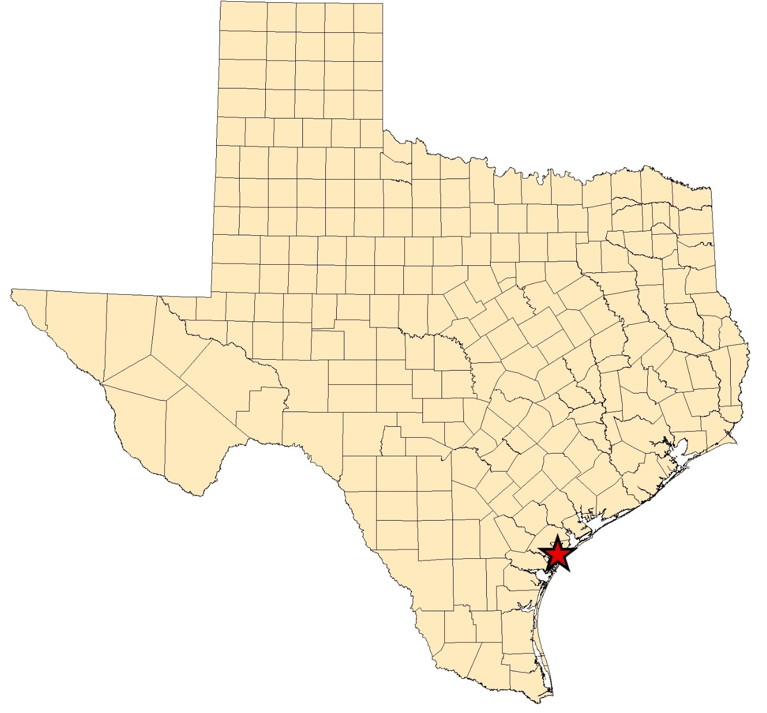
Work Session Agenda Item 12
Exhibit B
Vicinity Map for Rockport State Park Region 2 Headquarters
Rockport, Texas
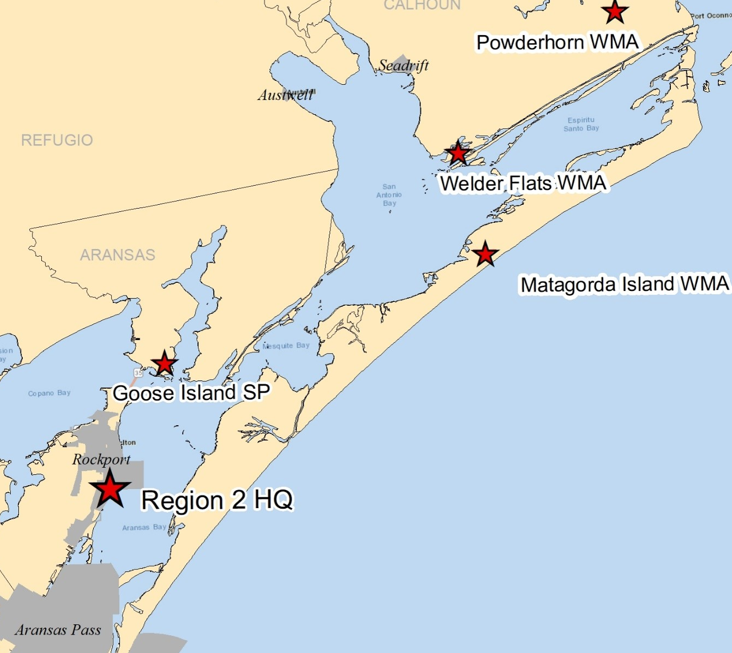
Work Session Agenda Item 12
Exhibit C
Site Map of Proposed Acquisition
Rockport State Park Region 2 Headquarters Outlined in Red
Subject Tract in Yellow
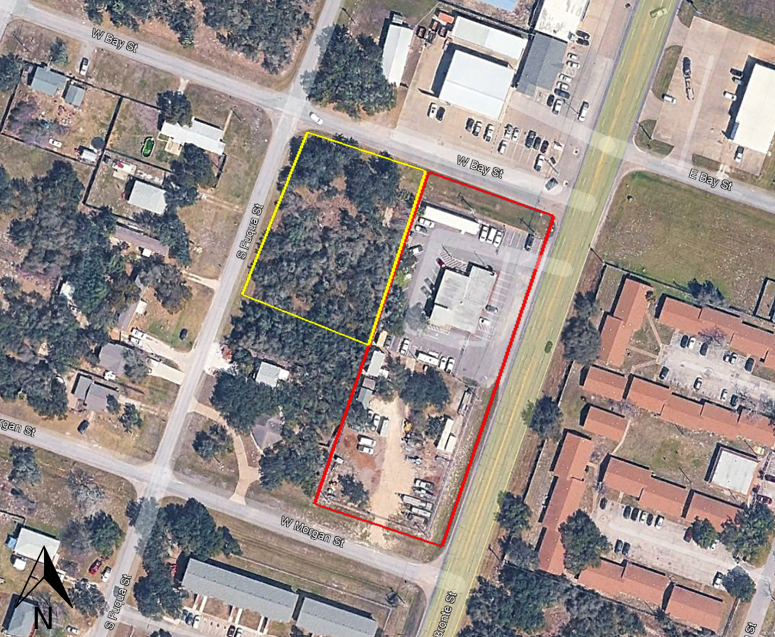
Work Session Agenda Item 13
Presenter: Jacob Aston
Land Acquisition – Blanco County – Approximately 4 Acres at Blanco State Park – Request Permission to Begin the Public Notice and Input Process
I. Executive Summary: Staff requests authorization to pursue acquisition of a 4-acre parcel adjacent to Blanco State Park. This tract is available for acquisition from a willing seller and would add operational utility to the park and remove an inholding from the park.
II. Discussion: The 90-acre Blanco State Park straddles the Blanco River for more than two miles within the City of Blanco. The park was acquired in the 1930s and is very popular with visitors, allowing access to the clear waters of the Blanco River for swimming, tubing, picnicking, and enjoying a picturesque Hill Country stream.
Staff prioritizes acquiring state park inholdings and adjacent properties from willing sellers to minimize operational and management conflicts and ensure the conservation of Texas Parks and Wildlife Department public lands. Staff has identified a 4-acre tract adjacent to Blanco State Park that is available from a willing seller. Currently, access to the tract is through the park on Park Road 23; therefore, the tract is functionally a private inholding. Acquisition of the subject tract would eliminate potential access issues with future owners and add operational utility, such as improved equipment storage options, to the park.
Staff requests permission to begin the public notice and input process.
Attachments – 3
Work Session Agenda Item 13
Exhibit A
Location Map for Blanco State Park
Blanco County
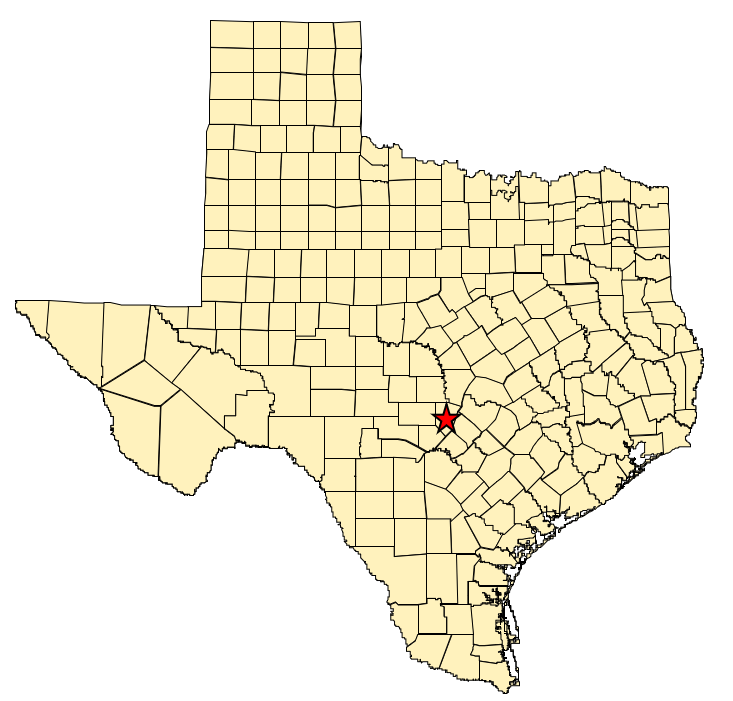
Work Session Agenda Item 13
Exhibit B
Vicinity Map for Blanco State Park
Approximately 50 Miles Southwest of Austin
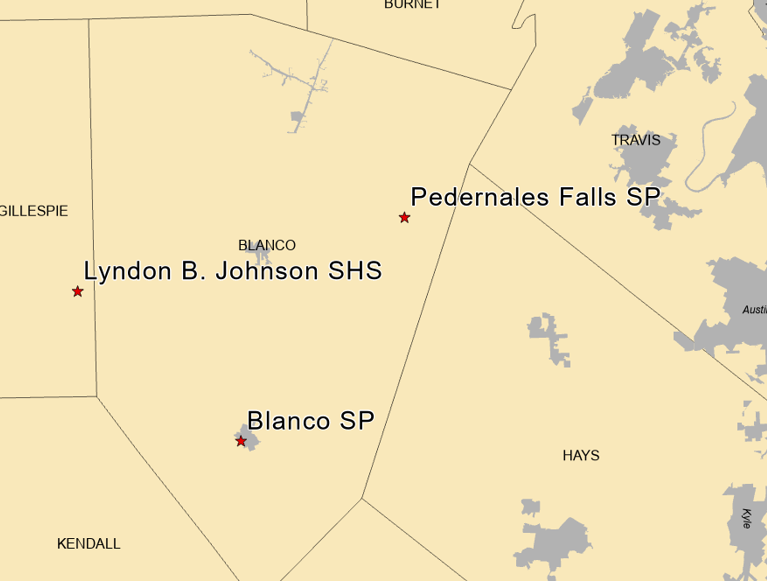
Work Session Agenda Item 13
Exhibit C
Site Map of Proposed Acquisition
Blanco State Park Outlined in Red
Subject Tract Outlined in Yellow
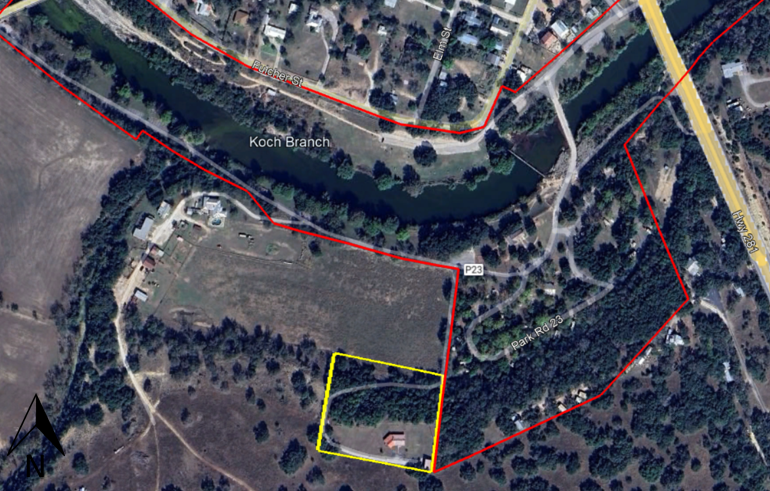
Work Session Agenda Item 15
Presenter: Stan David
Land Acquisition – Comal County – Approximately 30 Acres at Honey Creek State Natural Area – Request Permission to Begin the Public Notice and Input Process
I. Executive Summary: Staff requests authorization to pursue acquisition of a 30-acre parcel adjacent to Honey Creek State Natural Area (SNA). This tract is available for acquisition from a willing seller and would add an additional recreational area to the SNA and further protect Honey Creek.
II. Discussion: The 2,800-acre Honey Creek SNA protects the main headwaters of the pristine Honey Creek. Approximately 2,200 acres were acquired in 1985 and 1988, and most recently, in 2023, approximately 500 acres were added to the SNA. The SNA is also adjacent to the 1,900-acre Guadalupe River State Park.
Staff prioritizes acquiring state park inholdings and adjacent properties from willing sellers to minimize operational and management conflicts and ensure the conservation of Texas Parks and Wildlife Department public lands. Staff has identified a 30-acre tract adjacent to Honey Creek SNA that is available for acquisition from a willing seller. Acquisition of this parcel will help to provide additional area for trail systems and prevent future development near the headwaters of Honey Creek.
Staff requests permission to begin the public notice and input process.
Attachments – 3
Work Session Agenda Item 15
Exhibit A
Location Map for Honey Creek State Natural Area
Comal County
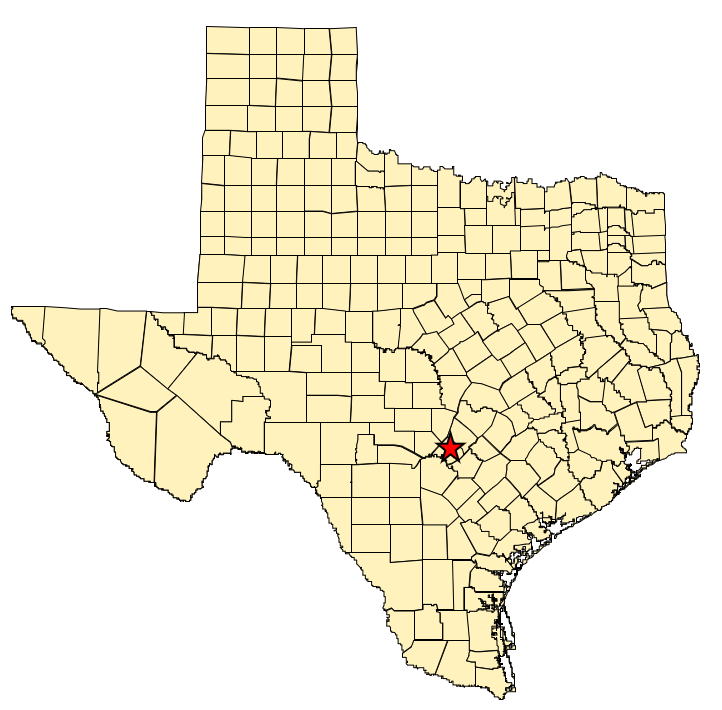
Work Session Agenda Item 15
Exhibit B
Vicinity Map for Honey Creek State Natural Area
Approximately 20 Miles North of San Antonio
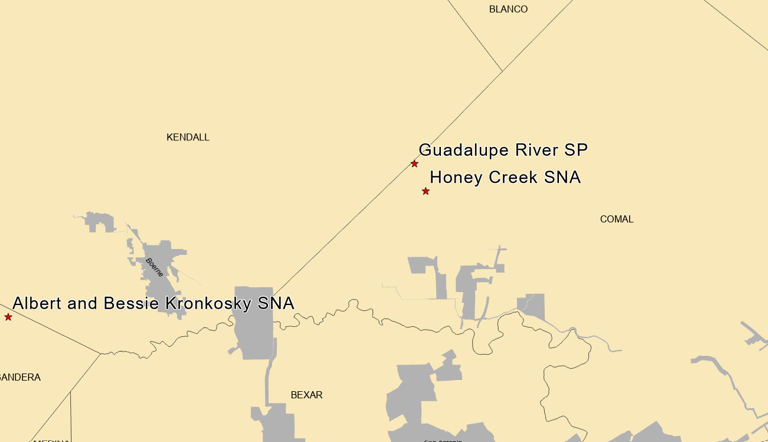
Work Session Agenda Item 15
Exhibit C
Site Map of Proposed Acquisition
Honey Creek State Natural Area Outlined in Red
Subject Tract Outlined in Yellow
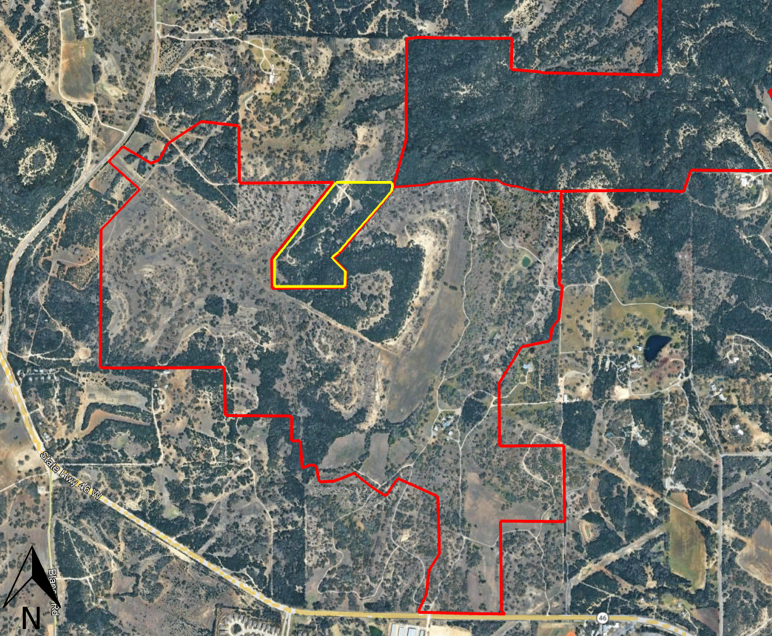
Work Session Agenda Item 17
Presenter: Stan David
Land Acquisition – Austin County – Approximately 230 Acres at Stephen F. Austin State Park – Request Permission to Begin the Public Notice and Input Process
I. Executive Summary: Staff requests authorization to pursue acquisition of a 230-acre parcel adjacent to Stephen F. Austin State Park. This tract is available for acquisition from a willing seller and would add additional recreational opportunity to the park.
II. Discussion: The 472-acre Stephen F. Austin State Park was deeded from the San Felipe de Austin Corporation in 1940. The park sits along the Brazos River and offers camping and five miles of hiking and biking trails along the riverbank, under tall hardwoods and through upland swamp land.
Staff prioritizes acquiring state park inholdings and adjacent properties from willing sellers to minimize operational and management conflicts and ensure the conservation of Texas Parks and Wildlife Department public lands. Staff has identified a 230-acre tract adjacent to Stephen F. Austin State Park that is available from a willing seller. The acquisition expands recreational opportunities for the park, such as hiking and biking trails.
Staff requests permission to begin the public notice and input process.
Attachments – 3
Work Session Agenda Item 17
Exhibit A
Location Map for Stephen F. Austin State Park
Austin County
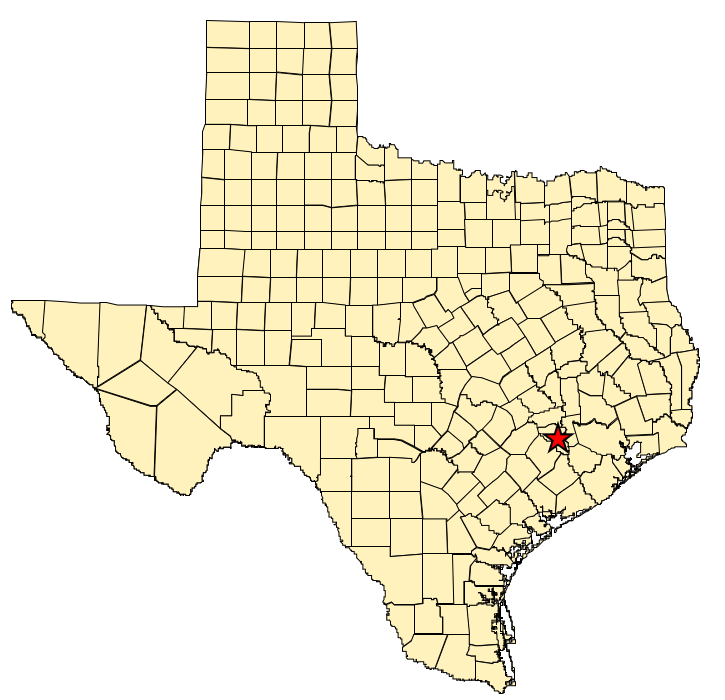
Work Session Agenda Item 17
Exhibit B
Vicinity Map for Stephen F. Austin State Park
Approximately 45 Miles West of Houston
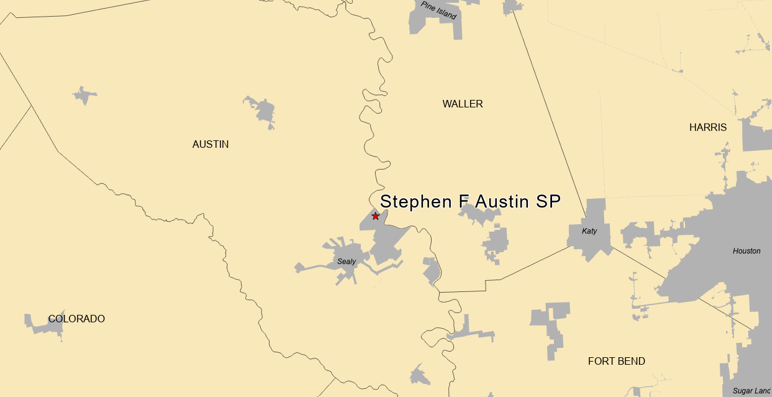
Work Session Agenda Item 17
Exhibit C
Site Map of Proposed Acquisition
Stephen F. Austin State Park Outlined in Red
Subject Tract Outlined in Yellow
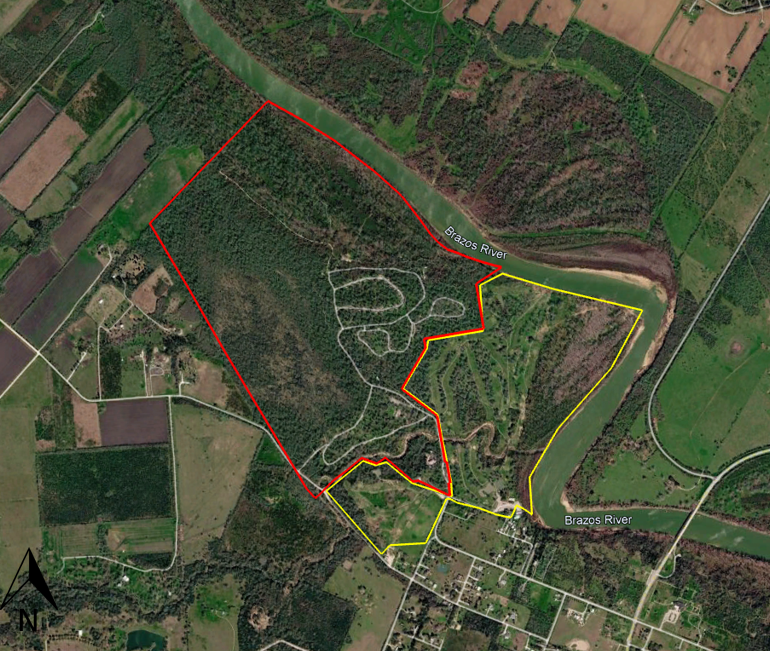
Work Session Agenda Item 18
Presenter: Stan David
Land Acquisition – Matagorda County – Approximately 825 Acres at Matagorda Peninsula Coastal Management Area – Request Permission to Begin the Public Notice and Input Process
I. Executive Summary: Staff requests authorization to pursue acquisition of approximately 825 acres of land in multiple tracts adjacent to the Matagorda Peninsula Coastal Management Area (CMA) that is available from a willing seller. The land would add excellent habitat to the Matagorda Peninsula CMA.
II. Discussion: In 2017, Texas Parks and Wildlife Department (TPWD) established the Matagorda Peninsula CMA with the acquisition of approximately 5,100 acres of land on Matagorda Peninsula from the Texas General Land Office. The Matagorda Peninsula CMA currently consists of more than 6,300 acres, preserving approximately 14 miles of peninsula from the Caney Creek Cut westward and from the Gulf of America to East Matagorda Bay. This CMA includes a remote and undeveloped barrier island system that preserves habitat for a remarkable diversity of coastal wildlife from nesting sea turtles to resident and migratory shore and wading birds, several of which are listed as Species of Greatest Conservation Need. Habitats consist of Gulf beaches, sand dunes, lagoons, strand prairies, bayous, tidal flats, and emergent salt marshes that are critical for the production of crustaceans, shellfish, and finfish. The East Matagorda Bay system has been identified as a conservation focal area by TPWD and its conservation partners. Goals to protect the East Matagorda Bay system include conserving as much of the peninsula and surrounding bay shoreline as opportunities and funding allow.
The subject tracts would add valuable land to expand TPWD’s research and management activities for indigenous and migratory wildlife species. Local staff regards these tracts as a high-priority strategic acquisition for the Matagorda Peninsula CMA. No additional staff or infrastructure would be needed to manage these tracts if acquired. The subject tracts would be acquired by the Matagorda Bay Foundation from a willing seller, and the sales contract for the properties will be assigned to TPWD prior to closing.
Staff requests permission to begin the public notice and input process.
Attachments – 3
Work Session Agenda Item 18
Exhibit A
Location Map for Matagorda Peninsula Coastal Management Area (CMA)
Matagorda County
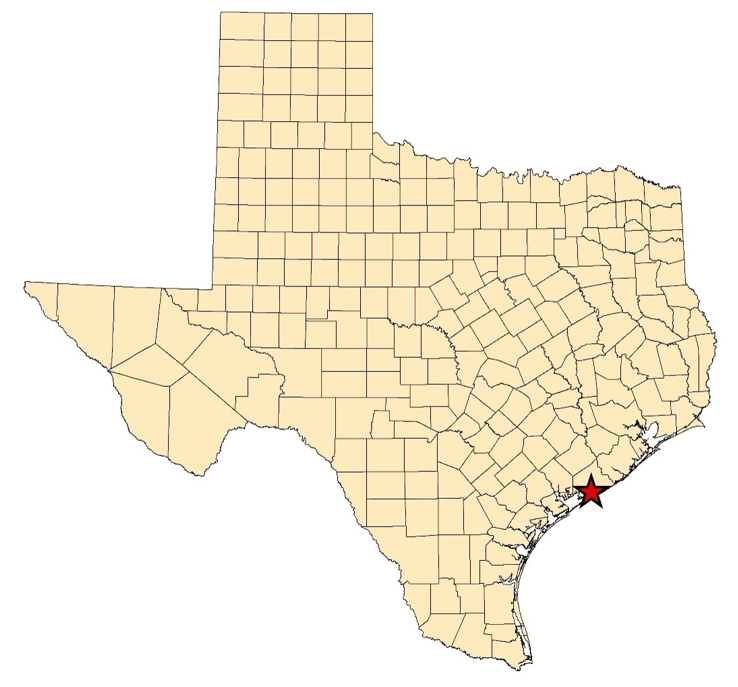
Work Session Agenda Item 18
Exhibit B
Vicinity Map for Matagorda Peninsula CMA
20 Miles South of Bay City
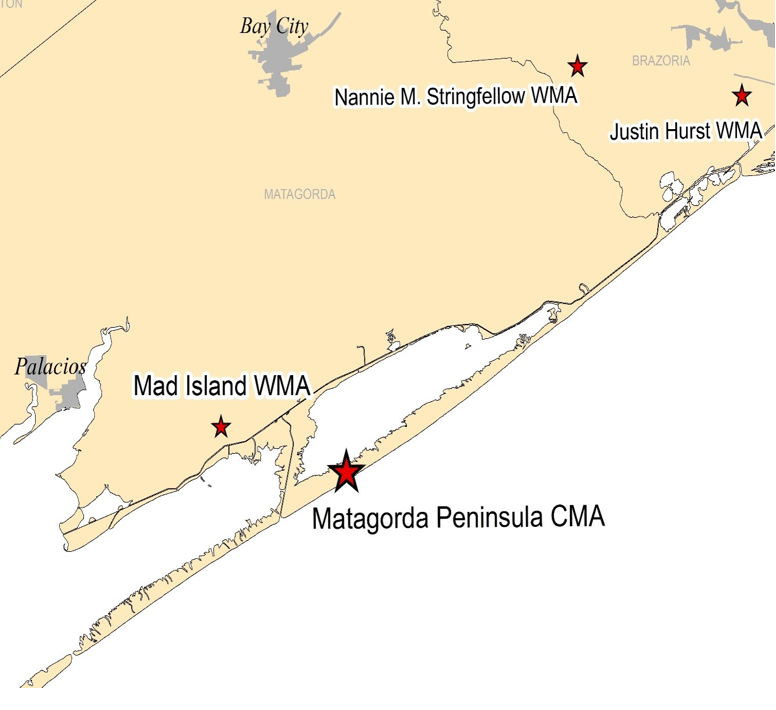
Work Session Agenda Item 18
Exhibit C
Site Map of Proposed Acquisition
Subject Tracts Outlined in Yellow
Matagorda Peninsula CMA Outlined in Green
Mad Island WMA Outlined in Red
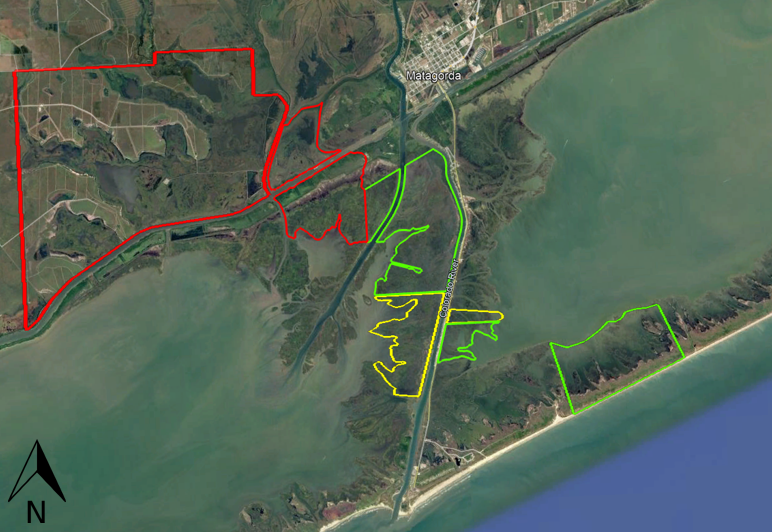
Work Session Agenda Item 20
Presenter: Whitney Gann, Ph.D.
Request for Pipeline Easement – Anderson County – Approximately 0.6 Acres at Trinity River Wildlife Management Area – Request Permission to Begin the Public Notice and Input Process
I. Executive Summary: Staff seeks approval of an easement at the Trinity River Wildlife Management Area (WMA) for the construction and installation of an 8-inch diameter natural gas pipeline.
II. Discussion: The Trinity River WMA consists of approximately 6,900 acres of bottomland hardwoods and approximately 11.3 miles of Trinity River frontage. The WMA is also the newest addition to the Middle Trinity River Ecosystem Project, which includes Gus Engeling, Richland Creek, Big Lake Bottom, and Keechi Creek WMAs. Together, these properties protect more than 38,000 acres in East Texas.
Encrescent Richland Pipeline LLC requests an easement of 40 feet in width, crossing 710 feet into the WMA. The total easement area is approximately 0.6 acres. This easement will replace an existing one and reduce the overall surface impact and footprint of this pipeline.
Staff requests permission to begin the public notice and input process.
Attachments – 4
Work Session Agenda Item 20
Exhibit A
Location Map for the Trinity River Wildlife Management Area (WMA)
Anderson County
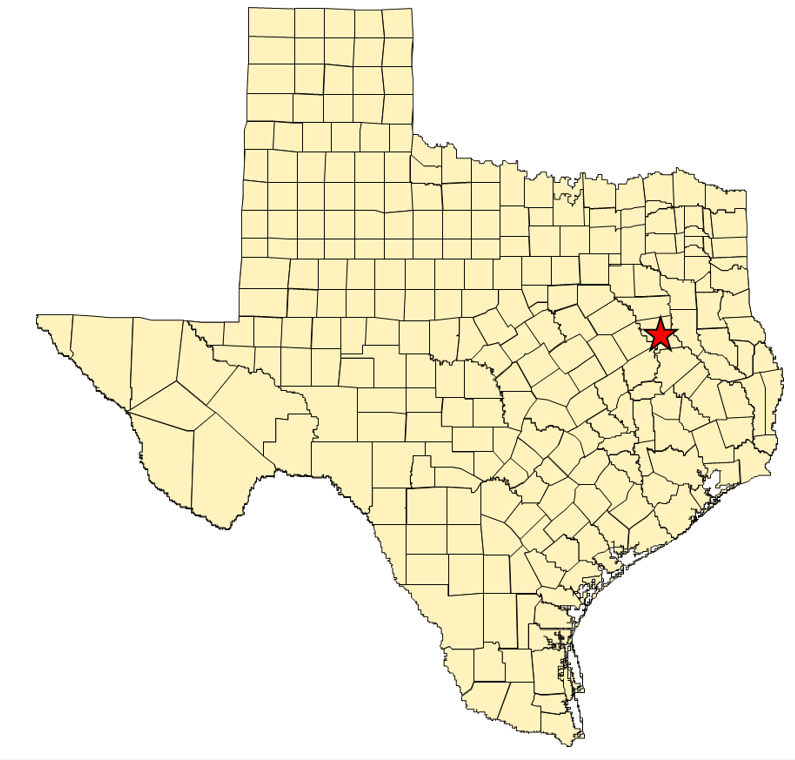
Work Session Agenda Item 20
Exhibit B
Vicinity Map for the Trinity River WMA
Approximately 20 Miles South of Athens
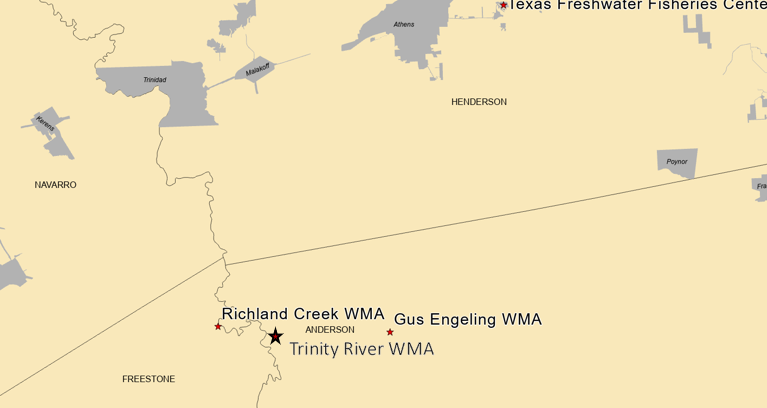
Work Session Agenda Item 20
Exhibit C
Area Map of the Trinity River WMA
Trinity River WMA Outlined in Red
Gus Engeling WMA Outlined in Orange
Richland Creek WMA Outlined in Green
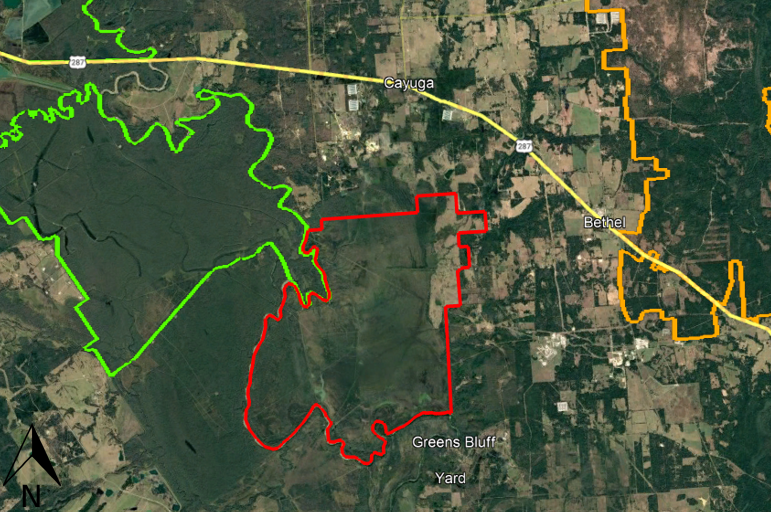
Work Session Agenda Item 20
Exhibit D
Location of Requested Easement
Trinity River WMA Outlined in Red
Richland Creek WMA Outlined in Green
Requested Easement in Yellow
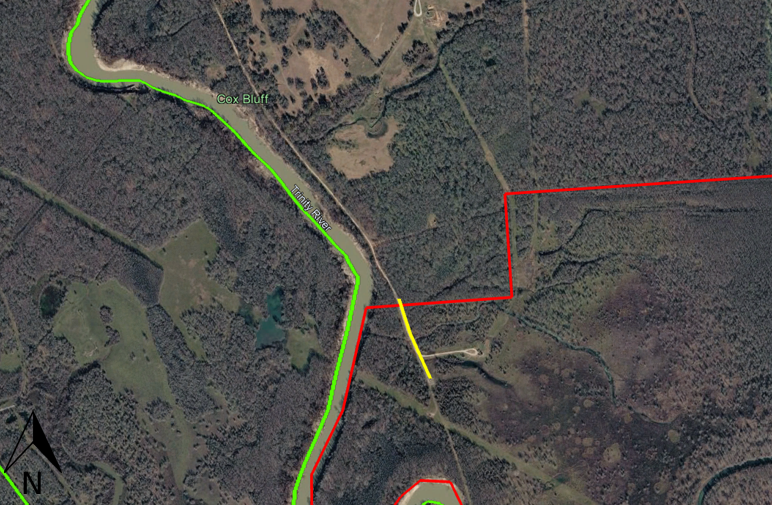
Work Session Agenda Item 21
Presenter: Whitney Gann, Ph.D.
Request for Pipeline Easement – Nacogdoches County – Approximately 8.6 Acres at Alazan Bayou Wildlife Management Area – Request Permission to Begin the Public Notice and Input Process
I. Executive Summary: Staff seeks approval of an easement across the Alazan Bayou Wildlife Management Area (WMA) for a 10-inch diameter ethylene pipeline.
II. Discussion: The Alazan Bayou WMA consists of approximately 2,063 acres, purchased in 1991 to preserve a mature bottomland hardwood forest adjacent to the Angelina River.
Westlake Chemical requests an easement of 35 feet in width, crossing 10,720 feet (2.03 miles) of the WMA. The total easement area is approximately 8.6 acres.
Staff requests permission to begin the public notice and input process.
Attachments – 3
Work Session Agenda Item 21
Exhibit A
Location Map for the Alazan Bayou Wildlife Management Area (WMA)
Nacogdoches County
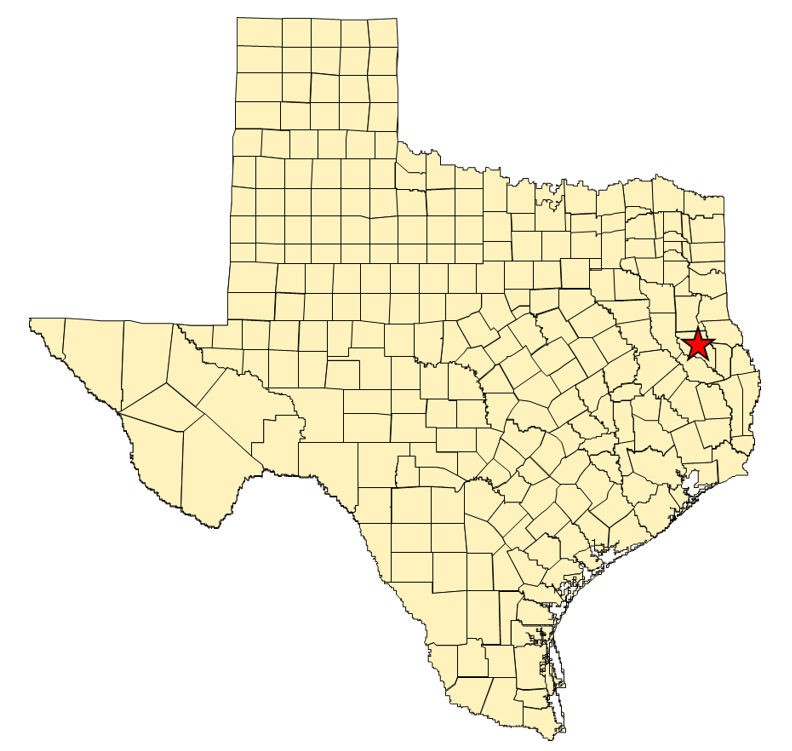
Work Session Agenda Item 21
Exhibit B
Vicinity Map for the Alazan Bayou WMA
Approximately 10 Miles South of Nacogdoches
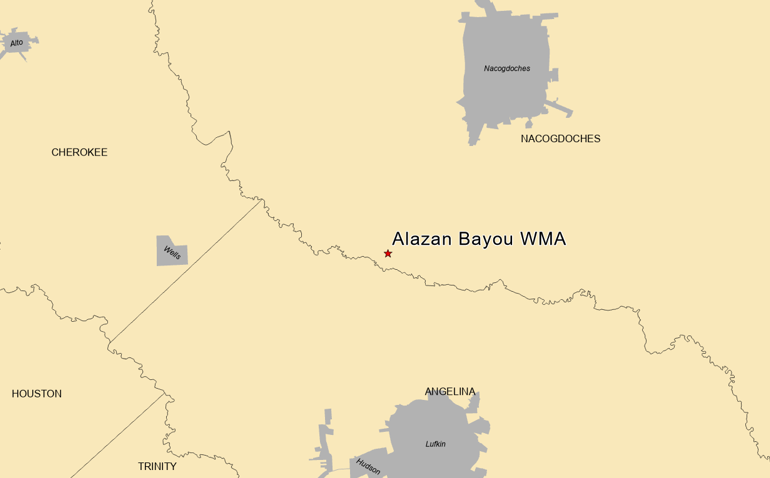
Work Session Agenda Item 21
Exhibit C
Location of Requested Easement
Alazan Bayou WMA Outlined in Red
Requested Easement in Yellow
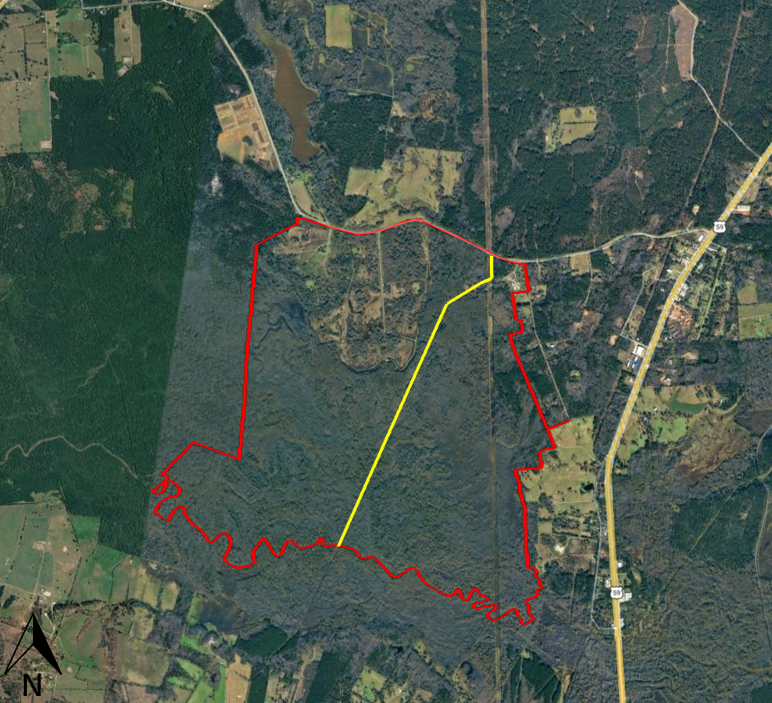
Work Session Agenda Item 22
Presenter: Rodney Franklin
Centennial Parks Conservation Fund Projects
I. Executive Summary: Staff will update the Texas Parks and Wildlife Commission on the acquisition of real property from willing sellers for Texas state parks using the Centennial Parks Conservation Fund and other funding sources.
Work Session Agenda Item 23
Presenter: James Murphy
Litigation Update
I. Executive Summary: Attorneys for the Texas Parks and Wildlife Department will update and advise the Texas Parks and Wildlife Commission regarding pending or anticipated litigation.