
Work Session
Commission Agenda Items
- Donations Over $500
- Contracts
- Nonprofit Partner List Update
- Service Awards
- Item 1
- Item 2
- Item 3
- Item 4
- Item 5
- Item 6
- Item 7
- Item 8
- Item 9
- Item 10
- Item 11
March 25-26, 2026, Transcripts
Work Session
Wednesday, May 27, 2026
9:00 a.m. CDT
Paul L. Foster, Commission Chair
David Yoskowitz, Ph.D., Executive Director
Texas Parks and Wildlife Department
Commission Hearing Room
4200 Smith School Road, Austin, TX 78744
Agenda
Approval of the Previous Minutes from the Commission Work Session held March 25, 2026
- Executive Director Updates – David Yoskowitz, Ph.D.
- Internal Affairs Update
- Palo Pinto Mountains State Park Opening
- Fund 9
- Centennial Update – Rodney Franklin
- Financial Overview – Reggie Pegues
- Strategic Plan – Michael Goldsmith
- Internal Audit Update – Brandy Meeks
- Texas Regulatory Efficiency Office Rules – Request Permission to Publish Proposed Changes in the Texas Register – James Murphy
- Public Hunting Program – Establishment of an Open Season on Public Hunting Lands and Approval of Public Hunting Activities on State Parks – Kevin Mote (Action Item No. 2)
Mountain Lion Harvest Reporting – Recommended Adoption of Proposed Changes – Jonah Evans (Action Item No. 3)WITHDRAWN- Wildlife Rehabilitation Rules – Recommended Adoption of Proposed Changes – Richard Heilbrun (Action Item No. 4)
- Selected Deer Harvest Rules – Request Permission to Publish Proposed Changes in the Texas Register – Alan Cain
- Depredation Permit Rules – Request Permission to Publish Proposed Changes in the Texas Register – Kory Gann
- Request for Drainage Easement – Hays County – Approximately 1.2 Acres at A.E. Wood Fish Hatchery – Request Permission to Begin the Public Notice and Input Process – Jacob Aston
- Land Acquisition – Aransas County – Approximately 0.8 Acres at Rockport State Park Region 2 Headquarters – Jacob Aston (Work Session and Executive Session) (Action Item No. 5)
- Land Acquisition – Blanco County – Approximately 4 Acres at Blanco State Park – Jacob Aston (Work Session and Executive Session) (Action Item No. 6)
- Land Acquisition – Comal County – Approximately 30 Acres at Honey Creek State Natural Area – Stan David (Work Session and Executive Session) (Action Item No. 7)
- Land Acquisition – Austin County – Approximately 230 Acres at Stephen F. Austin State Park – Stan David (Work Session and Executive Session) (Action Item No. 8)
- Land Acquisition – Matagorda County – Approximately 825 Acres at Matagorda Peninsula Coastal Management Area – Stan David (Work Session and Executive Session) (Action Item No. 9)
- Request for Pipeline Easement – Anderson County – Approximately 0.6 Acres at Trinity River Wildlife Management Area – Whitney Gann, Ph.D. (Work Session and Executive Session) (Action Item No. 10)
- Land Acquisition – Henderson County – Approximately 650 Acres – Request Permission to Begin the Public Notice and Input Process – Stan David (Work Session and Executive Session)
- Centennial Parks Conservation Fund Projects – Rodney Franklin (Executive Session Only)
- Litigation Update – James Murphy (Executive Session Only)
Land and Water Plan
Financial
Natural Resources
Land Conservation
Executive Session
Agenda Items
Work Session Agenda Item 1
Presenter: David Yoskowitz, Ph.D.
Executive Director Updates
I. Executive Summary: Executive Director David Yoskowitz, Ph.D. will provide the Texas Parks and Wildlife Commission an update regarding Texas Parks and Wildlife Department operations.
II. Discussion: Dr. Yoskowitz will present information on notable agency matters, such as key organizational priorities, recent developments, and strategic initiatives.
Work Session Agenda Item 2
Presenter: Rodney Franklin
Centennial Update
I. Executive Summary: Staff will provide an update on the funding status, development, and operational progress for Texas Parks and Wildlife Department (TPWD) state parks considered “centennial parks.”
II. Discussion: Staff will describe specific development timelines, funding updates, park programming highlights, and future acquisition strategies for state parks acquired through the Centennial Parks Conservation Fund.
Work Session Agenda Item 3
Presenter: Reggie Pegues
Financial Overview
I. Executive Summary: Staff will present a financial overview of the Texas Parks and Wildlife Department (TPWD).
II. Discussion: Staff will update the Texas Parks and Wildlife Commission on state park, boat registration and titling, and license fee revenues collected by TPWD for year-to-date Fiscal Year (FY) 2026. Staff will also summarize recent budget adjustments for FY 2026.
Work Session Agenda Item 4
Presenter: Michael Goldsmith
Strategic Plan
Executive Summary: Staff will summarize topics covered in the Texas Parks and Wildlife Department (TPWD) Legislative Strategic Plan for Fiscal Years (FY) 2027-2031.
Discussion: Staff will discuss themes covered in the TPWD Legislative Strategic Plan for FY 2027-2031, internally titled the TPWD Natural Agenda, as prescribed by the Legislative Budget Board and the Governor’s Office.
Work Session Agenda Item 5
Presenter: Brandy Meeks
Internal Audit Update
I. Executive Summary: Staff will update the Texas Parks and Wildlife Commission (Commission) on Internal Audit activities and projects that have taken place since the last Commission Meeting.
II. Discussion: Staff will present an update on the Texas Parks and Wildlife Department Fiscal Year (FY) 2025 and FY 2026 Internal Audit Plans, as well as an update on external audits and assessments.
Work Session Agenda Item 6
Presenter: James Murphy
Texas Regulatory Efficiency Office Rules – Request Permission to Publish Proposed Changes in the Texas Register
Executive Summary: Staff seeks permission to publish proposed amendments to rules in the Texas Register for public comment resulting from the Texas Regulatory Efficiency Office (TREO) review of Texas Parks and Wildlife Department (TPWD) rules.
Discussion: Established during the 89th Texas Legislature (Regular Session, 2025) and housed within the Office of the Governor, TREO assists state agencies in identifying outdated and redundant regulations and creating best practices to make agencies’ rulemaking processes more efficient. TREO reviews state agency rules and procedures to reduce regulatory burdens; eliminate unnecessary or ineffective rules; and increase transparency for Texas taxpayers.
TREO and TPWD collaborated to assess the department’s rules and develop a list of proposed changes that meet the above-referenced criteria, and the proposed changes have received stakeholder support. Due to the volume of the proposed changes, TPWD will bring them to the Texas Parks and Wildlife Commission in stages. For the first stage, TPWD is proposing changes to Chapters 51 (Executive), 52 (Stocking Policy), 53 (Finance), 55 (Law Enforcement), 59 (Parks), 60 (Maintenance Reviews), and 61 (Design and Construction) in Title 31 of the Texas Administrative Code. The changes will allow the department to better serve the public by streamlining and modernizing its regulations while continuing to ensure the protection of natural and cultural resources and the viability of outdoor recreation opportunities.
Attachments – 18
- Exhibit A – Texas Regulatory Efficiency Office Recommendations – Chapter 51, Subchapter E
- Exhibit B – Texas Regulatory Efficiency Office Recommendations – Chapter 51, Subchapter H
- Exhibit C – Texas Regulatory Efficiency Office Recommendations – Chapter 51, Subchapter J
- Exhibit D – Texas Regulatory Efficiency Office Recommendations – Chapter 51, Subchapter L
- Exhibit E – Texas Regulatory Efficiency Office Recommendations – Chapter 51, Subchapter M
- Exhibit F – Texas Regulatory Efficiency Office Recommendations – Chapter 52
- Exhibit G – Texas Regulatory Efficiency Office Recommendations – Chapter 53
- Exhibit H – Texas Regulatory Efficiency Office Recommendations – Chapter 55, Subchapter C
- Exhibit I – Texas Regulatory Efficiency Office Recommendations – Chapter 55, Subchapter E
- Exhibit J – Texas Regulatory Efficiency Office Recommendations – Chapter 55, Subchapter F
- Exhibit K – Texas Regulatory Efficiency Office Recommendations – Chapter 55, Subchapter I
- Exhibit L – Texas Regulatory Efficiency Office Recommendations – Chapter 55, Subchapter J
- Exhibit M – Texas Regulatory Efficiency Office Recommendations – Chapter 59, Subchapter A
- Exhibit N – Texas Regulatory Efficiency Office Recommendations – Chapter 59, Subchapter B
- Exhibit O – Texas Regulatory Efficiency Office Recommendations – Chapter 59, Subchapter C
- Exhibit P – Texas Regulatory Efficiency Office Recommendations – Chapter 59, Subchapter F
- Exhibit Q – Texas Regulatory Efficiency Office Recommendations – Chapter 60
- Exhibit R – Texas Regulatory Efficiency Office Recommendations – Chapter 61
Work Session Agenda Item 6
Exhibit A
TEXAS REGULATORY EFFICIENCY OFFICE RECOMMENDATIONS
CHAPTER 51. ADMINISTRATION
SUBCHAPTER E. LEAVE POOLS
PROPOSAL PREAMBLE
1. Introduction.
The Texas Parks and Wildlife Department proposes the repeal of 31 TAC §§51.141-51.143 and new §51.141, concerning Leave Pools. The proposed new rule would consolidate all provisions governing leave pools administered by the agency in a single, generic regulation applicable to all leave pools.
The proposed repeals and new rule either implement or are consistent with the recommendations of the Texas Regulatory Efficiency Office within the Office of the Governor.
2. Fiscal Note.
Robert Macdonald, Regulations Coordinator, has determined that for each of the first five years that the repeal and new rule as proposed are in effect, there will be no fiscal implications to state or local governments as a result of administering or enforcing the rules.
3. Public Benefit/Cost Note.
Mr. Macdonald also has determined that for each of the first five years the rules as proposed are in effect:
(A) The public benefit anticipated as a result of enforcing or administering the proposed rules will be execution of the recommendations of the Texas Regulatory Efficiency Office within the Office of the Governor.
(B) There will be no adverse economic effect on persons required to comply with the rules as proposed.
(C) Under the provisions of Government Code, Chapter 2006, a state agency must prepare an economic impact statement and a regulatory flexibility analysis for a rule that may have an adverse economic effect on small businesses, micro-businesses, or rural communities. As required by Government Code, §2006.002(g), the Office of the Attorney General has prepared guidelines to assist state agencies in determining a proposed rule’s potential adverse economic impact on small businesses, microbusinesses, and rural communities. Those guidelines state that an agency need only consider a proposed rule’s direct adverse economic impacts to determine if any further analysis is required. For that purpose, the department considers “direct economic impact“ to mean a requirement that would directly impose recordkeeping or reporting requirements; impose taxes or fees; result in lost sales or profits; adversely affect market competition; or require the purchase or modification of equipment or services. The department has determined that the proposed rules do not affect small businesses, micro-businesses, or rural communities; therefore, neither the economic impact statement nor the regulatory flexibility analysis described in Government Code, Chapter 2006, is required.
(D) The department has not drafted a local employment impact statement under the Administrative Procedures Act, §2001.022, as the agency has determined that the rules as proposed will not impact local economies.
(E) The department has determined that Government Code, §2001.0225 (Regulatory Analysis of Major Environmental Rules), does not apply to the proposed rules.
(F) The department has determined that there will not be a taking of private real property, as defined by Government Code, Chapter 2007, as a result of the proposed rules.
(G) In compliance with the requirements of Government Code, §2001.0221, the department has prepared the following Government Growth Impact Statement (GGIS). The rules as proposed, if adopted, will:
(1) neither create nor eliminate a government program;
(2) not result in an increase or decrease in the number of full-time equivalent employee needs;
(3) not result in a need for additional General Revenue funding;
(4) not affect the amount of any fee;
(5) not create a new regulation;
(6) not limit, expand, or repeal an existing regulation;
(7) neither increase nor decrease the number of individuals subject to regulation; and
(8) not positively or adversely affect the state’s economy.
4. Request for Public Comment.
Comments on the proposed rules may be submitted to Robert Macdonald (512) 389-4775, email: robert.macdonald@tpwd.texas.gov. Comments also may be submitted via the department’s website at http://www.tpwd.texas.gov/business/feedback/public_comment/.
5. Statutory Authority.
The new rule is proposed under the authority of Government Code, §661.002, which requires the governing body of each state agency to adopt rules to prescribe procedures relating to the operation of the agency’s sick leave pool; Government Code, §661.022, which requires the governing body of each state agency to adopt rules to prescribe procedures relating to the operation of the agency’s family leave pool; and Parks and Wildlife Code, §11.0183, which requires the commission to adopt rules to create and administer a peace officer legislative leave pool.
The proposed new rule affects Government Code, Chapter 661, and Parks and Wildlife Code, Chapter 11.
6. Rule Text.
§51.141. Leave Pools.
(a) The following leave pools are established for the benefit of eligible department employees.
(1) Sick Leave Pool. Provides for alleviation of hardship caused to an employee and their family if catastrophic illness or injury forces the employee to exhaust all leave time earned by the employee and lose compensation from the state.
(2) Family Leave Pool. Provides flexibility in bonding and caring for children during a child’s first year following birth, adoption, or foster placement, and caring for a seriously ill family member or the employee.
(3) Peace Officer Legislative Leave Pool. Provides peace officers commissioned by the department with the opportunity to use annual leave or compensatory time donated to the pool for use as legislative leave on behalf of a law enforcement association.
(b) The director of human resources is designated as the pool administrator for each pool established under this section.
(c) The pool administrator, with the advice and consent of the executive director, shall establish operating procedures consistent with the requirements of this section and applicable law governing operation of each pool.
(d) Donations to each pool are strictly voluntary.
This agency hereby certifies that the proposal has been reviewed by legal counsel and found to be within the agency’s authority to adopt.
Issued in Austin, Texas, on
Work Session Agenda Item 6
Exhibit B
TEXAS REGULATORY EFFICIENCY OFFICE RECOMMENDATIONS
CHAPTER 51. ADMINISTRATION
SUBCHAPTER H. GENERAL PLAN FOR PRESCRIBED BURNING ON TPWD LANDS
PROPOSAL PREAMBLE
1. Introduction.
The Texas Parks and Wildlife Department proposes an amendment to 31 TAC §51.170, concerning General Plan for Prescribed Burning on TPWD Lands. The proposed amendment would eliminate superfluous provisions that are not required by statute and need not be prescribed by rule.
The proposed amendment either implements or is consistent with the recommendations of the Texas Regulatory Efficiency Office within the Office of the Governor.
2. Fiscal Note.
Robert Macdonald, Regulations Coordinator, has determined that for each of the first five years that the rule as proposed is in effect, there will be no fiscal implications to state or local governments as a result of administering or enforcing the rule.
3. Public Benefit/Cost Note.
Mr. Macdonald also has determined that for each of the first five years the rule as proposed is in effect:
(A) The public benefit anticipated as a result of enforcing or administering the proposed rule will be execution of the recommendations of the Texas Regulatory Efficiency Office within the Office of the Governor.
(B) There will be no adverse economic effect on persons required to comply with the rule as proposed.
(C) Under the provisions of Government Code, Chapter 2006, a state agency must prepare an economic impact statement and a regulatory flexibility analysis for a rule that may have an adverse economic effect on small businesses, micro-businesses, or rural communities. As required by Government Code, §2006.002(g), the Office of the Attorney General has prepared guidelines to assist state agencies in determining a proposed rule’s potential adverse economic impact on small and microbusinesses and rural communities. Those guidelines state that an agency need only consider a proposed rule’s direct adverse economic impacts to determine if any further analysis is required. For that purpose, the department considers “direct economic impact“ to mean a requirement that would directly impose recordkeeping or reporting requirements; impose taxes or fees; result in lost sales or profits; adversely affect market competition; or require the purchase or modification of equipment or services. The department has determined that the proposed rules do not affect small businesses, micro-businesses, or rural communities; therefore, neither the economic impact statement nor the regulatory flexibility analysis described in Government Code, Chapter 2006, is required.
(D) The department has not drafted a local employment impact statement under the Administrative Procedures Act, §2001.022, as the agency has determined that the rule as proposed will not impact local economies.
(E) The department has determined that Government Code, §2001.0225 (Regulatory Analysis of Major Environmental Rules), does not apply to the proposed rule.
(F) The department has determined that there will not be a taking of private real property, as defined by Government Code, Chapter 2007, as a result of the proposed rule.
(G) In compliance with the requirements of Government Code, §2001.0221, the department has prepared the following Government Growth Impact Statement (GGIS). The rule as proposed, if adopted, will:
(1) neither create nor eliminate a government program;
(2) not result in an increase or decrease in the number of full-time equivalent employee needs;
(3) not result in a need for additional General Revenue funding;
(4) not affect the amount of any fee;
(5) not create a new regulation;
(6) not limit, expand, or repeal an existing regulation;
(7) neither increase nor decrease the number of individuals subject to regulation; and
(8) not positively or adversely affect the state’s economy.
4. Request for Public Comment.
Comments on the proposed rule may be submitted to Robert Macdonald (512) 389-4775, email: robert.macdonald@tpwd.texas.gov. Comments also may be submitted via the department’s website at http://www.tpwd.texas.gov/business/feedback/public_comment/.
5. Statutory Authority.
The amendment is proposed under Parks and Wildlife Code, §11.353, which requires the commission to adopt, and requires the department to implement, a general plan for the use of beneficial prescribed burns on department lands.
The proposed amendment affects Parks and Wildlife Code, Chapter 11.
6. Rule Text.
§51.170. General Plan for Prescribed Burning on TPWD Lands.
(a) It is the intent of the department to [that the department’s General Plan for Prescribed Burning on TPWD Lands] comply with the requirements of [the prescribed burn plan required by] Parks and Wildlife Code, Chapter 11, Subchapter M[§11.351].
(b) The department’s General Plan for Prescribed Burning on TPWD Lands is adopted by reference.
[(c) The department will maintain the current version of the General Plan for Prescribed Burning on TPWD Lands on the department’s website at www.tpwd.texas.gov along with the contact information of appropriate department staff for the benefit of interested parties.]
[(d) The department will publish notice in the Texas Register and seek input from interested parties when major modifications to the General Plan for Prescribed Burning on TPWD Lands (such as changes in procedures or notification processes) are contemplated. Public notice of an opportunity to comment will be provided at least 30 days prior to the effective date of any changes to the policy. The public notice will describe the proposed modifications and the reasons for the modifications, and how comments on the proposed modifications may be submitted to the department.]
This agency hereby certifies that the proposal has been reviewed by legal counsel and found to be within the agency’s authority to adopt.
Issued in Austin, Texas, on
Work Session Agenda Item 6
Exhibit C
TEXAS REGULATORY EFFICIENCY OFFICE RECOMMENDATIONS
CHAPTER 51. ADMINISTRATION
SUBCHAPTER J. CONTRACT DISPUTE RESOLUTION
PROPOSAL PREAMBLE
1. Introduction.
The Texas Parks and Wildlife Department proposes the repeal of 31 TAC §§51.203, 51.208, 51.211, 51.216, 51.218, 51.221, 51.222, and 51.225, and amendments to §§51.201, 51.202, 51.205, 51.207, 51.209, 51.210, 51.213-51.215, 51.220, and 51.224, concerning Contract Dispute Resolution. In general, the proposed repeals and amendments eliminate recapitulation of statutory provisions that stand alone and therefore need not be in rule, consolidate current provisions of the rules in fewer sections of the Texas Administrative Code, and make opportunistic nonsubstantive changes as needed to maintain grammatical sense structural parallelism.
The proposed amendment to §51.201, concerning Definitions, would make minor grammatical changes.
The proposed amendment to §51.202, concerning Prerequisites to Suit, would add the provisions of current §51.203, concerning Sovereign Immunity, which is proposed for repeal, as new subsection (b), and retitle the section accordingly.
The proposed amendment to §51.205, concerning Agency Counterclaim, would capitalize the first letter of subsection (a) to correct a grammatical error in the current rule.
The proposed amendment to §51.207, concerning Duty to Negotiate, would incorporate the provisions of current §51.208, which is proposed for repeal, as new subsections (b) – (j), make conforming changes to internal citations, and retitle the section accordingly.
The proposed amendment to §51.209, concerning Conduct of Negotiation, would alter internal citations to reflect the proposed amendment to §51.224.
The proposed amendment to §51.210, concerning Negotiation Settlements, would incorporate the provisions of current §51.211, concerning Settlement Agreement, which is proposed for repeal, as new subsections (b) – (d), and retitle the section accordingly.
The proposed amendment to §51.213, concerning Request for Contested Case Hearing, would alter internal citations to reflect the proposed amendment to §51.207.
The proposed amendment to §51.214, concerning Mediation Timetable, would incorporate the provisions of current §51.216, concerning Agreement to Mediate, which is proposed for repeal, as new subsections (c) and (d) and retitle the section accordingly.
The proposed amendment to §51.215, concerning Conduct of Mediation, would incorporate the provisions of current §51.218(a) as new subsection (d) for topical consistency.
The proposed amendment to §51.220, concerning Settlement Approval Procedures, would incorporate the provisions of current §51.221, concerning Initial Settlement Agreement, which is proposed for repeal, as new subsection (b); the provisions of §51.222, concerning Final Settlement Agreement, which is proposed for repeal, as new subsection (c); and the provisions of current §51.218(b), concerning Confidentiality of Mediation and Final Settlement Agreement (which is proposed for repeal), as new subsection (d), and retitle the section accordingly. The proposed amendment inserts the words “initial” and “final” where needed to reflect the fact that those phases of the process would be in one section rather than separate sections and therefore should be identified where applicable.
The proposed amendment to §51.224, concerning Assisted Negotiation Processes, would incorporate the provisions of current §51.225, concerning Alternative Dispute Resolution (which is proposed for repeal) as new subsection (b) and retitle the section accordingly.
The proposed repeals and amendments either implement or are consistent with the recommendations of the Texas Regulatory Efficiency Office within the Office of the Governor.
2. Fiscal Note.
Robert Macdonald, Regulations Coordinator, has determined that for each of the first five years that the rules as proposed are in effect, there will be no fiscal implications to state or local governments as a result of administering or enforcing the rules as proposed, as the proposed amendments are nonsubstantive.
3. Public Benefit/Cost Note.
Mr. Macdonald also has determined that that for each of the first five years that the rules as proposed are in effect:
(A) The public benefit anticipated as a result of enforcing or administering the proposed rules will be execution of the recommendations of the Texas Regulatory Efficiency Office with the Office of the Governor.
(B) There will be no adverse economic impacts to persons required to comply with the rules as proposed.
(C) Under provisions of Government Code, Chapter 2006, a state agency must prepare an economic impact statement and a regulatory flexibility analysis for a rule that may have an adverse economic effect on small businesses, micro-businesses, and rural communities. As required by Government Code, §2006.002(g), the Office of the Attorney General issued guidelines to assist state agencies in determining a proposed rule’s potential adverse economic impact on small businesses. Those guidelines state that an agency need only consider a proposed rule’s "direct adverse economic impacts" to small businesses and micro-businesses to determine if any further analysis is required. For that purpose, the department considers "direct economic impact" to mean a requirement that would directly impose recordkeeping or reporting requirements; impose taxes or fees; result in lost sales or profits; adversely affect market competition; or require the purchase or modification of equipment or services. The department has determined that the proposed rules do not affect small businesses and micro-businesses; t herefore, neither the economic impact statement nor the regulatory flexibility analysis described in Government Code, Chapter 2006, is required.
(D) The department has not drafted a local employment impact statement under the Administrative Procedures Act, §2001.022, as the agency has determined that the rules as proposed will not impact local economies.
(E) The department has determined that Government Code, §2001.0225 (Regulatory Analysis of Major Environmental Rules), does not apply to the proposed rules.
(F) The department has determined that there will not be a taking of private real property, as defined by Government Code, Chapter 2007, as a result of the proposed rules
(G) In compliance with the requirements of Government Code, §2001.0221, the department has prepared the following Government Growth Impact Statement (GGIS). The rule as proposed, if adopted, will:
(1) not create a government program;
(2) not result in an increase or decrease in the number of full-time equivalenemployee needs;
(3) not result in a need for additional General Revenue funding;
(4) not affect the amount of any fee;
(5) not create a new regulation, expand an existing regulation, or repeal the function of any current regulation;
(7) neither increase nor decrease the number of individuals subject to regulation; and
(8) not positively or adversely affect the state’s economy.
4. Request for Public Comment.
Comments on the proposed rules may be submitted to Robert Macdonald, Texas Parks and Wildlife Department, 4200 Smith School Road, Austin, Texas 78744; (512) 389-4775; email: robert.macdonald@tpwd.texas.gov or via the department website at www.tpwd.texas.gov.
5. Statutory Authority.
The amendments are proposed under the authority of Government Code, §2260.052(c), which requires each unit of state government with rulemaking authority to develop rules to govern the negotiation and mediation of contract claims against the state, and Parks and Wildlife Code, §11.0171, which requires the commission to adopt by rule policies and procedures for soliciting and awarding contracts.
The proposed amendments affect Government Code, Chapter 2260 and Parks and Wildlife Code, Chapter 11.
6. Rule Text.
§51.201. Definitions. The following words and terms, when used in this subchapter, shall have the following meaning, unless the context clearly indicates otherwise:
(1) – (3) (No change.)
(4) Contractor — Independent contractor who has entered into a contract directly with the department. The term does not include:
(A) the[The] contractor’s subcontractor, officer, employee, agent or other person furnishing goods or services to a contractor;
(B) an[An] employee of the department; or
(C) a[A] student at an institution of higher education.
(5) – (12) (No change.)
§51.202. Prerequisites to Suit; Sovereign Immunity
(a) The procedures contained in this chapter are exclusive and required prerequisites to suit under Civil Practice and Remedies Code, Chapter 107, and Government Code, Chapter 2260.
(b) This chapter does not waive the department’s sovereign immunity to suit or liability.
§51.205. Agency Counterclaim.
(a) The[the] department in asserting a counterclaim under the Government Code, Chapter 2260, shall file notice of the counterclaim as provided by this section.
(b) – (e) (No change.)
§51.207. Duty to Negotiate; Timetable.
(a) The parties shall negotiate in accordance with this section [the timetable set forth in §51.208 of this title (relating to Timetable)] to attempt to resolve all claims and counterclaims. No party is obligated to settle with the other party as a result of the negotiation.
(b) Following receipt of a contractor’s notice of claim, the executive director of the department or other representative designated in the contract shall review the contractor’s claim(s) and the department’s counterclaim(s), if any, and initiate negotiations with the contractor to attempt to resolve the claim(s) and counterclaim(s).
(c) Subject to subsection (d) of this section, the parties shall begin negotiations within a reasonable period of time, not to exceed 60 days following the later of:
(1) the date of termination of the contract;
(2) the completion date, or substantial completion date in the case of construction projects, in the original contract; or
(3) the date the department receives the contractor’s notice of claim.
(d) The department may delay negotiations until after the 180th day after the date of the event giving rise to the claim of breach of contract by:
(1) delivering written notice to the contractor that the commencement of negotiations will be delayed; and
(2) delivering written notice to the contractor when the department is ready to begin negotiations.
(e) The parties may conduct negotiations according to an agreed schedule as long as they begin negotiations no later than the deadlines set forth in subsections (c) or (d) of this section, whichever is applicable.
(f) Subject to subsection (g) of this section, the parties shall complete the negotiations that are required by this chapter as a prerequisite to a contractor’s request for contested case hearing no later than 270 days after the department receives the contractor’s notice of claim.
(g) The parties may agree in writing to extend the time for negotiations on or before the 270th day after the department receives the contractor’s notice of claim. The agreement shall be signed by representatives of the parties with authority to bind each respective party and shall provide for the extension of the statutory negotiation period until a date certain. The parties may enter into a series of written extension agreements that comply with the requirements of this section.
(h) The contractor may request a contested case hearing before the State Office of Administrative Hearings ("SOAH") pursuant to §51.210 of this title (relating to Request for Contested Case Hearing) after the 270th day after the department receives the contractor’s notice of claim, or the expiration of any extension agreed to under subsection (g) of this section.
(i) The parties may agree to mediate the dispute at any time before the 270th day after the department receives the contractor’s notice of claim or before the expiration of any extension agreed to by the parties pursuant to subsection (g) of this section. The mediation shall be governed by the provisions of this subchapter.
(j) Nothing in this section is intended to prevent the parties from agreeing to commence negotiations earlier than the deadlines established in subsections (c) and (d) of this section, or from continuing or resuming negotiations after the contractor requests a contested case hearing before SOAH.
§51.209. Conduct of Negotiation.
(a) (No change.)
(b) The parties may conduct negotiations with the assistance of one or more neutral third parties. If the parties choose to mediate their dispute, the mediation shall be conducted in accordance with this subchapter. Parties may choose an assisted negotiation process other than mediation, including without limitation, processes such as those described in §51.224 of this title (relating to Assisted Negotiation Processes; Alternative Dispute Resolution[§51.224 of this title (relating to Assisted Negotiation Processes) and §51.225 of this title (relating to Alternative Dispute Resolution)].
(c) – (d) (No change.)
§51.210. Negotiation Settlements [Settlement Approval Procedures].
(a) The parties’ settlement approval procedures shall be disclosed prior to, or at the beginning of, negotiations. To the extent possible, the parties shall select negotiators who are knowledgeable about the subject matter of the dispute, who are in a position to reach agreement, and who can credibly recommend approval of an agreement.
(b) A settlement agreement may resolve an entire claim or any designated and severable portion of a claim.
(c) To be enforceable, a settlement agreement must be in writing and signed by representatives of the contractor and the department who have authority to bind each respective party.
(d) A partial settlement does not waive a party’s rights under the Government Code, Chapter 2260, as to the parts of the claims or counterclaims that are not resolved.
§51.213. Request for Contested Case Hearing.
(a) If a claim for breach of contract is not resolved in its entirety through negotiation, mediation or other assisted negotiation process in accordance with this chapter on or before the 270th day after the department receives the notice of claim, or after the expiration of any extension agreed to by the parties pursuant to §51.207(g) of this title (relating to Duty to Negotiate; Timetable)[§51.207(g) of this title (relating to Timetable)], the contractor may file a request with the department for a contested case hearing before SOAH.
(b) A request for a contested case hearing shall state the legal and factual basis for the claim, and shall be delivered to the executive director of the department or other officer designated in the contract to receive notice within a reasonable time after the 270th day or the expiration of any written extension agreed to pursuant to §51.207(g)[§51.208(g) of this subchapter].
(c) — (d) (No change.)
§51.214. Agreement to Mediate; [Mediation] Timetable.
(a) – (b) (No change.)
(c) Parties may agree to use mediation as an option to resolve a breach of contract claim at the time they enter into the contract and include a contractual provision to do so. The parties may mediate a breach of contract claim even absent a contractual provision to do so if both parties agree.
(d) Any agreement to mediate should include consideration of the following factors:
(1) The source of the mediator. Potential sources of mediators include governmental officers or employees who are qualified as mediators under Civil Practice and Remedies Code, §154.052, private mediators, SOAH, the Center for Public Policy Dispute Resolution at The University of Texas School of Law, an alternative dispute resolution system created under Civil Practice and Remedies Code, Chapter 152, or another state or federal agency or through a pooling agreement with several state agencies. Before naming a mediator source in a contract, the parties should contact the mediator source to be sure that it is willing to serve in that capacity. In selecting a mediator, the parties should use the qualifications set forth in §51.217 of this title (relating to Qualifications and Immunity of Mediator).
(2) The time period for the mediation. The parties should allow enough time in which to make arrangements with the mediator and attending parties to schedule the mediation, to attend and participate in the mediation, and to complete any settlement approval procedures necessary to achieve final settlement. While this time frame can vary according to the needs and schedules of the mediator and parties, it is important that the parties allow adequate time for the process.
(3) The location of the mediation.
(4) Allocation of costs of the mediator.
(5) The identification of representatives who will attend the mediation on behalf of the parties, if possible, by name or position within the governmental unit or contracting entity.
(6) The settlement approval process in the event the parties reach agreement at the mediation.
§51.215. Conduct of Mediation.
(a) – (c) (No change.)
(d) A mediation conducted under this section is confidential in accordance with Government Code, §2009.054.
§51.220. Mediation Settlements[Settlement Approval Procedures].
(a) The parties’ settlement approval procedures shall be disclosed by the parties prior to the mediation. To the extent possible, the parties shall select representatives who are knowledgeable about the subject matter of the dispute, who are in a position to reach agreement, and who can credibly recommend approval of an agreement.
(b) Any initial settlement agreement reached during the mediation shall be signed by the representatives of the contractor and the department, and shall describe any procedures required to be followed by the parties in connection with final approval of the agreement.
(c) A final settlement agreement reached during, or as a result of mediation, that resolves an entire claim or any designated and severable portion of a claim shall be in writing and signed by representatives of the contractor and the department who have authority to bind each respective party.
(1) If the settlement agreement does not resolve all issues raised by the claim and counterclaim, the agreement shall identify the issues that are not resolved.
(2) A partial settlement does not waive a contractor’s rights under the Government Code, Chapter 2260, as to the parts of the claim that are not resolved.
(d) The confidentiality of a final settlement agreement to which the department is a signatory that is reached as a result of the mediation is governed by Government Code, Chapter 552.
§51.224. Assisted Negotiation Processes; Alternative Dispute Resolution.
(a) Parties to a contract dispute under Government Code, Chapter 2260 may agree, either contractually or when a dispute arises, to use assisted negotiation (alternative dispute resolution) processes in addition to negotiation and mediation to resolve their dispute.
(b) Parties to a contract dispute under these rules may agree, either contractually or when a dispute arises to use an Alternative Dispute Resolution process in addition to negotiation and mediation to resolve their disputes.
This agency hereby certifies that the proposal has been reviewed by legal counsel and found to be within the agency’s authority to adopt.
Issued in Austin, Texas, on
The repeals are proposed under the authority of Government Code, §2260.052(c), which requires each unit of state government with rulemaking authority to develop rules to govern the negotiation and mediation of contract claims against the state, and Parks and Wildlife Code, §11.0171, which requires the commission to adopt by rule policies and procedures for soliciting and awarding contracts.
The proposed repeals affect Government Code, Chapter 2260 and Parks and Wildlife Code, Chapter 11.
§51.203. Sovereign Immunity.
§51.208. Timetable.
§51.211. Settlement Agreement.
§51.216. Agreement to Mediate.
§51.218. Confidentiality of Mediation and Final Settlement Agreement.
§51.221. Initial Settlement Agreement.
§51.222. Final Settlement Agreement.
§51.225. Alternative Dispute Resolution.
This agency hereby certifies that the proposal has been reviewed by legal counsel and found to be within the agency’s authority to adopt.
Issued in Austin, Texas, on
Work Session Agenda Item 6
Exhibit D
TEXAS REGULATORY EFFICIENCY OFFICE RECOMMENDEDATIONS
CHAPTER 51. ADMINISTRATION
SUBCHAPTER L. VENDOR DISPUTE RESOLUTION
PROPOSAL PREAMBLE
1. Introduction.
The Texas Parks and Wildlife Department proposes an amendment to 31 TAC §51.350, concerning Vendor Dispute Resolution. The proposed amendment would modernize and update rule language
The proposed amendment either implements or is consistent with the recommendations of the Texas Regulatory Efficiency Office within the Office of the Governor.
2. Fiscal Note.
Robert Macdonald, Regulations Coordinator, has determined that for each of the first five years that the rule as proposed is in effect, there will be no fiscal implications to state or local governments as a result of administering or enforcing the rule.
3. Public Benefit/Cost Note.
Mr. Macdonald also has determined that for each of the first five years the rule as proposed is in effect:
(A) The public benefit anticipated as a result of enforcing or administering the proposed rule will be execution of the recommendations of the Texas Regulatory Efficiency Office within the Office of the Governor.
(B) There will be no adverse economic effect on persons required to comply with the rule as proposed.
(C) Under the provisions of Government Code, Chapter 2006, a state agency must prepare an economic impact statement and a regulatory flexibility analysis for a rule that may have an adverse economic effect on small businesses, micro-businesses, or rural communities. As required by Government Code, §2006.002(g), the Office of the Attorney General has prepared guidelines to assist state agencies in determining a proposed rule’s potential adverse economic impact on small and microbusinesses and rural communities. Those guidelines state that an agency need only consider a proposed rule’s direct adverse economic impacts to determine if any further analysis is required. The department considers “direct economic impact“ to mean a requirement that would directly impose recordkeeping or reporting requirements; impose taxes or fees; result in lost sales or profits; adversely affect market competition; or require the purchase or modification of equipment or services. The department has determined that the proposed rule does not affect small businesses, micro-businesses, or rural communities; therefore, neither the economic impact statement nor the regulatory flexibility analysis described in Government Code, Chapter 2006, is required.
(D) The department has not drafted a local employment impact statement under the Administrative Procedures Act, §2001.022, as the agency has determined that the rule as proposed will not impact local economies.
(E) The department has determined that Government Code, §2001.0225 (Regulatory Analysis of Major Environmental Rules), does not apply to the proposed rule.
(F) The department has determined that there will not be a taking of private real property, as defined by Government Code, Chapter 2007, as a result of the proposed rule.
(G) In compliance with the requirements of Government Code, §2001.0221, the department has prepared the following Government Growth Impact Statement (GGIS). The rule as proposed, if adopted, will:
(1) neither create nor eliminate a government program;
(2) not result in an increase or decrease in the number of full-time equivalent employee needs;
(3) not result in a need for additional General Revenue funding;
(4) not affect the amount of any fee;
(5) not create a new regulation;
(6) not limit, expand, or repeal an existing regulation;
(7) neither increase nor decrease the number of individuals subject to regulation; and
(8) not positively or adversely affect the state’s economy.
4. Request for Public Comment.
Comments on the proposed rule may be submitted to Robert Macdonald (512) 389-4775, email: robert.macdonald@tpwd.texas.gov. Comments also may be submitted via the department’s website at http://www.tpwd.texas.gov/business/feedback/public_comment/.
5. Statutory Authority.
The amendment is proposed under Government Code, §2155.076, which requires the department as a state agency to adopt rules for resolving vendor protests relating to purchasing issues.
The proposed amendment affects Government Code Chapter 2155.
6. Rule Text
§51.350. Vendor Dispute Resolution.
(a) (No change.)
(b) A[If the] vendor seeking termination of[wants] the solicitation or the award process [to be terminated, he] must make that request in the[his] protest and state the reasons for such termination [of the process]. The director [will review such request and], after consultation with the issuing division and the appropriate manager, shall make a written determination within three business days of receipt of the request [to terminate from the vendor].
(c) (No change.)
(d) The director shall have the authority, absent a proper appeal to the executive director of the department, to settle and resolve the dispute concerning the solicitation or award of a contract. The director may solicit written responses to the protest from other interested parties.
(e) If the protest is not resolved by mutual agreement, the director will issue a written determination on the protest:
(1) if the director determines that no violation of rules or statutes has occurred, [he shall so inform] the protesting [party,] and [the] other interested parties shall be informed in writing of[by letter which sets forth] the reasons for the determination; or
(2) if the director determines that a violation of the rules or statutes has occurred in a case where a contract has been awarded, [he will so inform] the protesting [party] and [the] other interested parties shall be informed in writing of [by letter which sets forth] the reasons for the determination, which may include ordering the contract void.
(f) – (h) (No change.)
This agency hereby certifies that the proposal has been reviewed by legal counsel and found to be within the agency’s authority to adopt.
Issued in Austin, Texas, on
Work Session Agenda Item 6
Exhibit E
TEXAS REGULATORY EFFICIENCY OFFICE RECOMMENDATIONS
CHAPTER 51. EXECUTIVE
SUBCHAPTER M. INVESTMENT OF LIFETIME LICENSE ENDOWMENT
PROPOSAL PREAMBLE
1. Introduction.
The Texas Parks and Wildlife Department (the department) proposes an amendment to 31 TAC §51.400, concerning Investment of Lifetime License Endowment. The proposed amendment would add a citation to the applicable statute.
The proposed amendment either implements or is consistent with the recommendations of the Texas Regulatory Efficiency Office within the Office of the Governor.
2. Fiscal Note.
Robert Macdonald, Regulations Coordinator, has determined that for each of the first five years that the rule as proposed is in effect, there will be no fiscal implications to state or local governments as a result of administering or enforcing the proposed rule.
3. Public Benefit/Cost Note.
Mr. Macdonald also has determined that for each of the first five years that the rule as proposed is in effect:
(A) The public benefit anticipated as a result of enforcing or administering the proposed rule will be execution of the recommendations of the Texas Regulatory Efficiency Office with the Office of the Governor.
(B) There will be no adverse economic effect on persons required to comply with the rule as proposed.
(C) Under the provisions of Government Code, Chapter 2006, a state agency must prepare an economic impact statement and a regulatory flexibility analysis for a rule that may have an adverse economic effect on small businesses and micro-businesses. As required by Government Code, §2006.002(g), in April 2008, the Office of the Attorney General issued guidelines to assist state agencies in determining a proposed rule’s potential adverse economic impact on small businesses. These guidelines state that “[g]enerally, there is no need to examine the indirect effects of a proposed rule on entities outside of an agency’s regulatory jurisdiction.” The guidelines state that an agency need only consider a proposed rule’s “direct adverse economic effects” to small businesses and micro-businesses to determine if any further analysis is required. The guidelines also list examples of the types of costs that may result in a “direct economic impact.” Such costs may include costs associated with additional recordkeeping or reporting requirements; new taxes or fees; lost sales or profits; changes in market competition; or the need to purchase or modify equipment or services. The department has determined that the rule as proposed will not affect small businesses, micro-businesses, or rural communities, since the rule does not impose any direct economic impacts on any business or community; therefore, the department has not prepared the economic impact statement or regulatory flexibility analysis described in Government Code, Chapter 2006.
(D) The department has not drafted a local employment impact statement under the Administrative Procedures Act, §2001.022, as the agency has determined that the rule as proposed will not impact local economies.
(E) The department has determined that Government Code, §2001.0225 (Regulatory Analysis of Major Environmental Rules), does not apply to the proposed rule.
(F) The department has determined that there will not be a taking of private real property, as defined by Government Code, Chapter 2007, as a result of the proposed rule.
(G) In compliance with the requirements of Government Code, §2001.0221, the department has prepared the following Government Growth Impact Statement (GGIS). The rule as proposed, if adopted, will:
(1) neither create nor eliminate a government program;
(2) not result in an increase or decrease in the number of full-time equivalent employee needs;
(3) not result in a need for additional General Revenue funding;
(4) not affect the amount of any fee;
(5) not create a new regulation;
(6) not expand, limit, or repeal an existing regulation;
(7) not increase the number of individuals subject to regulation; and
(8) neither positively nor adversely affect the state’s economy.
4. Request for Public Comment.
Comments on the proposed rule may be submitted to Robert Macdonald, (512) 389-4775, e-mail: robert.macdonald@tpwd.texas.gov. Comments also may be submitted via the department’s website at http://www.tpwd.texas.gov/business/feedback/public_comment/.
5. Statutory
The amendment is proposed under the authority of Parks and Wildlife Code, §11.065, which requires the commission to adopt rules for the investment of the lifetime license endowment account.
The proposed rule affects Parks and Wildlife Chapter 11.
6. Rule Text.
§51.400. Investment of Lifetime License Endowment Fund. The Executive Director is authorized to invest the Lifetime License Endowment Fund in accordance with:
(1) Parks and Wildlife Code, §11.065; and
(2) the investment policy approved by the commission.
This agency hereby certifies that the proposal has been reviewed by legal counsel and found to be within the agency’s authority to adopt.
Issued in Austin, Texas, on
Work Session Agenda Item 6
Exhibit F
TEXAS REGULATORY EFFICIENCY OFFICE RECOMMENDEDATIONS
CHAPTER 52. STOCKING POLICY
PROPOSAL PREAMBLE
1. Introduction
The Texas Parks and Wildlife Department proposes the repeal of 31 TAC §§52.101 – 52.105, 52.201, 52.202, 52.301, and 52.401, concerning Stocking Policy.
Chapter 52 was promulgated in 1990 as a result of irregularities in department stocking activities. It was intended as a symbolic response to reassure the public that public resources would not be used for political or personal purposes. The department has determined that because the rules do not provide any substantive benefit beyond what is already implicit in as well as explicitly articulated by current statutory law, they should be repealed and replaced by department policy.
The proposed repeals either implement or are consistent with the recommendations of the Texas Regulatory Efficiency Office within the Office of the Governor.
2. Fiscal Note.
Dr. David Yoskowitz, PhD, Executive Director of the Texas Parks and Wildlife Department, has determined that for each of the first five years that the repeals as proposed are in effect, there will be no fiscal implications to state or local government.
There will be no impact on persons required to comply with the repeals as proposed.
3. Public Benefit/Cost Note.
Dr. Yoskowitz also has determined that for each of the first five years that the repeals as proposed are in effect:
(A) The public benefit anticipated as a result of enforcing or administering the proposed repeals will be execution of the recommendations of the Texas Regulatory Efficiency Office within the Office of the Governor .
(B) Under provisions of Government Code, Chapter 2006, a state agency must prepare an economic impact statement and a regulatory flexibility analysis for a rule that may have an adverse economic effect on small businesses, micro-businesses, or rural communities. As required by Government Code, §2006.002(g), the Office of the Attorney General has prepared guidelines to assist state agencies in determining a proposed rule’s potential adverse economic impact on small and microbusinesses and rural communities. Those guidelines state that an agency need only consider a proposed rule’s direct adverse economic impacts to determine if any further analysis is required. For that purpose, the department considers "direct economic impact" to mean a requirement that would directly impose recordkeeping or reporting requirements; impose taxes or fees; result in lost sales or profits; adversely affect market competition; or require the purchase or modification of equipment or services. The department has determined that the proposed repeals will not result in any direct economic costs to any small businesses, micro-businesses, or rural communities; therefore, neither the economic impact statement nor the regulatory flexibility analysis described in Government Code, Chapter 2006, is required.
(C) The department has not drafted a local employment impact statement under the Administrative Procedures Act, §2001.022, as the agency has determined that the repeals as proposed will not impact local economies.
(D) The department has determined that Government Code, §2001.0225 (Regulatory Analysis of Major Environmental Rules), does not apply to the proposed repeals.
(E) The department has determined that there will not be a taking of private real property, as defined by Government Code, Chapter 2007, as a result of the proposed repeals.
(F) In compliance with the requirements of Government Code, §2001.0221, the department has prepared the following Government Growth Impact Statement (GGIS). The repeals as proposed, if adopted, will:
(1) neither create nor eliminate a government program;
(2) not result in an increase or decrease in the number of full-time equivalent employee needs;
(3) not result in a need for additional General Revenue funding;
(4) not affect the amount of a fee;
(5) create a new regulation;
(6) not expand an existing regulation;
(7) repeal existing rules;
(8) neither increase nor decrease the number of individuals subject to regulation; and
(9) not positively or adversely affect the state’s economy.
4. Request for Public Comment.
Comments on the proposed repeals may be submitted to Robert Macdonald, Regulations Coordinator, Texas Parks and Wildlife Department, 4200 Smith School Road, Austin, Texas 78744; (512) 389-; email: Robert.macdonald@tpwd.texas.gov or via the department website at www.tpwd.texas.gov.
5. Statutory Authority.
The repeals are proposed under Parks and Wildlife Code, §§1.012, 12.001, 12.013, 12.015, and 66.015, which provide the Parks and Wildlife Commission with the authority to promulgate regulations governing the stocking of wildlife in the state.
The proposed repeals affect Parks and Wildlife Code, Chapters 1, 12, and 66.
6. Rule Text.
§52.101. Purpose and Scope.
§52.102. Definitions.
§52.103. Goals.
§52.104. Policy of the Department.
§52.105. Powers and Duties of the Executive Director.
§52.201. Departmental Stocking under Federal Funding Guidelines.
§52.202. Conditions for Stockings Made or Authorized by the Department.
§52.301. Non-Federally Funded Departmental Stocking.
§52.401. Fish Stocking in Private Waters.
This agency hereby certifies that the proposal has been reviewed by legal counsel and found to be within the agency’s authority to adopt.
Issued in Austin, Texas, on
Work Session Agenda Item 6
Exhibit G
TEXAS REGULATORY EFFICIENCY OFFICE RECOMMENDEDATIONS
CHAPTER 53. FINANCE
PROPOSAL PREAMBLE
1. Introduction
The Texas Parks and Wildlife Department proposes amendments to 31 TAC §§53.1, 53.2, 53.10, 53.11, 53.60, 53.100, and 53.120, concerning Finance.
Ther proposed amendment to §53.1, concerning Applicability; Definitions, would add new subsection (b)(4) to clarify that stamps, stamp endorsements, and endorsements, as those terms are used in the subchapter, are synonymous terms. Stamps were historically issued in physical form; the agency has since discontinued the issuance of physical stamps and instead issues licenses bearing endorsements to indicate the purchase of stamps required for hunting and fishing activities.
The proposed amendment to §53.2, concerning License Issuance Procedures, Fees, Possession, and Exemption Rules, would eliminate the current 20-day period of validity of confirmation numbers for license purchases made electronically, and eliminate unnecessary language regarding the use of wireless devices to prove licensure. The department has determined that the intent of the 20-day period of validity was to create a temporary pathway (while awaiting fulfillment of license tags) for providing satisfaction to the department that a person engaging in hunting or fishing activities for which a license is required has in fact acquired the necessary license. The department has determined that such a time limit is not strictly necessary, but notes that a confirmation number in and of itself is not complete proof of lawful conduct, as certain tags may be required in addition to the appropriate license. With respect to the use of wireless devices to prove licensure, the department has determined that the language proposed for removal is unnecessary because it essentially repeats language that is already in statute and need not be repeated in rule.
The proposed amendments to §53.10, concerning Public Hunting and Fishing Permits and Fees, and §53.11, concerning Commercial Hunting Licenses and Permits, would function collectively to implement a universal fee of $50 for all permits involving the use of protected wildlife in dog training events. The Texas Legislature during the most recent regular session enacted Senate Bill 2801, which added new Parks and Wildlife Code Chapter 43, Subchapter J, to create a new type of field trial permit limited to the pursuit of squirrels, furbearing animals, and nongame wildlife on privately owned land or public lands authorized by the department by rule. The fee for the permit is set by statute at $50. The department already issues two types of “field trial” permits (one for private bird hunting areas, and the other for public hunting lands) and has determined that having three kinds of permits with the same or similar name that are valid for at least four different regulatory scenarios under multiple fee standards could create confusion that is avoidable; therefore, the proposed amendments would replace the current fee values for other types of similar permits with the $50 fee established by S. B. 2801.
The proposed amendment to §53.60, concerning Stamps, would eliminate subsections (d) and (e), which are no longer relevant because the department long ago ceased issuance of physical stamps; thus, the department no longer has physical stamps to sell as collectibles.
The proposed amendment to §53.100, concerning Bonded Title — Acceptable Situations, would replace a reference to a legacy database with a generic reference to data systems used for boat titling and registration, which will preclude having to go through rulemaking in the future when acronyms change.
The proposed amendment to §53.120, concerning License Format and Legibility, would reword paragraph (1) to remove a redundancy and eliminate paragraph (2)(A), which has been determined unnecessary because the intent of the provisions can be better addressed through procurement specifications.
The amendments as proposed either implement or are consistent with the recommendations of the Texas Regulatory Efficiency Office within the Office of the Governor.
2. Fiscal Note.
Robert Macdonald, Regulations Coordinator, has determined that for each of the first five years that the proposed amendments to §53.10 and §53.11 are in effect, there will be minor fiscal implications to the department as a result of administering the rules. The department estimates a revenue reduction of approximately $700 year resulting from the reduction of the fee for the current Private Bird Hunting Area Field Trial Permit (from $63 to $50). The department has issued an average of 56 such permits per year for the last five years. The department estimates a revenue reduction of zero dollars as a result of the proposed fee reduction for the Competitive Hunting Dog Trial Permit, as the department has not issued any in the last three years. There will be no other fiscal impacts to other units of state or local government as a result of administering or enforcing any of the remaining proposed rules.
There will be no adverse economic effects for persons required to comply with the rules as proposed.
3. Public Benefit/Cost Note.
Mr. Macdonald also has determined that for each of the first five years that the rules as proposed are in effect:
(A) The public benefit anticipated as a result of enforcing or administering the proposed rules will be a uniform fee for similar types of low-demand permits issued by the department and rules that implement or are consistent with the recommendations of the Texas Regulatory Efficiency Office.
(B) Under provisions of Government Code, Chapter 2006, a state agency must prepare an economic impact statement and a regulatory flexibility analysis for a rule that may have an adverse economic effect on small businesses and micro-businesses. As required by Government Code, §2006.002(g), in April 2008, the Office of the Attorney General issued guidelines to assist state agencies in determining a proposed rule’s potential adverse economic impact on small businesses. Those guidelines state that an agency need only consider a proposed rule’s "direct adverse economic impacts" to small businesses and micro-businesses to determine if any further analysis is required. For that purpose, the department considers "direct economic impact" to mean a requirement that would directly impose recordkeeping or reporting requirements; impose taxes or fees; result in lost sales or profits; adversely affect market competition; or require the purchase or modification of equipment or services. The department has determined that the rules as proposed do not directly regulate any small business, microbusiness, or rural community; therefore, there will be no adverse economic impact on small businesses, microbusinesses, or rural communities as a result of the proposed rules.
(C) The department has not drafted a local employment impact statement under the Administrative Procedures Act, §2001.022, as the agency has determined that the rules as proposed will not impact local economies.
(D) The department has determined that Government Code, §2001.0225 (Regulatory Analysis of Major Environmental Rules), does not apply to the proposed rules.
(E) The department has determined that there will not be a taking of private real property, as defined by Government Code, Chapter 2007, as a result of the proposed rules.
(F) In compliance with the requirements of Government Code, §2001.0221, the department has prepared the following Government Growth Impact Statement (GGIS). The rules as proposed, if adopted, will:
(1) neither create nor eliminate a government program;
(2) not result in an increase or decrease in the number of full-time equivalent employee needs;
(3) not result in a need for additional General Revenue funding;
(4) affect the amount of a fee, by reducing the fees for Private Bird Hunting Area Field Trial Permits and Competitive Hunting Dog Event Permits);
(5) not create a new regulation;
(6) not expand an existing regulation;
(7) neither increase nor decrease the number of individuals subject to regulation; and
(8) not positively or adversely affect the state’s economy.
4. Request for Public Comment.
Comments on the proposed rules may be submitted to Robert Macdonald, Texas Parks and Wildlife Department, 4200 Smith School Road, Austin, Texas 78744; (512) 389-4775-; email: robert.macdonald@tpwd.texas.gov or via the department website at www.tpwd.texas.gov.
5. Statutory Authority.
The amendments are proposed under the authority of Parks and Wildlife Code, §42.010, which requires the department to prescribe the form and issuance of hunting licenses authorized under Parks and Wildlife Code, Chapter 42; §42.0177, which authorizes the commission to modify or eliminate the tagging, carcass, final destination, and final processing requirements of Chapter 42; §42.006, which authorizes the commission to prescribe requirements relating to possessing a license issued under Chapter 42 by rule; §43.0764, which authorizes the commission to establish a fee for a field trial permit held on a licensed private bird hunting area; §46.0085, which authorizes the department to prescribe the form and issuance of fishing licenses and tags; §50.004, which requires the department to issue and prescribe the form and manner of issuance for combination hunting and fishing licenses, including identification and compliance requirements; §81.403, which authorizes the commission to issue a permit authorizing access to public hunting land or for specific hunting, fishing, recreational, or other use and to impose a fee; and §81.405, which authorizes the commission to adopt rules governing recreational activities in wildlife management areas.
The proposed amendments affect Parks and Wildlife Code, Chapters 42, 43, 46, 50, and 81.
6. Rule Text.
§53.1. Applicability; Definitions.
(a) (No change.)
(b) The following words and terms, when used in this chapter, shall have the following meaning, unless the context clearly indicates otherwise.
(1) – (3) (No change.)
(4) Stamp (stamp endorsement, endorsement)—An authorization required to be possessed under Parks and Wildlife Code, Chapter 43, in addition to a hunting or fishing license, for the lawful take of specific wildlife resources.
(5)[(4)] Virtual documentation — An electronic record obtained from and maintained by the department indicating the purchase, possession, or acquisition of a digital product.
§53.2. License Issuance Procedures, Fees, Possession, and Exemption Rules.
(a) Hunting license.
(1) (No change.)
(2) A person may hunt in this state without having a valid physical hunting license in immediate possession if that person has acquired a license electronically and has either:
(A) (No change.)
(B) a valid confirmation number in possession while awaiting fulfilment of the physical license. [Confirmation numbers shall only be valid for 20 days from date of purchase.]
(3) – (4) (No change.)
(b) Fishing license; Tags.
(1) A person may fish in this state without having a valid physical fishing license in immediate possession if that person:
(A) (No change.)
(B) has acquired a license electronically and has either:
(i) (No change.)
(ii) a valid confirmation number in possession while awaiting fulfilment of the physical license. [Confirmation numbers shall only be valid for 20 days from date of purchase.]
(2) (No change.)
(c) – (g) (No change.)
(h) A person who has purchased a valid physical hunting, fishing, or combination hunting and fishing license product but is not in physical possession of that physical license product in any circumstance for which physical possession of the license product is required may use a wireless communications device [(laptop, cellphone, smart phone, electronic tablet, phablet, or similar device)] to satisfy applicable license possession requirements.
[(1) Upon request for proof of licensure by a department employee in the performance of official duties, a person may display one of the following images via a wireless communications device:]
[(A) an image of information from the Internet website of the department or mobile application verifying issuance of the license valid for the activity or circumstance for which proof of licensure has been requested; or]
[(B) a display image of a digital photograph of the applicable license issued to the person.]
(1)[(2)] If a person displays a photograph of the license, the[The] requirements of [paragraph (1)(B) of] this subsection are satisfied by separate digital images of the entirety of the front and back of the license. The images must be of a resolution, contrast, and image size sufficient to allow definitive verification of the information on the license.
(2)[(3)] This subsection applies only to proof of licensure and does not relieve any person from any legal requirement or obligation to be in physical possession of a stamp, stamp endorsement, tag, or permit.
§53.10. Public Hunting and Fishing Permits and Fees.
(a) – (c) (No change.)
(d) Competitive hunting dog events and field trials on public lands — $50 [Competitive hunting dog field trial permit fees:]
[(1) 10 or less participants — $105 per day;]
[(2) 11-25 participants — $210 per day;]
[(3) 26-50 participants — $315 per day;]
[(4) 51-75 participants — $420 per day; and]
[(5) 76 or more participants — $525 per day.]
§53.11. Commercial Hunting Licenses and Permits.
(a) – (d) (No change.)
(e) field trial permit — $50[$63];
(f) – (i) (No change.)
This agency hereby certifies that the proposal has been reviewed by legal counsel and found to be within the agency’s authority to adopt.
Issued in Austin, Texas, on
The amendment is proposed under Parks and Wildlife Code, §11.027, which authorizes the department to sell any item in the possession of the department in which the state has title, or acquire and resell items if a profit can be made, to provide funding for programs administered by the department; §43.403, which requires the commission to prescribe by regulation the form, design, and manner of issuance of a saltwater sportfishing stamp; §43.654, which requires the commission to prescribe by rule the form, design, and manner of issuance of migratory and upland game bird stamps, and authorizes the issuance and sale of a collector’s edition; and §43.804, which requires the commission to prescribe the form, design, and manner of issuance of the freshwater fishing stamp, and authorizes a collectible freshwater fishing stamp.
The proposed amendments affect Parks and Wildlife Code, Chapters 11 and 43.
§53.60. Stamps.
(a) – (c) (No change.)
[(d) Obsolete Stamps and Decals.]
[(1) An obsolete stamp is a stamp that is not valid.]
[(2) Obsolete stamps and decals shall be sold for informational purposes, at an established fee for collector’s edition stamp package, plus a processing charge sufficient to recover shipment, postage, and sales tax.]
[(e) In addition to the freshwater fishing stamp, the department may make available a collectible freshwater habitat stamp for a fee of $5.]
This agency hereby certifies that the proposal has been reviewed by legal counsel and found to be within the agency’s authority to adopt.
Issued in Austin, Texas, on
The amendment is proposed under the authority of Parks and Wildlife Code, §31.0465, which authorizes the department by rule to define acceptable situations in which certificates of title may be issued after the filing of a bond.
The proposed amendments affect Parks and Wildlife Code, Chapter 31.
§53.100. Bonded Title — Acceptable Situations.
(a) – (c) (No change.)
(d) For a bonded title situation involving an abandoned vessel or outboard motor, the requirements of this subsection apply, in addition to any other requirements of this section or Parks and Wildlife Code, Chapter 31, Subchapters B and B-1.
(1) – (2) (No change.)
(3) The department may employ internal data management systems[the department’s Boat Registration Information and Titling System (BRITS)] and the Vessel Identification System (VIS) operated by the United States Coast Guard to determine the most recent owner of record of a vessel or outboard motor.
This agency hereby certifies that the proposal has been reviewed by legal counsel and found to be within the agency’s authority to adopt.
Issued in Austin, Texas, on
The amendment is proposed under Parks and Wildlife Code, §12.703, which requires the commission to specify standards for licenses issued by an electronic point-of-sale system, including the legibility of the licenses.
The proposed amendment affects Parks and Wildlife Code, Chapter 12.
§53.120. License Format and Legibility. The provisions of this section apply only to licenses sold through the department’s electronic point-of-sale system and do not apply to licenses sold directly via the Internet for printing by the customer.
(1) All[Except as provided in this section, all] licenses issued by the department or an agent of the department will conform to format requirements established by the department for a given license year.
(2) [In negotiating contract provisions regarding the license sales system, the department will consider the following guidelines regarding license format and legibility:]
[(A) Licenses issued by the department or an agent of the department should be:]
[(i) printed on durable paper (or plastic);]
[(ii) waterproof;]
[(iii) tear resistant; and]
[(iv) printed in a fashion that renders the text indelible.]
[(B)] License print should be:
(A)[(i)] a size that is reasonable, within the constraints of the overall size of the license;
(B)[(ii)] in no case a font size less than 6pt; and
(C)[(iii)] a color that contrasts with the background.
(3)[(C)] Information on the license, including tags, will be presented in a consistent and orderly manner and will meet any Texas statutory requirement and/or Texas Parks and Wildlife Commission regulation.
(4)[(D)] The executive director may waive the provisions of this section singly or entirely in the event that unforeseeable circumstances or emergencies make it impractical to comply without jeopardizing the ability of the public to purchase and immediately enjoy the privileges of licensure.
This agency hereby certifies that the proposal has been reviewed by legal counsel and found to be within the agency’s authority to adopt.
Issued in Austin, Texas, on
Work Session Agenda Item 6
Exhibit H
TEXAS REGULATORY EFFICIENCY OFFICE RECOMMENDATIONS
CHAPTER 55. LAW ENFORCEMENT
SUBCHAPTER C. DEPUTY AND SPECIAL GAME WARDEN COMMISSION
PROPOSAL PREAMBLE
1. Introduction.
The Texas Parks and Wildlife Department (the department) proposes an amendment to 31 TAC §55.63, concerning Special Game Wardens. The proposed amendment would update a reference to the state agency governing the certification of peace officers in Texas and add language to accommodate future name changes.
The proposed amendment either implements or is consistent with the recommendations of the Texas Regulatory Efficiency Office within the Office of the Governor.
2. Fiscal Note.
Robert Macdonald, Regulations Coordinator, has determined that for each of the first five years that the rule as proposed is in effect, there will be no fiscal implications to state or local governments as a result of administering or enforcing the proposed rule.
3. Public Benefit/Cost Note.
Mr. Macdonald also has determined that for each of the first five years that the rule as proposed is in effect:
(A) The public benefit anticipated as a result of enforcing or administering the proposed rule will be execution of the recommendations of the Texas Regulatory Efficiency Office with the Office of the Governor.
(B) There will be no adverse economic effect on persons required to comply with the rule as proposed.
(C) Under the provisions of Government Code, Chapter 2006, a state agency must prepare an economic impact statement and a regulatory flexibility analysis for a rule that may have an adverse economic effect on small businesses and micro-businesses, or rural communities. As required by Government Code, §2006.002(g), the Office of the Attorney General issued guidelines to assist state agencies in determining a proposed rule’s potential adverse economic impact on small and microbusinesses and rural communities. The guidelines state that an agency need only consider a proposed rule’s “direct adverse economic effects” to determine if any further analysis is required. For that purpose, the department considers “direct economic impact” to mean a requirement that would directly impose recordkeeping or reporting requirements; impose taxes or fees; result in lost sales or profits; adversely affect market competition; or require the purchase or modification of equipment or services. The department has determined that the rule as proposed will not result in any direct economic costs to any small businesses, micro-businesses, or rural communities; therefore, the department has not prepared the economic impact statement or regulatory flexibility analysis described in Government Code, Chapter 2006.
(D) The department has not drafted a local employment impact statement under the Administrative Procedures Act, §2001.022, as the agency has determined that the rule as proposed will not impact local economies.
(E) The department has determined that Government Code, §2001.0225 (Regulatory Analysis of Major Environmental Rules), does not apply to the proposed rule.
(F) The department has determined that there will not be a taking of private real property, as defined by Government Code, Chapter 2007, as a result of the proposed rule.
(G) In compliance with the requirements of Government Code, §2001.0221, the department has prepared the following Government Growth Impact Statement (GGIS). The rule as proposed, if adopted, will:
(1) neither create nor eliminate a government program;
(2) not result in an increase or decrease in the number of full-time equivalent employee needs;
(3) not result in a need for additional General Revenue funding;
(4) not affect the amount of any fee;
(5) not create a new regulation;
(6) not expand, limit, or repeal an existing regulation;
(7) not increase the number of individuals subject to regulation; and
(8) neither positively nor adversely affect the state’s economy.
4. Request for Public Comment.
Comments on the proposed rule may be submitted to Assistant Commander Kevin Winters, Texas Parks and Wildlife Department, 4200 Smith School Road, Austin, Texas 78744; (512) 389-4628; email: kevin.winters@tpwd.texas.gov or via the department website at www.tpwd.texas.gov.
5. Statutory
The amendment is proposed under the authority of Parks and Wildlife Code, §11.0201, which requires the commission to by rule establish standards governing the conduct and duties of special game wardens.
The proposed amendment affects Parks and Wildlife Code, Chapter 11.
6. Rule Text.
§55.63. Special Game Wardens. The following provisions are applicable to special game wardens, in addition to the provisions of Parks and Wildlife Code, §11.0201.
(1) – (3) (No change.)
(4) Compensation: Special game wardens on active status may be compensated not to exceed the salary of a game warden IV and may claim per diem or other expenses authorized by the Director. Special game wardens on inactive status may not be compensated by salary, but may claim per diem expenses for in-service training required by the Texas Commission on Law Enforcement or successor agency[Officer Standards and Education].
This agency hereby certifies that the proposal has been reviewed by legal counsel and found to be within the agency’s authority to adopt.
Issued in Austin, Texas, on
Work Session Agenda Item 6
Exhibit I
TEXAS REGULATORY EFFICIENCY OFFICE RECOMMENDATIONS
CHAPTER 55. LAW ENFORCEMENT
SUBCHAPTER E. SHOW, TEST, AND DEMONSTRATION OF VESSELS
PROPOSAL PREAMBLE
1. Introduction.
The Texas Parks and Wildlife Department (the department) proposes an amendment to 31 TAC §55.130, concerning Show, Test, and Demonstration of Vessels. The proposed amendment would correct references to reflect the proper title for persons authorized to enforce marine safety laws.
The proposed amendment either implements or is consistent with the recommendations of the Texas Regulatory Efficiency Office within the Office of the Governor.
2. Fiscal Note.
Robert Macdonald, Regulations Coordinator, has determined that for each of the first five years that the rule as proposed is in effect, there will be no fiscal implications to state or local governments as a result of administering or enforcing the proposed rule.
3. Public Benefit/Cost Note.
Mr. Macdonald also has determined that for each of the first five years that the rule as proposed is in effect:
(A) The public benefit anticipated as a result of enforcing or administering the proposed rule will be execution of the recommendations of the Texas Regulatory Efficiency Office with the Office of the Governor.
(B) There will be no adverse economic effect on persons required to comply with the rule as proposed.
(C) Under provisions of Government Code, Chapter 2006, a state agency must prepare an economic impact statement and a regulatory flexibility analysis for a rule that may have an adverse economic effect on small businesses, and micro-businesses, or rural communities. As required by Government Code, §2006.002(g), the Office of the Attorney General has prepared guidelines to assist state agencies in determining a proposed rule’s potential adverse economic impact on small and microbusinesses and rural communities. Those guidelines state that an agency need only consider a proposed rule’s "direct adverse economic impacts" to determine if any further analysis is required. For that purpose, the department considers "direct economic impact" to mean a requirement that would directly impose recordkeeping or reporting requirements; impose taxes or fees; result in lost sales or profits; adversely affect market competition; or require the purchase or modification of equipment or services. The department has determined that the proposed rule will not result in any direct economic costs to any small businesses, micro-businesses, or rural communities; therefore, neither the economic impact statement nor the regulatory flexibility analysis described in Government Code, Chapter 2006, is required.
(D) The department has not drafted a local employment impact statement under the Administrative Procedures Act, §2001.022, as the agency has determined that the rule as proposed will not impact local economies.
(E) The department has determined that Government Code, §2001.0225 (Regulatory Analysis of Major Environmental Rules), does not apply to the proposed rule.
(F) The department has determined that there will not be a taking of private real property, as defined by Government Code, Chapter 2007, as a result of the proposed rule.
(G) In compliance with the requirements of Government Code, §2001.0221, the department has prepared the following Government Growth Impact Statement (GGIS). The rule as proposed, if adopted, will:
(1) neither create nor eliminate a government program;
(2) not result in an increase or decrease in the number of full-time equivalent employee needs;
(3) not result in a need for additional General Revenue funding;
(4) not affect the amount of any fee;
(5) not create a new regulation;
(6) not expand, limit, or repeal an existing regulation;
(7) not increase the number of individuals subject to regulation; and
(8) neither positively nor adversely affect the state’s economy.
4. Request for Public Comment.
Comments on the proposed rule may be submitted to Assistant Commander Cody Jones, Boating Law Administrator, at 512.389.4624, email: cody.jones@tpwd.texas.gov or via the department website at www.tpwd.texas.gov.
5. Statutory Authority.
The amendment is proposed under the authority of Parks and Wildlife Code, Chapter 31, Subchapter B, which authorizes the commission to establish rules concerning the issuance and price of validation cards and decals permitting the limited and temporary use of vessels for recreational purposes or participation in contests or events and to adopt rules regarding dealer’s, distributor’s, and manufacturer’s licenses, including application forms, application and renewal procedures, and reporting and recordkeeping requirements.
The proposed amendment affects Parks and Wildlife Code Chapter 31, Subchapter B.
6. Rule Text.
§55.130. Show, Test, or Demonstration of Vessel.
(a) – (c) (No change.)
(d) A validation card must immediately be made available for inspection upon the request of any peace officer, marine safety enforcement officer, or department employee acting within the scope of their official duties.
(e) (No change.)
(f) A licensee shall maintain at the licensee’s place of business a current daily log accounting for each use of each validation card issued to the licensee. The log shall be retained for a period of two years and must immediately be made available for inspection during normal business hours at the request of any peace officer, marine safety enforcement officer, or department employee acting within the scope of their official duties. The log shall indicate, for each use of a validation card:
(1) – (5) (No change.)
(g) – (h) (No change.)
This agency hereby certifies that the proposal has been reviewed by legal counsel and found to be within the agency’s authority to adopt.
Issued in Austin, Texas, on
Work Session Agenda Item 6
Exhibit J
TEXAS REGULATORY EFFICIENCY OFFICE RECOMMENDATIONS
CHAPTER 55. LAW ENFORCEMENT
SUBCHAPTER F. FLOATING CABINS
PROPOSAL PREAMBLE
1. Introduction.
The Texas Parks and Wildlife Department (the department) proposes amendments to 31 TAC §55.201 and §55.207, concerning Floating Cabins. The proposed amendment to §55.201, concerning Definitions, would eliminate paragraph (2), which is being relocated to §55.207, concerning Specifications for Marine Sanitation Devices, reword the section to refer to a statutory citation, and eliminate a definition that need not be repeated in rule. The proposed amendments are nonsubstantive.
The proposed amendments either implement or are consistent with the recommendations of the Texas Regulatory Efficiency Office within the Office of the Governor.
2. Fiscal Note.
Robert Macdonald, Regulations Coordinator, has determined that for each of the first five years that the rules as proposed are in effect, there will be no fiscal implications to state or local governments as a result of administering or enforcing the proposed rules.
3. Public Benefit/Cost Note.
Mr. Macdonald also has determined that for each of the first five years that the rules as proposed are in effect:
(A) The public benefit anticipated as a result of enforcing or administering the proposed rules will be execution of the recommendations of the Texas Regulatory Efficiency Office with the Office of the Governor.
(B) There will be no adverse economic effect on persons required to comply with the rules as proposed.
(C) Under provisions of Government Code, Chapter 2006, a state agency must prepare an economic impact statement and a regulatory flexibility analysis for a rule that may have an adverse economic effect on small businesses, micro-businesses, or rural communities. As required by Government Code, §2006.002(g), the Office of the Attorney General has prepared guidelines to assist state agencies in determining a proposed rule’s potential adverse economic impact on small and microbusinesses and rural communities. Those guidelines state that an agency need only consider a proposed rule’s "direct adverse economic impacts" to determine if any further analysis is required. For that purpose, the department considers "direct economic impact" to mean a requirement that would directly impose recordkeeping or reporting requirements; impose taxes or fees; result in lost sales or profits; adversely affect market competition; or require the purchase or modification of equipment or services. The department has determined that the proposed repeals will not result in any direct economic costs to any small businesses, micro-businesses, or rural communities; therefore, neither the economic impact statement nor the regulatory flexibility analysis described in Government Code, Chapter 2006, is required.
(D) The department has not drafted a local employment impact statement under the Administrative Procedures Act, §2001.022, as the agency has determined that the rules as proposed will not impact local economies.
(E) The department has determined that Government Code, §2001.0225 (Regulatory Analysis of Major Environmental Rules), does not apply to the proposed rules.
(F) The department has determined that there will not be a taking of private real property, as defined by Government Code, Chapter 2007, as a result of the proposed rules.
(G) In compliance with the requirements of Government Code, §2001.0221, the department has prepared the following Government Growth Impact Statement (GGIS). The rules as proposed, if adopted, will:
(1) neither create nor eliminate a government program;
(2) not result in an increase or decrease in the number of full-time equivalent employee needs;
(3) not result in a need for additional General Revenue funding;
(4) not affect the amount of any fee;
(5) not create a new regulation;
(6) not expand, limit, or repeal an existing regulation;
(7) not increase the number of individuals subject to regulation; and
(8) neither positively nor adversely affect the state’s economy.
4. Request for Public Comment.
Comments on the proposed rules may be submitted to Assistant Commander Cody Jones, Boating Law Administrator, at 512.389.4624, email: cody.jones@tpwd.texas.gov or via the department website at www.tpwd.texas.gov.
5. Statutory Authority.
The rules are proposed under the authority of Parks and Wildlife Code, §32.005, which authorizes the commission to adopt rules necessary to implement Parks and Wildlife Code, Chapter 32.
The proposed rules affect Parks and Wildlife Code, Chapter 32.
6. Rule Text.
§55.201. Definitions. This subchapter applies to floating cabins as defined by Parks and Wildlife Code, §32.001. [The following words or terms, when used in this subchapter, shall have the following meanings, except where context clearly indicates otherwise:]
[(1) Floating Cabin — means a structure securely moored in the coastal water of this state used for habitation or shelter and not routinely used for transportation. The term includes all mooring lines, anchors, anchor lines, spuds, and pilings and any other tethering devices. The term does not include a structure permitted by the General Land Office under Chapter 33, Natural Resources Code.]
[(2) Portable Marine Sanitation Device — A device that is designed to facilitate the transport of sewage for onshore disposal.]
§55.207. Specifications for Marine Sanitation Devices. Floating Cabins required to be permitted by Parks and Wildlife Code, Chapter 32, shall have sewage disposal devices and equipment meeting the following requirements:
(1) For the purposes of this section, Portable Marine Sanitation Device means a device that is designed to facilitate the transport of sewage for onshore disposal. A Portable Marine Sanitation Device shall meet the following specifications:
(A) – (B) (No change.)
(2) (No change.)
This agency hereby certifies that the proposal has been reviewed by legal counsel and found to be within the agency’s authority to adopt.
Issued in Austin, Texas, on
Work Session Agenda Item 6
Exhibit K
TEXAS REGULATORY EFFICIENCY OFFICE RECOMMENDATIONS
CHAPTER 55. LAW ENFORCEMENT
SUBCHAPTER I. DISPOSITION OF DANGEROUS WILD ANIMALS
PROPOSAL PREAMBLE
1. Introduction.
The Texas Parks and Wildlife Department (the department) proposes amendments to 31 TAC §§55.501, 55.503, and 55.505, concerning Disposition of Dangerous Wild Animals. The proposed amendments would alter references to “conviction” to refer instead to “final conviction” and remove archaic capitalization conventions with respect to references to the department. Under Parks and Wildlife Code, Chapter 12, the term “final conviction” is defined and the department has determined that it is useful to align the terminology of Subchapter I with that statutory standard.
The proposed amendments either implement or are consistent with the recommendations of the Texas Regulatory Efficiency Office within the Office of the Governor.
2. Fiscal Note.
Robert Macdonald, Regulations Coordinator, has determined that for each of the first five years that the rules as proposed are in effect, there will be no fiscal implications to state or local governments as a result of administering or enforcing the proposed rules.
3. Public Benefit/Cost Note.
Mr. Macdonald also has determined that for each of the first five years that the rules as proposed are in effect:
(A) The public benefit anticipated as a result of enforcing or administering the proposed rules will be execution of the recommendations of the Texas Regulatory Efficiency Office with the Office of the Governor.
(B) There will be no adverse economic effect on persons required to comply with the rules as proposed.
(C) Under provisions of Government Code, Chapter 2006, a state agency must prepare an economic impact statement and a regulatory flexibility analysis for a rule that may have an adverse economic effect on small businesses,microbusinesses, or rural communities. As required by Government Code, §2006.002(g), the Office of the Attorney General has prepared guidelines to assist state agencies in determining a proposed rule’s potential adverse economic impact on small and microbusinesses and rural communities. Those guidelines state that an agency need only consider a proposed rule’s direct adverse economic impacts to determine if any further analysis is required. For that purpose, the department considers "direct economic impact" to mean a requirement that would directly impose recordkeeping or reporting requirements; impose taxes or fees; result in lost sales or profits; adversely affect market competition; or require the purchase or modification of equipment or services. The department has determined that the proposed repeals will not result in any direct economic costs to any small businesses, micro-businesses, or rural communities; therefore, neither the economic impact statement nor the regulatory flexibility analysis described in Government Code, Chapter 2006, is required.
(D) The department has not drafted a local employment impact statement under the Administrative Procedures Act, §2001.022, as the agency has determined that the rules as proposed will not impact local economies.
(E) The department has determined that Government Code, §2001.0225 (Regulatory Analysis of Major Environmental Rules), does not apply to the proposed rules.
(F) The department has determined that there will not be a taking of private real property, as defined by Government Code, Chapter 2007, as a result of the proposed rules.
(G) In compliance with the requirements of Government Code, §2001.0221, the department has prepared the following Government Growth Impact Statement (GGIS). The rules as proposed, if adopted, will:
(1) neither create nor eliminate a government program;
(2) not result in an increase or decrease in the number of full-time equivalent employee needs;
(3) not result in a need for additional General Revenue funding;
(4) not affect the amount of any fee;
(5) not create a new regulation;
(6) not expand, limit, or repeal an existing regulation;
(7) not increase the number of individuals subject to regulation; and
(8) neither positively nor adversely affect the state’s economy.
4. Request for Public Comment.
Comments on the proposed rules may be submitted to Assistant Commander Kevin Winters, Texas Parks and Wildlife Department, 4200 Smith School Road, Austin, Texas 78744; (512) 389-4628; email: kevin.winters@tpwd.texas.gov or via the department website at www.tpwd.texas.gov.
5. Statutory
The amendments are proposed under the authority of Parks and Wildlife Code, §62.104, which requires the commission to adopt rules for the final disposition of a carcass, hide, part, product, or live animal seized by the department as provided by law.
The proposed amendments affect Parks and Wildlife Code, Chapter 62.
6. Rule Text.
§55.501. Application.
(a) (No change.)
(b) For purposes of this subchapter, "finally convicted" means found guilty by a judge or jury, a plea of guilty or nolo contendere, or placed on deferred adjudication.
§55.503. Disposition of Live Animals.
(a) A game warden, or other authorized department[Department] employee, or a licensed veterinarian acting under the direction of a game warden, may euthanize a dangerous wild animal to eliminate its suffering due to illness or injury, or if the department[Department] is unable to locate a suitable place for the animal under subsection (b) of this section.
(b) If a person is finally convicted of a violation of Chapter 62, Subchapter F, Parks and Wildlife Code, the dangerous wild animal may be transferred to a sanctuary, or to a person with a permit that allows for possession of the animal.
(c) If no person is finally convicted of a violation of Chapter 62, Subchapter F, Parks and Wildlife Code, the dangerous wild animal shall be disposed of according to the instructions of the court.
§55.505. Disposition of Carcass, Hide, or Part of Animal, or Product Made from Animal.
(a) If a person is finally convicted of a violation of Chapter 62, Subchapter F, Parks and Wildlife Code, the department[Department] may destroy, or keep, or place on loan for use in an educational display, a carcass, hide, or part of or product made from a dangerous wild animal.
(b) If no person is finally convicted of a violation of Chapter 62, Subchapter F, Parks and Wildlife Code, the carcass, hide, or part of or product made from a dangerous wild animal shall be disposed of according to the instructions of the court, if any, or returned to the person from whom it was seized.
This agency hereby certifies that the proposal has been reviewed by legal counsel and found to be within the agency’s authority to adopt.
Issued in Austin, Texas, on
Work Session Agenda Item 6
Exhibit L
TEXAS REGULATORY EFFICIENCY OFFICE RECOMMENDATIONS
CHAPTER 55. LAW ENFORCEMENT
SUBCHAPTER J. CONTROLLED EXOTIC SNAKES
PROPOSAL PREAMBLE
1. Introduction.
The Texas Parks and Wildlife Department (the department) proposes the repeal of 31 TAC §55.656 and amendments to §§55.651, 55.653, and 55.657, concerning Controlled Exotic Snakes.
The proposed amendment to §55.651, concerning Definitions, would define “animal control authority” as “the local governmental entity responsible for regulating and/or enforcing laws applicable to the possession, control, welfare, and disposition of animals.” The department has received numerous requests from various law enforcement and first-responder entities for assistance in identifying places and locations where persons may be holding wildlife, because first-responders find it helpful to know about the possibility of encountering captive wildlife in the course of their duties, and because there may be local ordinances and laws that apply to such situations. Therefore, the rules as proposed would require permittees to notify the local animal control authority of the existence and location of facilities and an unambiguous definition of that term is necessary to facilitate compliance and enforcement.
The proposed amendment to §55.653, concerning Permit Issuance and Period of Validity, would require permittees to notify the appropriate local animal control authority of the location within the jurisdiction of the animal control authority where controlled exotic snakes are held under a permit, within 10 days of the effective date of the subsection or the issuance of a permit under the subchapter, as applicable. Upon being notified, the appropriate local animal control authority would be required to provide written acknowledgment of the notification, which would be retained by the permittee. As noted earlier in this preamble, the department believes it is prudent to create a mechanism for first responders to be aware of situations in which captive wildlife are present and could be encountered. To do so, the proposed amendment would establish a notification requirement and specify criteria for determining compliance.
The proposed amendment to §55.657, concerning Violations and Penalties, would eliminate subsection (a), which is duplicative of statue and need not be repeated in rule.
The proposed repeal is necessary because the section is duplicative of statue and need not be repeated in rule.
The proposed repeal and amendments either implement or are consistent with the recommendations of the Texas Regulatory Efficiency Office within the Office of the Governor.
2. Fiscal Note.
Robert Macdonald, Regulations Coordinator, has determined that for each of the first five years that the rules as proposed are in effect, there will be no fiscal implications to state or local governments as a result of administering or enforcing the proposed rules. The department has determined that the response required upon being notified by a permittee is negligible in terms of cost.
3. Public Benefit/Cost Note.
Mr. Macdonald also has determined that for each of the first five years that the rules as proposed are in effect:
(A) The public benefit anticipated as a result of enforcing or administering the proposed rule will be execution of the recommendations of the Texas Regulatory Efficiency Office with the Office of the Governor.
(B) There will be minimal adverse economic effect on persons required to comply with the rules as proposed. Persons who possess controlled exotic snakes would be required to notify the local animal control authority of the location where controlled exotic snakes possessed under a permit are kept; however, the department has determined that compliance with the requirement requires very little effort and for all practical purposes, no expense.
(C) Under provisions of Government Code, Chapter 2006, a state agency must prepare an economic impact statement and a regulatory flexibility analysis for a rule that may have an adverse economic effect on small businesses, micro-businesses, or rural communities. As required by Government Code, §2006.002(g), the Office of the Attorney General has prepared guidelines to assist state agencies in determining a proposed rule’s potential adverse economic impact on small and microbusinesses and rural communities. Those guidelines state that an agency need only consider a proposed rule’s direct adverse economic impacts to determine if any further analysis is required. For that purpose, the department considers "direct economic impact" to mean a requirement that would directly impose recordkeeping or reporting requirements; impose taxes or fees; result in lost sales or profits; adversely affect market competition; or require the purchase or modification of equipment or services. The department has determined that the proposed repeals will not result in any direct economic costs to any small businesses, micro-businesses, or rural communities; therefore, neither the economic impact statement nor the regulatory flexibility analysis described in Government Code, Chapter 2006, is required.
(D) The department has not drafted a local employment impact statement under the Administrative Procedures Act, §2001.022, as the agency has determined that the rules as proposed will not impact local economies.
(E) The department has determined that Government Code, §2001.0225 (Regulatory Analysis of Major Environmental Rules), does not apply to the proposed rules.
(F) The department has determined that there will not be a taking of private real property, as defined by Government Code, Chapter 2007, as a result of the proposed rules.
(G) In compliance with the requirements of Government Code, §2001.0221, the department has prepared the following Government Growth Impact Statement (GGIS). The rules as proposed, if adopted, will:
(1) neither create nor eliminate a government program;
(2) not result in an increase or decrease in the number of full-time equivalent employee needs;
(3) not result in a need for additional General Revenue funding;
(4) not affect the amount of any fee;
(5) create a new regulation (requiring notification of local animal control authorities);
(6) not expand, limit, or repeal the function of an existing regulation;
(7) not increase the number of individuals subject to regulation; and
(8) neither positively nor adversely affect the state’s economy.
4. Request for Public Comment.
Comments on the proposed rule may be submitted to Assistant Commander Kevin Winters, Texas Parks and Wildlife Department, 4200 Smith School Road, Austin, Texas 78744; (512) 389-4628; email: kevin.winters@tpwd.texas.gov or via the department website at www.tpwd.texas.gov.
5. Statutory Authority.
The amendments are proposed under the authority of Parks and Wildlife Code, §43.855, which authorizes the commission to adopt rules to implement Parks and Wildlife Code, Chapter 43, Subchapter V, including rules to govern the possession or transport of a snake covered by the subchapter and other matters the commission considers necessary.
The proposed amendments affect Parks and Wildlife Code, Chapter 43.
6. Rule Text.
§55.651. Definitions. The following words and terms, when used in this subchapter, shall have the following meanings, unless the context clearly indicates otherwise.
(1) Animal control authority — The local governmental entity responsible for regulating and/or enforcing laws applicable to the possession, control, welfare, and disposition of animals.
(2)[(1)] Commercial possession — The possession of a controlled exotic snake for the purpose of sale.
(3)[(2)] Controlled exotic snake — Any live snake that is:
(A) – (C) (No change.)
(4)[(3)] Possession — Actual care, custody, or control.
(5)[(4)] Recreational possession — The possession or transportation of a controlled exotic snake for any purpose other than sale.
(6)[(5)] Sale — The transfer of ownership or the right of possession or the offer to transfer ownership or the right of possession of a controlled exotic snake to a person for a monetary consideration.
§55.653. Permit Issuance and Period of Validity.
(a) – (b) (No change.)
(c) Within 21 days of the effective date of this subsection or the issuance of a permit under this subchapter, as applicable, a permittee shall notify the appropriate local animal control authority of the location(s) within the jurisdiction of the local animal control authority where a controlled exotic snake possessed by the permittee is kept by the permittee. Upon the notification required by this subsection, the appropriate local animal control authority shall provide written acknowledgment of the notification, which shall be maintained by the permittee.
(d)[(c)] A person who sells a controlled exotic snake or snakes to another person for purposes of recreational possession shall inform the purchaser at the time of the sale that:
(1) – (2) (No change.)
§55.657. Violations and Penalties.
(a) [A person may not intentionally, knowingly, recklessly, or with criminal negligence release or allow the release from captivity of a snake covered by this subchapter.]
[(b)] A person who violates any provision of the subchapter is subject to the penalties prescribed by Parks and Wildlife Code, §43.856.
(b)[(c)] The provisions of Parks and Wildlife Code, Chapter 43, Subchapter V and this subchapter may be enforced by any Texas peace officer.
(c)[(d)] It is a defense to prosecution under §55.652 of this title (relating to Permit Required) that the person charged produces in court an appropriate permit issued to the person and valid when the offense was committed.
This agency hereby certifies that the proposal has been reviewed by legal counsel and found to be within the agency’s authority to adopt.
Issued in Austin, Texas, on
The repeal is proposed under the authority of Parks and Wildlife Code, §43.855, which authorizes the commission to adopt rules to implement Parks and Wildlife Code, Chapter 43, Subchapter V, including rules to govern the possession or transport of a snake covered by the subchapter and other matters the commission considers necessary.
The proposed repeal affects Parks and Wildlife Code, Chapter 43.
§55.656. Inspection; Seizure.
This agency hereby certifies that the proposal has been reviewed by legal counsel and found to be within the agency’s authority to adopt.
Issued in Austin, Texas, on
Work Session Agenda Item 6
Exhibit M
TEXAS REGULATORY EFFICIENCY OFFICE RECOMMENDATIONS
CHAPTER 59. PARKS
SUBCHAPTER A. PARK ENTRANCE AND PARK USER FEES
PROPOSAL PREAMBLE
1. Introduction.
The Texas Parks and Wildlife Department proposes an amendment to 31 TAC §59.4, concerning Park Entrance and Park User Fees.
The proposed amendment would adjust the fee range for group overnight use of certain facilities to align the lower limits with current values. The proposed amendment also would make a minor word change for improved clarity.
The proposed amendment either implements or is consistent with the recommendations of the Texas Regulatory Efficiency Office within the Office of the Governor.
2. Fiscal Note.
Robert Macdonald, Regulations Coordinator, has determined that for each of the first five years that the rule as proposed is in effect, there will be no fiscal implications to state or local governments as a result of administering or enforcing the
3. Public Benefit/Cost Note.
Mr. Macdonald also has determined that for each of the first five years that the rule as proposed is in effect:
(A) The public benefit anticipated as a result of enforcing or administering the proposed rule will be execution of the recommendations of the Texas Regulatory Efficiency Office with the Office of the Governor.
There will be no adverse economic effect on persons required to comply with the rule as proposed.
(B) Under the provisions of Government Code, Chapter 2006, a state agency must prepare an economic impact statement and a regulatory flexibility analysis for a rule that may have an adverse economic effect on small businesses, micro-businesses, or rural communities. As required by Government Code, §2006.002(g), the Office of the Attorney General has prepared guidelines to assist state agencies in determining a proposed rule’s potential adverse economic impact on small and microbusinesses and rural communities. Those guidelines state that an agency need only consider a proposed rule’s direct adverse economic impacts to determine if any further analysis is required. The department considers “direct economic impact“ to mean a requirement that would directly impose recordkeeping or reporting requirements; impose taxes or fees; result in lost sales or profits; adversely affect market competition; or require the purchase or modification of equipment or services. The department has determined that the proposed rule would result in no direct economic effect on any small businesses, micro-businesses, or rural community; therefore, neither the economic impact statement nor the regulatory flexibility analysis described in Government Code, Chapter 2006, is required.
(C) The department has not drafted a local employment impact statement under the Administrative Procedures Act, §2001.022, as the agency has determined that the rule as proposed will not impact local economies.
(D) The department has determined that Government Code, §2001.0225 (Regulatory Analysis of Major Environmental Rules), does not apply to the proposed rule.
(E) The department has determined that there will not be a taking of private real property, as defined by Government Code, Chapter 2007, as a result of the proposed rule.
(F) In compliance with the requirements of Government Code, §2001.0221, the department has prepared the following Government Growth Impact Statement (GGIS). The rule as proposed, if adopted, will:
(1) neither create nor eliminate a government program;
(2) not result in an increase or decrease in the number of full-time equivalent employee needs;
(3) not result in a need for additional General Revenue funding;
(4) not affect the amount of any fee;
(5) not create a new regulation;
(6) not limit, expand, or repeal an existing regulation;
(7) neither increase nor decrease the number of individuals subject to regulation; and
(8) not positively or adversely affect the state’s economy.
4. Request for Public Comment.
Comments on the proposed rule may be submitted to Kimberly McNeeley, (512) 389-4415, e-mail: kimberly.mcneeley@tpwd.texas.gov. Comments also may be submitted via the department’s website at http://www.tpwd.texas.gov/business/feedback/public_comment/.
5. Statutory Authority.
The amendment is proposed under Parks and Wildlife Code, §11.027(e), which authorizes the commission to establish by rule a fee for entering, reserving, or using a facility or property owned or managed by the department; §13.015(a), which authorizes the commission to set park user fees for park services; and §13.0191, which authorizes the department to set fees for the use of a facility or lodging at a state park in an amount to recover the direct and indirect costs of providing the facility or lodging and provide a reasonable rate of return to the department.
The proposed amendment affects Parks and Wildlife Code, Chapters 11 and 13.
6. Rule Text.
§59.4. Activity and Facility Use Fees.
(a) (No change.)
(b) Fee ranges — facility use:
(1) – (3) (No change.)
(4) group overnight use facility or area (bunkhouses, barracks, campsites, shelters), variable by facility type or number of occupants — $50 [$100] — $1,500;
(5) – (8) (No change.)
(c) – (e) (No change.)
This agency hereby certifies that the proposal has been reviewed by legal counsel and found to be within the agency’s authority to adopt.
Issued in Austin, Texas, on
Work Session Agenda Item 6
Exhibit N
TEXAS REGULATORY EFFICIENCY OFFICE RECOMMENDATIONS
CHAPTER 59. PARKS
SUBCHAPTER B. LOCAL PARK PLANNING ASSISTANCE
PROPOSAL PREAMBLE
1. Introduction.
The Texas Parks and Wildlife Department proposes amendments to 31 TAC §59.11, concerning Limitations, and §59.12, concerning Application for Assistance. The proposed amendments would align the application process with existing grant processes and modernize language.
The proposed amendments either implement or are consistent with the recommendations of the Texas Regulatory Efficiency Office within the Office of the Governor.
2. Fiscal Note.
Robert Macdonald, Regulations Coordinator, has determined that for each of the first five years that the proposed amendments are effect, there will be no fiscal implications to state or local governments as a result of administering or enforcing the rules.
3. Public Benefit/Cost Note.
Mr. Macdonald also has determined that for each of the first five years the proposed rules as proposed are in effect:
(A) The public benefit anticipated as a result of enforcing or administering the proposed rules will be execution of the recommendations of the Texas Regulatory Efficiency Office with the Office of the Governor.
There will be no adverse economic effect on persons required to comply with the rules as proposed.
(B) Under the provisions of Government Code, Chapter 2006, a state agency must prepare an economic impact statement and a regulatory flexibility analysis for a rule that may have an adverse economic effect on small businesses, micro-businesses, or rural communities. As required by Government Code, §2006.002(g), the Office of the Attorney General has prepared guidelines to assist state agencies in determining a proposed rule’s potential adverse economic impact on small and microbusinesses and rural communities. Those guidelines state that an agency need only consider a proposed rule’s direct adverse economic impacts to determine if any further analysis is required. The department considers “direct economic impact “to mean a requirement that would directly impose recordkeeping or reporting requirements; impose taxes or fees; result in lost sales or profits; adversely affect market competition; or require the purchase or modification of equipment or services. The department has determined that the proposed rule does not affect small businesses or micro-businesses, and any effect on rural communities will be positive; therefore, neither the economic impact statement nor the regulatory flexibility analysis described in Government Code, Chapter 2006, is required.
(C) The department has not drafted a local employment impact statement under the Administrative Procedures Act, §2001.022, as the agency has determined that the rules as proposed will not directly impact local economies.
(D) The department has determined that Government Code, §2001.0225 (Regulatory Analysis of Major Environmental Rules), does not apply to the proposed rules.
(E) The department has determined that there will not be a taking of private real property, as defined by Government Code, Chapter 2007, as a result of the proposed rules.
(F) In compliance with the requirements of Government Code, §2001.0221, the department has prepared the following Government Growth Impact Statement (GGIS). The rules as proposed, if adopted, will:
(1) neither create nor eliminate a government program;
(2) not result in an increase or decrease in the number of full-time equivalent employee needs;
(3) not result in a need for additional General Revenue funding;
(4) not affect the amount of any fee;
(5) not create a new regulation;
(6) not limit, expand, or repeal an existing regulation;
(7) neither increase nor decrease the number of individuals subject to regulation; and
(8) not positively or adversely affect the state’s economy.
4. Request for Public Comment.
Comments on the proposed rules may be submitted to Kimberly McNeeley, (512) 389-4415, email: kimberly.mcneeley@tpwd.texas.gov. Comments also may be submitted via the department’s website at http://www.tpwd.texas.gov/business/feedback/public_comment/.
5. Statutory Authority.
The amendments are proposed under Local Government Code, §331.010, which provides that the department may cooperate with a municipality or county in the acquisition and establishment of parks and playgrounds, and may adopt rules for the acquisition, establishment, and operation of the parks and playgrounds with the municipality or county as the department and the municipality or county consider advisable.
The proposed amendments affect Local Government Code, Chapter 331.
6. Rule Text.
§59.11. Limitations.
(a) (No change)
(b) Basic site planning information is defined as information provided by the department to assist applicants in defining project scope, identifying appropriate facilities, and developing site plans consistent with departmental standards and grant program requirements[the dissemination of minimal oral, written or graphic data needed by an applicant to reasonably define the scope of recreational activities desired or needed for a particular site and the basic kinds and quantities of facilities needed to provide such recreational activities].
§59.12. Application for Assistance.
(a) An eligible entity may apply for park planning assistance by submitting an application in the form and manner prescribed by the department [The governing body of the city or county must adopt a resolution directing the highest administrative official to request park planning assistance. This resolution vests that official with full authority to act for purposes of the request, if approved].
(b) The department shall notify the applicant of the status within 30 days of receipt [A letter from the authorized administrative official to the executive director, accompanied by a copy of the resolution authorizing the request, constitutes the method of applying for park planning assistance].
[(c) Within 30 days of receipt, the executive director or his designee shall notify the applicant of the status of the request.]
This agency hereby certifies the proposal has been reviewed by legal counsel and found to be within the agency’s authority to adopt.
Issued in Austin, Texas, on
Work Session Agenda Item 6
Exhibit O
TEXAS REGULATORY EFFICIENCY OFFICE RECOMMENDATIONS
CHAPTER 59. PARKS
SUBCHAPTER C. ACQUISITION AND DEVELOPMENT OF
HISTORIC SITES, BUILDINGS AND STRUCTURES
PROPOSAL PREAMBLE
1. Introduction.
The Texas Parks and Wildlife Department proposes an amendment to 31 TAC §59.42, concerning Land Acquisition Guidelines (Including Donations). In general, the proposed amendment reduces wordiness and eliminates repetition while preserving the gist and intent of the current guidelines without compromising effectiveness. In particular, the proposed amendment would broaden the criteria for land acquisition to allow for consideration of more properties that could be suitable as a site for parklands.
The proposed amendment either implements or is consistent with the recommendations of the Texas Regulatory Efficiency Office within the Office of the Governor.
2. Fiscal Note.
Robert Macdonald, Regulations Coordinator, has determined that for each of the first five years that the rule as proposed is in effect, there will be no fiscal implications to state or local governments as a result of administering or enforcing the rule.
3. Public Benefit/Cost Note.
Mr. Macdonald also has determined that for each of the first five years that the rule as proposed is in effect:
(A) The public benefit anticipated as a result of enforcing or administering the proposed rule will be execution of the recommendations of the Texas Regulatory Efficiency Office with the Office of the Governor.
There will be no adverse economic effect on persons required to comply with the rule, as the proposed amendment does not affect individual persons.
(B) Under the provisions of Government Code, Chapter 2006, a state agency must prepare an economic impact statement and a regulatory flexibility analysis for a rule that may have an adverse economic effect on small businesses, micro-businesses, or rural communities. As required by Government Code, §2006.002(g), the Office of the Attorney General has prepared guidelines to assist state agencies in determining a proposed rule’s potential adverse economic impact on small and microbusinesses and rural communities. Those guidelines state that an agency need only consider a proposed rule’s direct adverse economic impacts to determine if any further analysis is required. The department considers “direct economic impact“ to mean a requirement that would directly impose recordkeeping or reporting requirements; impose taxes or fees; result in lost sales or profits; adversely affect market competition; or require the purchase or modification of equipment or services. The department has determined that the rule as proposed will result in no direct economic effect on any small businesses, micro-businesses, or rural community, as the proposed amendment is purely an internal administrative provision; therefore, neither the economic impact statement nor the regulatory flexibility analysis described in Government Code, Chapter 2006, is required.
(C) The department has not drafted a local employment impact statement under the Administrative Procedures Act, §2001.022, as the agency has determined that the rule as proposed will not impact local economies.
(D) The department has determined that Government Code, §2001.0225 (Regulatory Analysis of Major Environmental Rules), does not apply to the proposed rule.
(E) The department has determined that there will not be a taking of private real property, as defined by Government Code, Chapter 2007, as a result of the proposed rule.
(F) In compliance with the requirements of Government Code, §2001.0221, the department has prepared the following Government Growth Impact Statement (GGIS). The rules as proposed, if adopted, will:
(1) neither create nor eliminate a government program;
(2) not result in an increase or decrease in the number of full-time equivalent employee needs;
(3) not result in a need for additional General Revenue funding;
(4) not affect the amount of any fee;
(5) not create a new regulation;
(6) not limit, expand, or repeal an existing regulation;
(7) neither increase nor decrease the number of individuals subject to regulation; and
(8) not positively or adversely affect the state’s economy.
4. Request for Public Comment.
Comments on the proposed rule may be submitted to Kimberly McNeeley, (512) 389-4415, e-mail: kimberly.mcneeley@tpwd.texas.gov. Comments also may be submitted via the department’s website at http://www.tpwd.texas.gov/business/feedback/public_comment/.
5. Statutory Authority.
The amendment is proposed under Parks and Wildlife Code, §13.001, which requires the commission to adopt rules governing the acquisition and development of recreational areas, natural areas, or historical sites.
The proposed rule affects Parks and Wildlife Code, Chapter 13.
6. Rule Text.
§59.42 Land Acquisition Guidelines (Including Donations)
(a) The commission finds that there are many factors that affect the suitability of land for use as a state park, natural area or historic site, and objectively quantifying the relative value of one tract over another can be difficult or impossible. Nonetheless, all potential acquisitions (including donations) are evaluated for their attributes with respect to the categories delineated in this section. The relative importance of each parameter within the categories will vary from proposal to proposal, depending upon the specific needs and goals of the department at the time of consideration.
(1) Consistency with the Land and Water Resources Conservation and Recreation Plan.
(2) Location near or adjacent to existing state park properties.
(3) Ability to provide meaningful outdoor recreation opportunities for the public.
(4) Presence of important natural features, habitats, or ecosystems.
(5) Presence of significant cultural, historical, or interpretive resources.
(6) Addresses gaps in recreational opportunities or resource representation within the state park system.
(7) Provides additional benefits such as but not limited to viewsheds, wildlife corridors, watersheds, or buffers from incompatible land uses.
(8) The department shall consider the size of a parcel of land as it relates to the factors listed in paragraphs (1)-(5) of this subsection.
(A) Small parcels (less than 500 acres) should normally be contiguous to existing properties in the state park system to be considered, unless the value of the parcel in terms of the criteria listed in paragraphs (1) — (5) of this subsection is such that the department has a compelling interest in acquiring the land.
(B) Large parcels (greater than 500 acres) need not be contiguous to existing properties within the state park system to be considered for acquisition.
(9) Other relevant factors, including but not limited to cost, funding availability, access, restrictions, operational feasibility, and long-term sustainability
[(1) Contribution to Land and Water Resources Conservation and Recreation Plan. The department will consider whether the addition of land for inclusion in the state parks system is consistent with the department’s Land and Water Resources Conservation and Recreation Plan.]
[(2) Contiguity with existing land in the state parks system. The land is near, adjacent to, or within the boundaries of an existing unit of the state parks system.]
[(3) Recreational value. The land possesses a high potential for providing popular, strategic, or critical opportunities for recreational enjoyment of the natural world by the public. Such potential is characterized by:]
[(A) water features such as springs, creeks, bayous, rivers, lakes, or coastline;]
[(B) landforms such as mountains, hills, canyons, etc., that are suitable for hiking, camping, or other types of outdoor use that are typically sought after or enjoyed by the public;]
[(C) underground features such as caves, caverns, or sinkholes;]
[(D) significant aesthetic resources, such as views or panoramas; or]
[(4) Natural resource value. The land:]
[(A) contains a high-value natural feature or features;]
[(B) is habitat for rare or endangered species of plants or animals;]
[(C) reflects a representative ecosystem of the state or could be restored or managed to reflect a natural ecosystem; or]
[(D) significant geological or paleontological resources.]
[(5) Historical or Interpretive value. The land provides significant cultural or historical resources or interpretive value consistent with the department’s Land and Water Resources Conservation and Recreation Plan.]
[(6) The land fills a gap in the inventory of natural or cultural resources or recreational opportunities offered by the state park system.]
[(7) Ancillary values. The land offers or contains significant or valuable:]
[(A) viewsheds;]
[(B) wildlife corridors;]
[(C) watersheds; or]
[(D) buffers for existing parkland from development or other incompatible land uses.]
[(8) Size. The department shall consider the size of a parcel of land as it relates to the factors set forth in paragraphs (1)-(5) of this subsection.]
[(A) Small parcels (less than 500 acres) should normally be contiguous to existing properties in the state park system to be considered, unless the value of the parcel in terms of the criteria listed in paragraphs (1) — (5) of this subsection is such that the department has a compelling interest in acquiring the land.]
[(B) Large parcels (greater than 500 acres) need not be contiguous to existing properties within the state park system to be considered for acquisition, provided that acquisition is consistent with the department’s Land and Water Resources Conservation and Recreation Plan.]
[(9) Other criteria. The department will consider other criteria, including, but not limited to cost effectiveness, source or availability of funding, access, deed restrictions, potential threats to future operations from mineral activity, use agreements, previous land uses, operating and maintenance costs or any other factors would make the use of the land undesirable, impractical, or problematic].
(b) (No change.)
This agency hereby certifies that the proposal has been reviewed by legal counsel and found to be within the agency’s authority to adopt.
Issued in Austin, Texas, on
Work Session Agenda Item 6
Exhibit P
TEXAS REGULATORY EFFICIENCY OFFICE RECOMMENDATIONS
CHAPTER 59. PARKS
SUBCHAPTER F. STATE PARK OPERATIONAL RULES
PROPOSAL PREAMBLE
1. Introduction.
The Texas Parks and Wildlife Department proposes an amendment to 31 TAC §59.134, concerning Rules of Conduct in Parks. The proposed amendment would provide for electronic means of notification in addition to verbal and written media and replace references to “permits” with references to authorizations by the department, in order to increase efficiency and accuracy. The proposed amendment also would delegate certain authorities to park superintendents and their designees (or the department generally) rather than the director, in order to provide faster response times. Additionally, the proposed amendment would reword subsection (g)(5) to restate the terms of the provision another way with fewer words and alter subsection (l)(3) to require a permit from the from the Texas Historical Commission rather than the permission of the department to disturb or remove cultural resources.
The proposed amendment either implements or is consistent with the recommendations of the Texas Regulatory Efficiency Office within the Office of the Governor.
2. Fiscal Note.
Robert Macdonald, Regulations Coordinator, has determined that for each of the first five years that the rule as proposed is in effect, there will be no fiscal implications to state or local governments as a result of administering or enforcing the rule.
3. Public Benefit/Cost Note.
Mr. Macdonald also has determined that for each of the first five years that the rule as proposed is in effect:
(A) The public benefit anticipated as a result of enforcing or administering the proposed rule will be execution of the recommendations of the Texas Regulatory Efficiency Office with the Office of the Governor.
There will be no adverse economic effect on persons required to comply with the rule, as the proposed amendment applies only to internal operational procedures of the department.
(B) Under the provisions of Government Code, Chapter 2006, a state agency must prepare an economic impact statement and a regulatory flexibility analysis for a rule that may have an adverse economic effect on small businesses, micro-businesses, or rural communities. As required by Government Code, §2006.002(g), the Office of the Attorney General has prepared guidelines to assist state agencies in determining a proposed rule’s potential adverse economic impact on small and microbusinesses and rural communities. Those guidelines state that an agency need only consider a proposed rule’s direct adverse economic impacts to determine if any further analysis is required. The department considers “direct economic impact“ to mean a requirement that would directly impose recordkeeping or reporting requirements; impose taxes or fees; result in lost sales or profits; adversely affect market competition; or require the purchase or modification of equipment or services. The department has determined that the proposed rules would result in no direct economic effect on any small businesses, micro-businesses, or rural communities; therefore, neither the economic impact statement nor the regulatory flexibility analysis described in Government Code, Chapter 2006, is required.
(C) The department has not drafted a local employment impact statement under the Administrative Procedures Act, §2001.022, as the agency has determined that the rule as proposed will not impact local economies.
(D) The department has determined that Government Code, §2001.0225 (Regulatory Analysis of Major Environmental Rules), does not apply to the proposed rule.
(E) The department has determined that there will not be a taking of private real property, as defined by Government Code, Chapter 2007, as a result of the proposed rule.
(F) In compliance with the requirements of Government Code, §2001.0221, the department has prepared the following Government Growth Impact Statement (GGIS). The rule as proposed, if adopted, will:
(1) neither create nor eliminate a government program;
(2) not result in an increase or decrease in the number of full-time equivalent employee needs;
(3) not result in a need for additional General Revenue funding;
(4) not affect the amount of any fee;
(5) not create a new regulation;
(6) not limit, expand, or repeal an existing regulation;
(7) neither increase nor decrease the number of individuals subject to regulation; and
(8) not positively or adversely affect the state’s economy.
4. Request for Public Comment.
Comments on the proposed rule may be submitted to Kimberly McNeeley, (512) 389-4415, e-mail: kimberly.mcneeley@tpwd.texas.gov. Comments also may be submitted via the department’s website at http://www.tpwd.texas.gov/business/feedback/public_comment/.
5. Statutory Authority.
The amendment is proposed under Parks and Wildlife Code, Chapter 13, which authorizes the commission to promulgate rules governing the conservation, preservation, and use of state property; the activities of park users (including camping, swimming, boating, fishing, or other recreational activities); the regulation of traffic and parking; and conduct which endangers the health or safety of park users or their property.
The proposed amendment affects Parks and Wildlife Code, Chapter 13.
6. Rule Text.
§59.134 Rules of Conduct in Parks
(a) Abandoned and unattended property. It is an offense for any person to:
(1) – (2) (No change.)
(3) leave property unattended in a state park without having received prior verbal or electronic permission from the park superintendent or designee [director] or to leave a vehicle unattended after the closing hour, unless such person is legally in the park after closing, and unless he has parked the vehicle in a place designated by the director or he has prior verbal or electronic permission from the park superintendent or designee [director].
(b) Alcoholic beverages.
(1) (No change.)
(2) Exceptions. The provisions delineated in paragraph (1) of this subsection do not apply to an alcoholic beverage:
(A) consumed or displayed by an individual in accordance with the terms and conditions of a special event authorization issued by the department, which may be issued electronically [director];
(B) consumed or displayed by an individual within an area for which such consumption or display is authorized pursuant to a concession agreement or authorization issued by the department, which may be issued electronically [director]; or
(C) sold by a concessionaire under the terms and conditions of a concession agreement or special event authorization issued by the department, which may be issued electronically [director], provided:
(i) – (ii) (No change.)
(D) (No change.)
(c) Animals. Except as provided in this subsection, it is an offense for any person to bring into a state park, possess while in a state park, or release into a state park any species of animal. A pet, equine, or llama may be brought into and possessed within a state park as provided in this subsection.
(1) – (2) (No change.)
(3) Wildlife. It is an offense for any person to:
(A) harm, harass, disturb, trap, confine, catch, possess, or remove any wildlife, or portions of wildlife from a unit of the state park system, except by a permit issued by the department, which may be issued electronically, [director] or as provided by the Parks and Wildlife Code, Chapter 62, Subchapter D;
(B) release or introduce any species of animal life within a park (including waters within a park), except as authorized by the Parks and Wildlife Code and written order of the Executive Director or designee, which may be issued electronically; or
(C) feed or offer food to any wildlife or exotic wildlife, or to leave food unsecured in a manner that makes the food available to wildlife or exotic wildlife, unless specifically authorized by the department, which may be done electronically. The feeding of birds may be permitted on a park-by-park basis as prescribed by the department.
(d) Arms and Firearms. It is an offense for any person to display or discharge an arm or firearm in a state park, except while:
(1) – (4) (No change.)
(5) the person has been authorized to do so by written order of the department, which may be issued electronically [director].
(e) Closed Area. It is an offense for any person to:
(1) (No change.)
(2) enter or remain in an area of a state park that has been closed by the director or their designee for any reason, including security, safety, preservation, or restoration.
(f) (No change.)
(g) Facilities Use. It is an offense for any person to:
(1) (No change.)
(2) keep, use, or arrange a motor vehicle, trailer, camping, or other equipment except as specified by the department [director]. All vehicles and trailers are restricted to designated roads and parking areas, unless otherwise specified by the department [permit];
(3) – (4) (No change.)
(5) continue to occupy a facility past the established check-out time [when a check-out time has been established by the director]; or
(6) engage in camping except as authorized by permit, which may be issued electronically, in areas designated or marked for that purpose.
(h) Fires, Firewood, Smoking and Fireworks. Portable gas-fueled camp stoves may be used in designated campsites or picnic areas; however, it is an offense for any person to:
(1) light, build, or maintain a fire within a state park except in a facility or device provided, maintained, or designated for such purposes or to smoke or build fires when an extreme fire hazard has been posted by the department or a burn ban has been instituted by local government ordinance;
(2) gather firewood except when authorized by the department [permit];
(3) (No change.)
(4) possess within a state park any fireworks, explosives, or similar devices capable of explosion, or to discharge, set off, or cause to be discharged in or into a state park any such device or substance, except with written authorization from the department, which may be issued electronically [director].
(i) Metal detector. It is an offense for any person to operate or use a metal detector, except as authorized by the park superintendent or designee [permit].
(j) (No change.)
(k) Motor Vehicle Use, Possession and Operation.
(1) Operation. It is an offense for any person to:
(A) (No change.)
(B) operate a motor vehicle in a state park if the motor vehicle is not licensed and inspected as required by the Texas Transportation Code or other law regarding the operation of motor vehicles, except as specifically authorized by permit, which may be issued electronically; or
(C) (No change.)
(2) – (5) (No change.)
(l) Natural and Cultural Resources.
(1) Plant life. It is an offense for any person to willfully mutilate, injure, destroy, pick, cut, remove, or introduce any plant life except by permit issued by the department, which may be issued electronically [director].
(2) Geological features. It is an offense for any person to take, remove, destroy, deface, tamper with, or disturb any rock, earth, soil, gem, mineral, fossil, or other geological deposit except by permit issued by the department, which may be issued electronically [director].
(3) Cultural resources. It is an offense for any person to take, remove, destroy, deface, tamper with, disturb, or otherwise adversely impact any prehistoric or historic resource, including but not limited to, buildings, structures, cultural features, rock art, or artifacts, except under an antiquities permit issued by the Texas Historical Commission, which may be issued electronically [by written order of the director].
(m) Peace and quiet. It is an offense for any person to:
(1) – (2) (No change.)
(3) use electronic equipment, including electrical speakers, at a volume which emits sound beyond the immediate individual camp or picnic site at any time without specific permission of the department, which may be issued electronically [director]; or
(4) (No change.)
(n) (No change.)
(o) Soliciting. It is an offense for any person to solicit funds or donation of any item, or offer to sell any goods, wares, merchandise, liquid, or edibles, or render any service for hire, or distribute written material, in a state park, except by authority of a concession agreement with the department, which may be issued electronically [approved by the director].
(p) Water Recreation. It is an offense for any person to:
(1) – (4) (No change.)
(5) moor, dock, or berth a boat or any other object between the hours of 10 p.m. and 6 a.m., except in mooring areas designated by the department [director]; or
(6) moor, dock, or berth a commercial vessel at any part of a state park except by authorization from the department, which may be issued electronically [permit from the director].
(q) (No change.)
This agency hereby certifies that the proposal has been reviewed by legal counsel and found to be within the agency’s authority to adopt.
Issued In Austin, Texas, on
Work Session Agenda Item 6
Exhibit Q
TEXAS REGULATORY EFFICIENCY OFFICE RECOMMENDEDATIONS
CHAPTER 60. MAINTENANCE REVIEWS
PROPOSAL PREAMBLE
1. Introduction.
The Texas Parks and Wildlife Department proposes the repeal of 31 TAC §60.4 and §60.10 and amendments to §§60.2, 60.3, and 61.11, concerning Maintenance Reviews.
In 2007, the 80th Texas Legislature enacted House Bill 12, which required the commission to establish by rule an equipment review system through which the department annually determines whether any of the department’s maintenance equipment has become outdated equipment. The bill also required the commission to establish by rule a maintenance provider review system through which the department annually determines whether a department maintenance task could be performed more cost-effectively by a third-party contractor. The rules in 31 TAC Chapter 60 implemented the requirements of H.B. 12.
The proposed amendments and repeals would function collectively to make grammatical corrections, eliminate duplication of terminology and redundant or self-evident provisions of law, and reorganize agency rules into fewer sections of the Texas Administrative Code.
The proposed either implement or are consistent with the recommendations of the Texas Regulatory Efficiency Office within the Office of the Governor.
2. Fiscal Note.
Robert Macdonald, Regulations Coordinator, has determined that for each of the first five years that the rules as proposed are in effect, there will be no fiscal implications to state or local governments as a result of administering or enforcing the rules as proposed.
3. Public Benefit/Cost Note.
Mr. Macdonald also has determined that that for each of the first five years that the rules as proposed are in effect:
(A) The public benefit anticipated as a result of enforcing or administering the proposed rules will be execution of the recommendation of the Texas Regulatory Efficiency Office.
(B) The rules as proposed will not result in adverse economic impacts to persons required to comply.
(C) Under provisions of Government Code, Chapter 2006, a state agency must prepare an economic impact statement and a regulatory flexibility analysis for a rule that may have an adverse economic effect on small businesses, micro-businesses, and rural communities. As required by Government Code, §2006.002(g), the Office of the Attorney General issued guidelines to assist state agencies in determining a proposed rule’s potential adverse economic impact on small businesses. Those guidelines state that an agency need only consider a proposed rule’s "direct adverse economic impacts" to small businesses and micro-businesses to determine if any further analysis is required. For that purpose, the department considers "direct economic impact" to mean a requirement that would directly impose recordkeeping or reporting requirements; impose taxes or fees; result in lost sales or profits; adversely affect market competition; or require the purchase or modification of equipment or services. The department has determined that the proposed rules do not affect small businesses, micro-businesses, or rural communities; therefore, neither the economic impact statement nor the regulatory flexibility analysis described in Government Code, Chapter 2006, is required.
(D) The department has not drafted a local employment impact statement under the Administrative Procedures Act, §2001.022, as the agency has determined that the rules as proposed will not impact local economies.
(E) The department has determined that Government Code, §2001.0225 (Regulatory Analysis of Major Environmental Rules), does not apply to the proposed rules.
(F) The department has determined that there will not be a taking of private real property, as defined by Government Code, Chapter 2007, as a result of the proposed rules.
(G) In compliance with the requirements of Government Code, §2001.0221, the department has prepared the following Government Growth Impact Statement (GGIS). The rules as proposed, if adopted, will:
(1) not create a government program;
(2) not result in an increase or decrease in the number of full-time equivalent employee needs;
(3) not result in a need for additional General Revenue funding;
(4) not affect the amount of any fee;
(5) not create a new regulation;
(6) not expand an existing regulation;
(7) neither increase nor decrease the number of individuals subject to regulation; and
(8) not positively or adversely affect the state’s economy.
4. Request for Public Comment.
Comments on the proposed rule may be submitted to Robert Macdonald, Texas Parks and Wildlife Department, 4200 Smith School Road, Austin, Texas 78744; 512-389-4775; email: robert.macdonald.texas.gov or via the department website at www.tpwd.texas.gov.
5. Statutory Authority.
The amendments are proposed under the authority of Parks and Wildlife Code, §11.251, which requires the commission to establish by rule an equipment review system through which the department annually determines whether equipment has become outdated.
The proposed amendments affect Parks and Wildlife Code, Chapter 11.
6. Rule Text.
§60.2. Definitions. The following words and terms, when used in this subchapter, shall have the following meanings, unless the context clearly indicates otherwise.
(1) (No change.)
[(2) Commission — Texas Parks and Wildlife Commission.]
[(3) Department — Texas Parks and Wildlife Department.]
(2)[(4)] Department purpose — Any function of the department required or authorized by state or federal law.
(3)[(5)] Fair market value — The price at which a piece of maintenance equipment would change hands between a willing buyer and a willing seller, neither being under any compulsion to buy or to sell and both having reasonable knowledge of relevant facts.
(4)[(6)] Maintenance cost — The annual cost to repair or otherwise keep a piece of maintenance equipment in working order, but does not include routine maintenance, such as oil changes, tire replacement, and lubrication, that are part of a scheduled regime of equipment care.
[(7) Maintenance equipment — Personal property owned by the department that is used to administer, operate, preserve, repair, expand, or otherwise maintain real property, including improvements and fixtures, owned or operated by the department.]
[(8) Operational — The condition of being currently in use or functionally capable of being used.]
(5)[(9)] Outdated equipment — Capitalized maintenance equipment that:
(A) – (C) (No change.)
[(10) Replacement cost — The cost of replacing maintenance equipment with maintenance equipment having similar functionality.]
§60.3. Maintenance Equipment Review System.
(a) (No change.)
(b) Within 60 days after the completion of the report described in subsection (a) of this section, the department shall initiate the process to sell or otherwise dispose of outdated equipment that meets any of the following three criteria:
(1) (No change.)
(2) the equipment no longer serves a department purpose;
(3) (No change.)
(c) The department shall sell or dispose of outdated equipment identified for sale or disposition pursuant to this subchapter in accordance with applicable law.
(d) The provisions of this subchapter do not prevent the department from disposing of any property as otherwise may be provided for by law.
This agency hereby certifies that the proposal has been reviewed by legal counsel and found to be within the agency’s authority to adopt.
Issued in Austin, Texas, on
The repeal is proposed under the authority of Parks and Wildlife Code, §11.251, which requires the commission to establish by rule an equipment review system through which the department annually determines whether equipment has become outdated.
The proposed repeal and amendments affect Parks and Wildlife Code, Chapter 11.
§60.4. Sale of Outdated Equipment.
This agency hereby certifies that the proposal has been reviewed by legal counsel and found to be within the agency’s authority to adopt.
Issued in Austin, Texas, on
The repeal is proposed under the authority of Parks and Wildlife Code, §11.252, which requires the commission to establish by rule a maintenance provider review system through which the department annually determines whether a department maintenance task could be performed more cost-effectively by a third-party contractor.
The proposed repeal and amendments affect Parks and Wildlife Code, Chapter 11.
§60.10. Definitions,
This agency hereby certifies that the proposal has been reviewed by legal counsel and found to be within the agency’s authority to adopt.
Issued in Austin, Texas, on
The amendment is proposed under the authority of Parks and Wildlife Code, §11.252, which requires the department to establish by rule a maintenance provider review system through which the department annually determines whether a department maintenance task could be performed more cost-effectively by a third-party contractor.
The proposed amendment affects Parks and Wildlife Code, Chapter 11.
§60.11. Maintenance Provider Review System.
(a) – (b) (No change.)
(c) For the purposes of this subchapter:
(1) “capitalized personal property” means personal property having an acquisition value of $5,000 or more; and
(2) “maintenance service” means the administration, operation, preservation, repair, and expansion of capitalized personal property or real property owned or operated by the department.
This agency hereby certifies that the proposal has been reviewed by legal counsel and found to be within the agency’s authority to adopt.
Issued in Austin, Texas, on
Work Session Agenda Item 6
Exhibit R
TEXAS REGULATORY EFFICIENCY OFFICE RECOMMENDATIONS
CHAPTER 61. DESIGN AND CONSTRUCTION
SUBCHAPTER E. LOCAL PARKS AND RECREATION GRANT PROGRAMI
1. Introduction.
The Texas Parks and Wildlife Department (the department) proposes amendments to 31 TAC §§61.133-61.136, concerning Local Parks and Recreation Grant Program.
The proposed amendment to §61.133, concerning General Provisions, would replace the word “sponsor” with the word “recipient” in subsection (g) to more accurately reflect the fact that once a grant has been awarded, the sponsor becomes a recipient.
The proposed amendment to §61.134, concerning Local Park and Recreation Grant Program, would decrease the point range for and condense and simplify the provisions of subsection (b)(8). The proposed amendment would increase the point range in subsection (b)(9) to offset the proposed decrease of the point range in subsection (b)(8).
The proposed amendment to §61.135, concerning Grants for Community Outreach Outdoor Programs (CO-OP), would increase the total and individual point ranges in subsection (b)(1) and decrease the point range in subsection (b)(2) accordingly, while condensing it by eliminating subparagraphs (B) and (C) and rewording current subparagraph (A) to eliminate redundant language. The proposed amendment also would increase point ranges in subsection (b)(3)(A) and (b)(5)(B). The proposed amendment also would increase the total and individual point ranges in subsection (b)(3) and (5) to offset the alterations made to the point ranges in subsection (b)(2).
The proposed amendment to §61.136, concerning Small Community Grant Program, would decrease the point range in and condense and simplify the provisions of subsection (b)(7). The proposed amendment would increase the point range of subsection (b)(8) to offset the proposed decrease of the point range in subsection (b)(7).
The proposed amendments either implement or are consistent with the recommendations of the Texas Regulatory Efficiency Office within the Office of the Governor.
2. Fiscal Note.
Robert Macdonald, Regulations Coordinator, has determined that for each of the first five years that the rules as proposed are in effect, there will be no fiscal implications to state or local governments as a result of administering or enforcing the proposed rules.
3. Public Benefit/Cost Note.
Mr. Macdonald also has determined that for each of the first five years that the rules as proposed are in effect:
(A) The public benefit anticipated as a result of enforcing or administering the proposed rules will be execution of the recommendations of the Texas Regulatory Efficiency Office with the Office of the Governor.
(B) There will be no adverse economic effect on persons required to comply with the rules as proposed.
(C) Under provisions of Government Code, Chapter 2006, a state agency must prepare an economic impact statement and a regulatory flexibility analysis for a rule that may have an adverse economic effect on small businesses, micro-businesses, or rural communities. As required by Government Code, §2006.002(g), the Office of the Attorney General has prepared guidelines to assist state agencies in determining a proposed rule’s potential adverse economic impact on small and microbusinesses and rural communities. Those guidelines state that an agency need only consider a proposed rule’s direct adverse economic impacts to determine if any further analysis is required. For that purpose, the department considers "direct economic impact" to mean a requirement that would directly impose recordkeeping or reporting requirements; impose taxes or fees; result in lost sales or profits; adversely affect market competition; or require the purchase or modification of equipment or services. The department has determined that the proposed repeals will not result in any direct economic costs to any small businesses, micro-businesses, or rural communities; therefore, neither the economic impact statement nor the regulatory flexibility analysis described in Government Code, Chapter 2006, is required.
(D) The department has not drafted a local employment impact statement under the Administrative Procedures Act, §2001.022, as the agency has determined that the rule as proposed will not impact local economies.
(E) The department has determined that Government Code, §2001.0225 (Regulatory Analysis of Major Environmental Rules), does not apply to the proposed rule.
(F) The department has determined that there will not be a taking of private real property, as defined by Government Code, Chapter 2007, as a result of the proposed rule.
(G) In compliance with the requirements of Government Code, §2001.0221, the department has prepared the following Government Growth Impact Statement (GGIS). The rule as proposed, if adopted, will:
(1) neither create nor eliminate a government program;
(2) not result in an increase or decrease in the number of full-time equivalent employee needs;
(3) not result in a need for additional General Revenue funding;
(4) not affect the amount of any fee;
(5) not create a new regulation;
(6) not expand, limit, or repeal an existing regulation;
(7) not increase the number of individuals subject to regulation; and
(8) neither positively nor adversely affect the state’s economy.
4. Request for Public Comment.
Comments on the proposed rules may be submitted to Kimberly McNeeley, Texas Parks and Wildlife Department, 4200 Smith School Road, Austin, Texas 78744; (512) 389-4415; email: kimberly.mcneeley@tpwd.texas.gov or via the department website at www.tpwd.texas.gov.
5. Statutory
The amendments are proposed under the authority of Parks and Wildlife Code, Chapter 24, which requires the department to adopt regulations for grant assistance to local governmental entities.
The proposed amendments affect Parks and Wildlife Code, Chapter 24.
6. Rule Text.
§61.133. General Provisions.
(a) – (f) (No change.)
(g) Projects funded under this subchapter shall be pursued by the recipient [sponsor] in accordance with the timelines established by the department for each project, unless the department determines that circumstances beyond the recipient’s [sponsor’s] control warrant timeline extension. Failure to meet timelines or timeline extensions shall be grounds for the department to initiate cancellation of the affected project.
(h) (No change.)
§61.134. Local Parks and Recreation Grant Program
(a) (No change.)
(b) Scoring Criteria.
(1)- (7) (No change.)
(8) Under-served Populations (Total Range: 0-5[10] points). The proposed project increases opportunity and improves access to parks and recreation facilities for low-income citizens, defined as the percentage of households making less than $35,000 per year, based on economic and demographic data for the service area from the most recent federal census data[under-served populations].
[(A) Project improves opportunities for low-income citizens, defined as the percent of households making less than $35,000 per year, based on economic and demographic data for the service area from the most recent federal census data; and/or]
[(B) Project improves opportunities for ethnic minority citizens, defined as the percent of a population that does not select "white alone" on the US Census, based on economic and demographic data for the service area from the most recent census data; determined by multiplying the sum of percentage of population qualifying as low-income and percentage of population qualifying as minority by 5.]
(9) Accessibility (Total Range: 0-10[5] points). The proposed project provides park and recreation opportunities for physically/mentally challenged citizens that exceed federal and state required accessibility standards.
(10) – (13) (No change.)
§61.135. Grants for Community Outreach Outdoor Programs (CO-OP).
(a) (No change.)
(b) Scoring Criteria:
(1) CO-OP Priorities (Total Range: 0-25[15] points).
(A) The quality and efficacy of proposed project outcomes relative to CO-OP priorities. (0-10[8] point range)
(B) The quality of the proposed project’s involvement of participants in sustained direct connections to the department, including department sites, programs, and personnel. (0-15[7] point range)
(2) Under-served Populations (Total Range: 0-5[30] points).
[(A)] The extent to which the proposed project includes under-served [target] populations, including [female, ethnic minority,] low-income[,] and physically or mentally challenged populations. [(0-6 point range per target population for a maximum of 24 points.)]
[(B) A clearly articulated plan demonstrating a reasonable probability that the proposed project will reach the target demographic. (0-3 point range)]
[(C) A feasible plan to track and report demographic information. (0-3 point range)]
(3) Expected Impact (Total Range: 0-40[30] points). The expected project results in terms of participant and environmental impact, including:
(A) A project narrative illustrating goals that are feasible, fully developed, specific, measurable, attainable, relevant, and present a high potential for success. (0-15[5] point range)
(B) – (E) (No change.)
(4) (No change.)
(5) Organizational Capacity (Total Range: 0-10[5] points). The applicant demonstrates the capacity to manage and implement the grant project:
(A) (No change.)
(B) The applicant demonstrates to the department’s satisfaction that qualified staff and resources are in place to manage the grant from inception to completion, or, alternatively, evidence that the applicant is partnered with an entity to provide staff and/or resources necessary to manage the grant from inception to completion. (0-7[2] point range)
(C) (No change.)
(6) (No change.)
§61.136. Small Community Grant Program.
(a) (No change.)
(b) Scoring Criteria:
(1) – (6) (No change.)
(7) Under-served Populations (Total Range: 0-5[10] points). The proposed project increases opportunity and improves access to parks and recreation facilities for low-income citizens, defined as the percentage of households making less than $35,000 per year, based on economic and demographic data for the service area from the most recent federal census data. [under-served populations.
[(A) Project improves opportunities for low-income citizens, defined as the percent of households making less than $35,000 per year, based on economic and demographic data for the service area from the most recent federal census data; or]
[(B) Project improves opportunities for ethnic minority citizens, defined as the percent of a population that does not select "white alone" on the US Census, based on economic and demographic data for the service area from the most recent census data; determined by multiplying the sum of percentage of population qualifying as low-income and percentage of population qualifying as minority by 5.]
(8) Accessibility (Total Range: 0-10[5] points). The proposed project provides park and recreation opportunities for physically/mentally challenged citizens that exceed federal and state required accessibility standards.
(9) – (13) (No change.)
This agency hereby certifies that the proposal has been reviewed by legal counsel and found to be within the agency’s authority to adopt.
Issued in Austin, Texas, on
Work Session Agenda Item 10
Presenter: Alan Cain
Selected Deer Harvest Rules – Request Permission to Publish Proposed Changes in the Texas Register
I. Executive Summary: Staff seeks permission to publish proposed amendments to the Statewide Hunting Proclamation regarding open seasons and bag limits for deer in the Texas Register for public comment.
II. Discussion: Responsibility for establishing seasons, bag limits, and means and methods for taking wildlife resources is delegated to the Texas Parks and Wildlife Commission under Texas Parks and Wildlife Code chapter 61 (Uniform Wildlife Regulatory Act). The proposed changes are based upon statutory requirements and Commission policy, including scientific investigation and required findings of fact where applicable. The proposed changes are intended to increase recreational opportunity, decrease regulatory complexity where possible, promote enforcement, and provide for the sound biological management of the wildlife resources of the state.
The proposed changes would allow for use of any lawful means for the harvest of white-tailed deer on properties in Collin, Dallas, Grayson, and Rockwall counties that are enrolled in the Managed Lands Deer Program and completely surrounded by a high fence. They would also clarify closing dates of archery-only mule deer seasons to eliminate calendar conflict.
Attachment – 1
Work Session Agenda Item 10
Exhibit A
STATEWIDE HUNTING PROCLAMATION
PROPOSAL PREAMBLE
1. Introduction
The Texas Parks and Wildlife Department proposes an amendment to 31 TAC §65.42, concerning Deer. The proposed amendment would alter provisions governing the take of mule deer by archery equipment to eliminate calendar conflict and allow the use of firearms for the take of white-tailed deer on high-fenced properties in Collin, Dallas, Grayson, and Rockwall counties that are enrolled in the department’s Managed Lands Deer Program (MLDP).
Under current rule, the take of white-tailed deer in Collin, Dallas, Grayson, and Rockwall counties is restricted to lawful archery equipment, including on properties enrolled in the MLDP (a habitat improvement program in which participants agree to a harvest quota specified by the department in exchange for enhanced bag limits and extended season dates). The department has received a petition for rulemaking requesting that firearms be made lawful means for the harvest of deer on MLDP properties in the affected counties, provided the property is surrounded by a high fence. The department has determined that there is no biological reason to restrict the means of take for white-tailed deer in Collin, Dallas, Grayson, and Rockwall counties generally, and certainly not on high-fenced properties enrolled in the MLDP; therefore, the department proposes to allow any lawful means for the take of white-tailed deer in the affected counties, provided the property is enrolled in the MLDP and surrounded by a fence of least seven feet in height that is capable of retaining deer at all times. The seven-foot value was selected because it is a generally accepted standard and is the standard used in other department regulations governing deer management.
In a previous rulemaking, the commission lengthened archery seasons for mule deer. In the process, an inadvertent calendar conflict was created with other mule deer seasons, which could cause confusion. The proposed amendment would remedy that issue.
2. Fiscal Note.
Robert Macdonald, Regulations Coordinator, has determined that for each of the first five years that the rules as proposed are in effect, there will be no fiscal implications to state or local government as a result of enforcing or administering the rules as proposed.
There will be no effect on persons required to comply with the rules as proposed with respect to mule deer harvest and the rule as proposed requires no person to take white-tailed deer in Collin, Dallas, Grayson, or Rockwall counties; however, persons who wish to take or allow the take of white-tailed deer by firearm in the affected counties would not be able to do so unless the property is surrounded by a fence of at least seven feet in height. The department estimates that the cost of fencing meeting the requirements of the rule as proposed is approximately $55,000 per mile, which could be higher or lower depending on terrain.
3. Public Benefit/Cost Note.
Mr. Macdonald also has determined that for each of the first five years that the rule as proposed is in effect:
(A) The public benefit anticipated as a result of enforcing or administering the proposed rule will be accurate rules free of conflict and increased flexibility in the choice of means of take in certain counties.
(B) Under the provisions of Government Code, Chapter 2006, a state agency must prepare an economic impact statement and a regulatory flexibility analysis for a rule that may have an adverse economic effect on small businesses and micro-businesses. Those guidelines state that an agency need only consider a proposed rule’s "direct adverse economic impacts" to small businesses and micro-businesses to determine if any further analysis is required. For that purpose, the department considers "direct economic impact" to mean a requirement that would directly impose recordkeeping or reporting requirements; impose taxes or fees; result in lost sales or profits; adversely affect market competition; or require the purchase or modification of equipment or services.
The department has determined that the proposed rule regulates various aspects of recreational license privileges that allow individual persons to pursue and harvest wildlife resources in this state and therefore does not directly affect small businesses, micro-businesses, or rural communities. Therefore, neither the economic impact statement nor the regulatory flexibility analysis described in Government Code, Chapter 2006, is required.
(C) The department has not drafted a local employment impact statement under the Administrative Procedures Act, §2001.022, as the agency has determined that the rule as proposed will not impact local economies.
(D) The department has determined that Government Code, §2001.0225 (Regulatory Analysis of Major Environmental Rules), does not apply to the proposed rule.
(E) The department has determined that there will not be a taking of private real property, as defined by Government Code, Chapter 2007, as a result of the proposed rule.
(F) In compliance with the requirements of Government Code, §2001.0221, the department has prepared the following Government Growth Impact Statement (GGIS). The rule as proposed, if adopted, will:
(1) neither create nor eliminate a government program;
(2) not result in an increase or decrease in the number of full-time equivalent employee needs;
(3) not result in a need for additional General Revenue funding;
(4) not affect the amount of a fee;
(5) not limit or repeal an existing rule or create a new regulation, but will liberalize means and methods for the take of white-tailed deer in four counties;
(6) neither increase nor decrease the number of individuals subject to regulation; and
(7) not positively or adversely affect the state’s economy.
4. Request for Public Comment.
Comments on the proposed rules may be submitted to Kory Gann, Big Game Program Director, at 512.389.4363, email: kory.gann@tpwd.texas.gov, or via the department website at www.tpwd.texas.gov.
5. Statutory Authority.
The amendment is proposed under the authority of Parks and Wildlife Code, Chapter 61, which requires the commission to regulate the periods of time when it is lawful to hunt, take, or possess game animals, game birds, or aquatic animal life in this state; the means, methods, and places in which it is lawful to hunt, take, or possess game animals, game birds, or aquatic animal life in this state; the species, quantity, age or size, and, to the extent possible, the sex of the game animals, game birds, or aquatic animal life authorized to be hunted, taken, or possessed; and the region, county, area, body of water, or portion of a county where game animals, game birds, or aquatic animal life may be hunted, taken, or possessed.
The proposed amendment affects Parks and Wildlife Code, Chapter 61.
6. Rule Text.
§65.42. Deer.
(a) (No change.)
(b) White-tailed deer. The open seasons and bag limits for white-tailed deer shall be as follows.
(1) (No change.)
(2) North Zone. The general open season for the counties listed in this paragraph is from the first Saturday in November through the first Sunday in January.
(A) – (G) (No change.)
(H) In Collin, Dallas, Grayson, and Rockwall counties there is a general open season:
(i) – (ii) (No change.)
(iii) lawful means are restricted to lawful archery equipment, except on properties subject to the provisions of §65.29 of this title (relating to Managed Lands Deer (MLD) Programs), where any lawful means may be used, provided the property is completely surrounded by a fence of not less than seven feet in height that is capable of retaining deer at all times under reasonable and ordinary circumstances[, including properties for which MLDP tags have been issued]; and
(iv) all deer harvested on properties not subject to the provisions of §65.29 of this title [(relating to Managed Lands Deer (MLD) Programs)] must be reported via the department’s internet or mobile application within 24 hours of the time of kill, including deer harvested during any special season established by subsection (b)(5) — (7) of this section.
(c) Mule Deer.
(1 )- (4) (No change.)
(5) Archery-only open seasons and bag and possession limits shall be as follows.
(A) In Andrews, Armstrong, Bailey, Borden, Briscoe, Carson, Castro, Childress, Cochran, Coke, Collingsworth, Cottle, Crosby, Dallam, Dawson, Deaf Smith, Dickens, Donley, Fisher, Floyd, Foard, Gaines, Garza, Gray, Hale, Hall, Hansford, Hardeman, Hartley, Hemphill, Hockley, Hutchinson, Kent, King, Knox, Lamb, Lipscomb, Lubbock, Lynn, Martin, Moore, Motley, Ochiltree, Oldham, Parmer, Potter, Randall, Roberts, Scurry, Sherman, Stonewall, Swisher, Terry, Wheeler, and Yoakum counties:
(i) from the Saturday closest to September 30 through the Friday immediately prior to Thanksgiving Day[for 56 consecutive days]; and
(ii) (No change.)
(B) In Crane, Crockett, Culberson, Ector, El Paso, Hudspeth, Jeff Davis, Loving, Midland, Presidio, Reagan, Reeves, Upton, Val Verde, Ward, and Winkler counties:
(i) from the Saturday closest to September 30 through Thanksgiving Day[for 62 consecutive days]; and
(ii) (No change.)
(C) In Brewster, Pecos, and Terrell counties:
(i) from the Saturday closest to September 30 through Thanksgiving Day[for 62 consecutive days].
(ii) (No change.)
(D) (No change.)
This agency hereby certifies that the proposal has been reviewed by legal counsel and found to be within the agency’s authority to adopt.
Issued in Austin, Texas, on
Work Session Agenda Item 11
Presenter: Kory Gann
Depredation Permit Rules – Request Permission to Publish Proposed Changes in the Texas Register
I. Executive Summary: Staff seeks permission to publish proposed amendments to rules governing the take of protected wildlife under depredation permits in the Texas Register for public comment.
II. Discussion: Under Texas Parks and Wildlife Code chapter 43, subchapter H, Texas Parks and Wildlife Department (TPWD) may issue depredation permits authorizing the take of protected wildlife that causes damage to commercial agricultural interests or threatens public safety. The proposed amendments would allow TPWD to authorize additional methods of take under a depredation permit in areas where use of centerfire firearms is unsafe or restricted by local ordinances. They would also eliminate language that is redundant or duplicative of statutory provisions and reword administrative provisions for simplicity.
Attachment – 1
Work Session Agenda Item 11
Exhibit A
PERMITS TO TAKE DEPREDATING WILDLIFE
PROPOSAL PREAMBLE
1. Introduction.
The Texas Parks and Wildlife Department proposes the repeal of 31 TAC §65.224 and 65.226, amendments to 31 TAC §65.221 and §65.227, and new §65.224 and §65.226, concerning Depredation Permits. The proposed rules eliminate language that is redundant or duplicative of statutory provisions, reword administrative provisions for simplicity, and provide for the department to prescribe additional methods of take of wildlife under a permit issued under the subchapter. Under current rule, the means of take under a depredation permit for terrestrial wildlife other than alligators is limited to centerfire firearms, rimfire firearms, and shotguns.
The passage of H.B. 2842 by the most recent regular session of the Texas Legislature altered the Parks and Wildlife Code to provide a pathway for political subdivisions, state and federal agencies, public institutions of higher education, and property owners’ associations to address public safety and habitat impacts caused by wildlife overpopulations in areas where traditional hunting activities are inadequate for that purpose. Proposed new §65.226, regarding Means and Methods, would simply replace the current species-by-species enumeration of restrictions with a general mechanism for the department to prescribe or allow modalities for lethal take (such as air rifles and archery equipment) as appropriate or necessary.
The remaining components of the proposed rules eliminate language that is either redundant or already in statute and therefore unnecessary, or reword provisions to improve readability.
2. Fiscal Note.
Kory Gann, Big Game Program Leader, Wildlife Division, has determined that for each of the first five years that the rules as proposed are in effect, there will be no direct fiscal implications to state or local governments as a result of administering or enforcing the rules.
3. Public Benefit/Cost Note.
Mr. Gann also has determined that for each of the first five years the proposed repeal rules as proposed are in effect:
(A) The public benefit anticipated as a result of enforcing or administering the proposed rules will be additional mechanisms for protection of public safety via supervised control of wildlife population management.
There will be no adverse economic effect on persons required to comply with the rules as proposed.
(B) Under the provisions of Government Code, Chapter 2006, a state agency must prepare an economic impact statement and a regulatory flexibility analysis for a rule that may have an adverse economic effect on small businesses, micro-businesses, or rural communities. As required by Government Code, §2006.002(g), the Office of the Attorney General has prepared guidelines to assist state agencies in determining a proposed rule’s potential adverse economic impact on small and microbusinesses and rural communities. Those guidelines state that an agency need only consider a proposed rule’s direct adverse economic impacts to determine if any further analysis is required. The department considers “direct economic impact “to mean a requirement that would directly impose recordkeeping or reporting requirements; impose taxes or fees; result in lost sales or profits; adversely affect market competition; or require the purchase or modification of equipment or services.
The department has determined that the proposed rules do not affect small businesses, micro-businesses, or rural communities. Therefore, neither the economic impact statement nor the regulatory flexibility analysis described in Government Code, Chapter 2006, is required.
(C) The department has not drafted a local employment impact statement under the Administrative Procedures Act, §2001.022, as the agency has determined that the rules as proposed will not impact local economies.
(D) The department has determined that Government Code, §2001.0225 (Regulatory Analysis of Major Environmental Rules), does not apply to the proposed rules.
(E) The department has determined that there will not be a taking of private real property, as defined by Government Code, Chapter 2007, as a result of the proposed rules.
(F) In compliance with the requirements of Government Code, §2001.0221, the department has prepared the following Government Growth Impact Statement (GGIS). The rules as proposed, if adopted, will:
(1) neither create nor eliminate a government program;
(2) not result in an increase or decrease in the number of full-time equivalent employee needs;
(3) not result in a need for additional General Revenue funding;
(4) not affect the amount of any fee;
(5) not create a new regulation per se;
(6) not limit, expand, or repeal an existing regulation;
(7) neither increase nor decrease the number of individuals subject to regulation; and
(8) not positively or adversely affect the state’s economy.
4. Request for Public Comment.
Comments on the proposed rules may be submitted to Kory Gann (512) 389-4363, email: kory.gann@tpwd.texas.gov. Comments also may be submitted via the department’s website at http://www.tpwd.texas.gov/business/feedback/public_comment/.
5. Statutory Authority.
The amendments and new rules are proposed under the authority of Parks and Wildlife Code, Chapter 43, Subchapter H, authorizes the department to adopt rules to implement that chapter.
The proposed new rules affect Parks and Wildlife Code, Chapter 43.
6. Rule Text.
§65.221. General Provisions.
(a) – (b) (No change.)
[(c) A depredation permit may be issued at any time upon a finding by the department that protected wildlife presents a threat to public safety.]
(c)[(d)] Lawful hunting activities may take place on a property for which a depredation permit has been issued.
(d)[(e)] The department will not issue a permit under this subchapter to control fur-bearing animals. Nuisance fur-bearing animals are addressed by Subchapter Q of this chapter (relating to Statewide Fur-bearing Animal Proclamation).
(e)[(f)] Nothing in this subchapter shall be construed to relieve any person of any other applicable requirements of federal, state, or local law, including laws prescribing hunting license and hunter education requirements.
[(g) Notwithstanding other provisions of this subchapter, the department will not issue a permit under this subchapter for the killing of mule deer, pronghorn antelope, or desert bighorn sheep, except as provided in Parks and Wildlife Code, §43.152(b) and §43.154(a-1).]
(f)[(h)] The department may at any time require an applicant for a depredation permit or a person to whom a depredation permit has been issued to furnish evidence clearly showing serious damage as defined in §65.220(4)(B) and (C) of this title (relating to Definitions).
§65.224. Period of Validity.
(a) The department shall specify the period of validity for a depredation permit.
(b) Regardless of the period of validity specified by the department, a depredation permit issued for agricultural damage is not valid:
(1) unless the crop, or product, for which the permit is issued has been planted and is growing on the property for which the permit is issued or;
(2) after the crop for which the permit is issued has been harvested on the property for which the permit is issued.
§65.226. Means and Methods.
(a) The means and methods for take of wildlife under a permit issued under this subchapter shall be prescribed by the department.
§65.227. Documentation, Reporting, and Recordkeeping.
(a) (No change.)
(b) A person conducting activities under a depredation permit shall maintain an accurate daily log of all activities conducted under a depredation permit. The daily log shall be made available at the request of any department employee acting within the scope of official duties, and shall indicate, at a minimum:
(1) – (2) (No change.)
(3) if the animal is a deer, whether the deer was antlered or antlerless[,and if the deer was antlered, the number of antler points on each main beam];
(4) – (5) (No change.)
(c) (No change.)
This agency hereby certifies that the proposal has been reviewed by legal counsel and found to be within the agency’s authority to adopt.
Issued in Austin, Texas, on
The repeals are proposed under the authority of Parks and Wildlife Code, Chapter 43, Subchapter H, authorizes the department to adopt rules to implement that chapter.
The proposed repeals affect Parks and Wildlife Code, Chapter 43.
§65.224. Period of Validity.
§65226. Means and Methods.
This agency hereby certifies that the proposal has been reviewed by legal counsel and found to be within the agency’s authority to adopt.
Issued in Austin, Texas, on
Work Session Agenda Item 12
Presenter: Jacob Aston
Request for Drainage Easement – Hays County – Approximately 1.2 Acres at A.E. Wood Fish Hatchery – Request Permission to Begin the Public Notice and Input Process
I. Executive Summary: Staff seeks approval to grant a drainage easement to the City of San Marcos, adjacent to the A.E. Wood Fish Hatchery, for the construction and installation of approximately 2,100 linear feet of reinforced concrete culvert. The easement will improve and increase capacity to an existing stormwater drainage system, benefiting both the hatchery and area neighborhoods.
II. Discussion: A.E. Wood Fish Hatchery was built in 1949 and named after A.E. Wood, who served on the Texas Game and Oyster Commission. The hatchery was a mainstay of warm water fish production for Texas until 1984, when it closed for renovation. After four years and $14 million, primarily from Federal Aid in Sportfish Restoration funds, Texas Parks and Wildlife Department reopened it as one of the most modern fish hatcheries in the United States. The fish hatchery has a 33,000 square-foot building for intensive culture operation and 50-plastic lined ponds that provide nearly 47 surface acres of water. The hatchery is responsible for raising millions of fish each year for stocking into the public waters of Texas.
The City of San Marcos requests a drainage easement that is approximately 2,100 feet long and 25 feet wide, with a total easement area of 1.2 acres. The easement will be used for the construction and installation of approximately 2,100 linear feet of 8-foot by 4-foot reinforced concrete boxes for drainage purposes to divert storm water away from the hatchery and surrounding neighborhood.
Staff requests permission to begin the public notice and input process.
Attachments – 4
Work Session Agenda Item 12
Exhibit A
Location Map for the A.E. Wood Fish Hatchery
Hays County
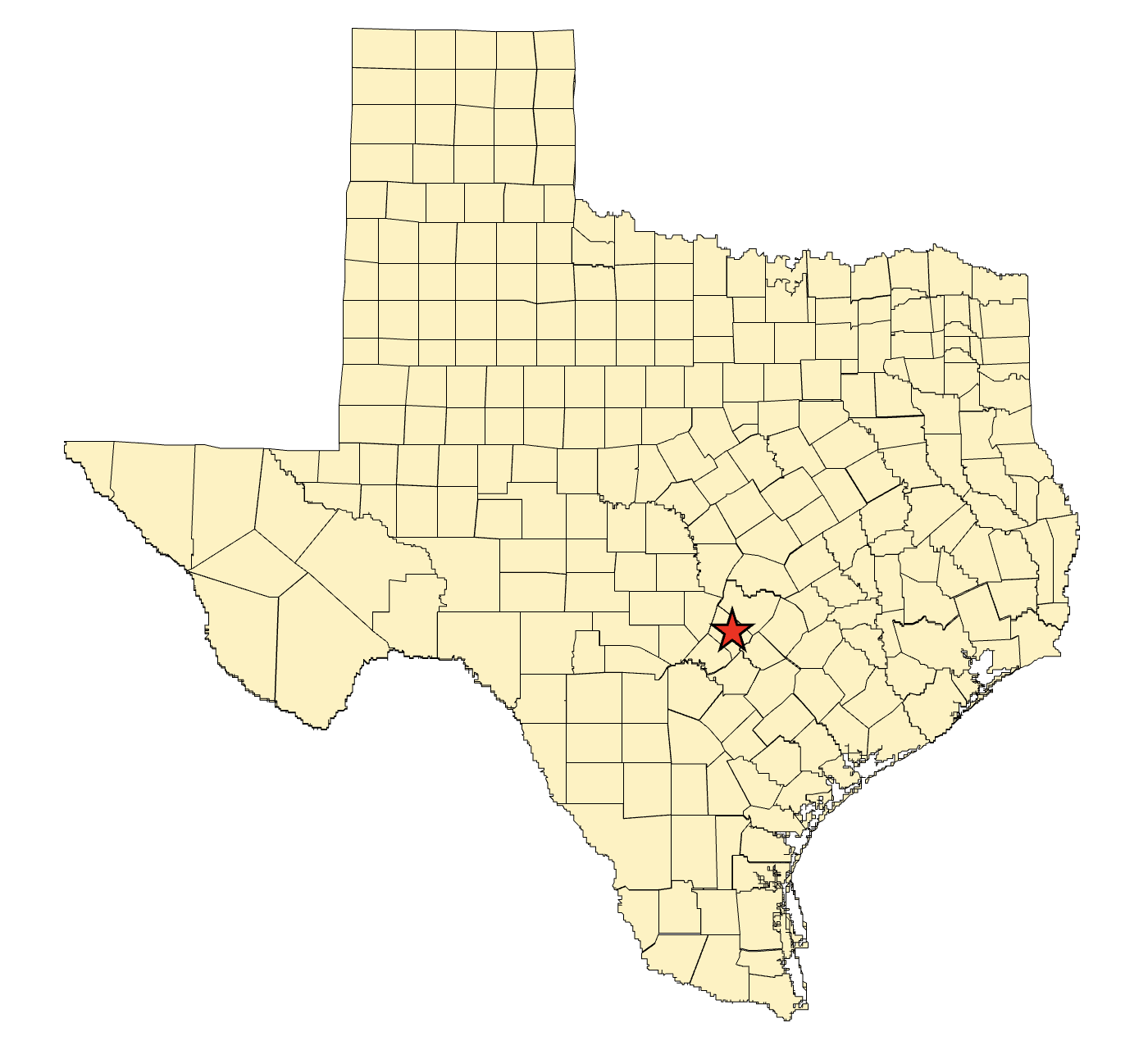
Work Session Agenda Item 12
Exhibit B
Vicinity Map for the A.E. Wood Fish Hatchery
San Marcos, Texas
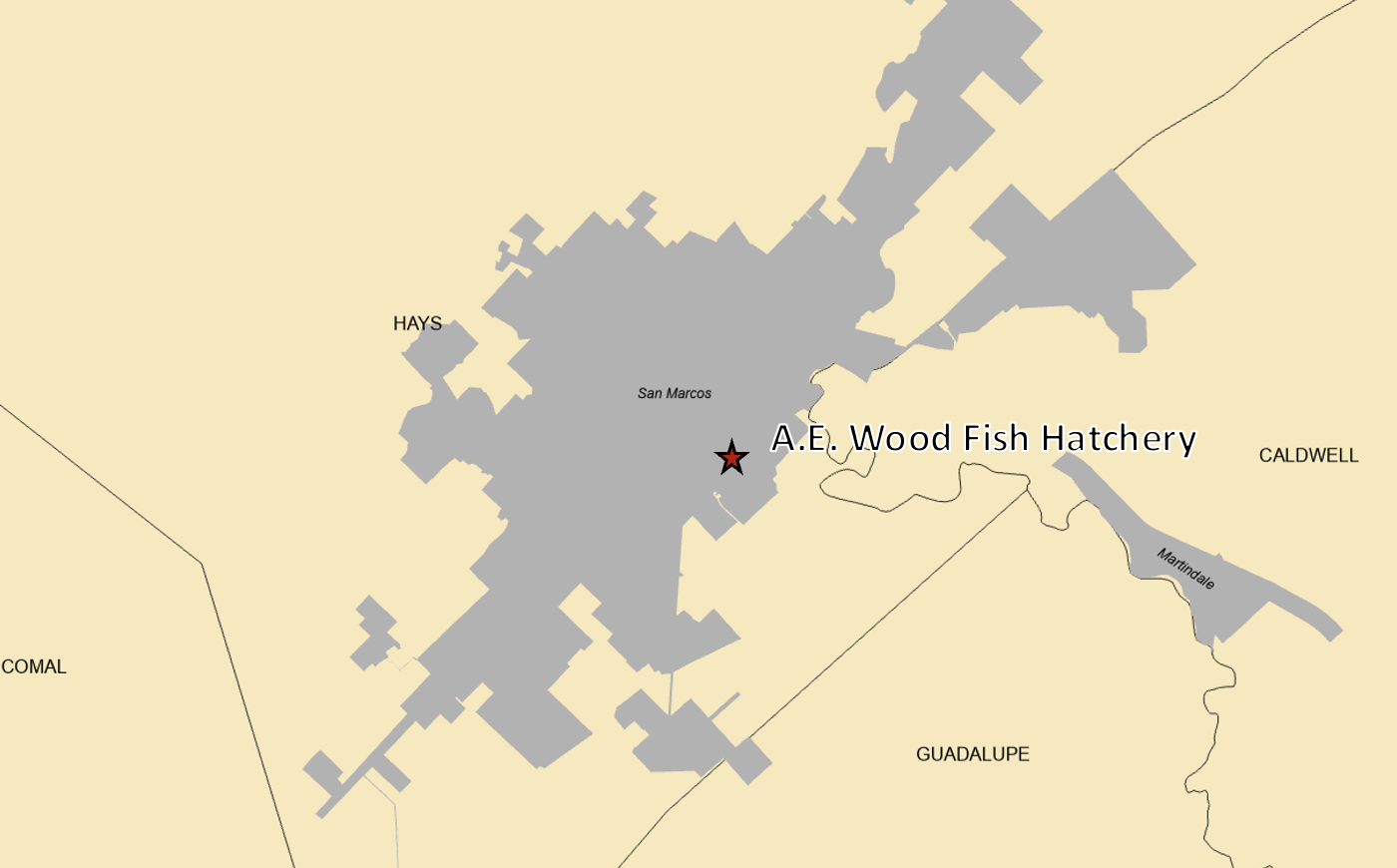
Work Session Agenda Item 12
Exhibit C
Area Map of the A.E. Wood Fish Hatchery
A.E. Wood Fish Hatchery Outlined in Red

Work Session Agenda Item 12
Exhibit D
Location of Requested Easement
A.E. Wood Fish Hatchery Outlined in Red
Requested Easement in Yellow
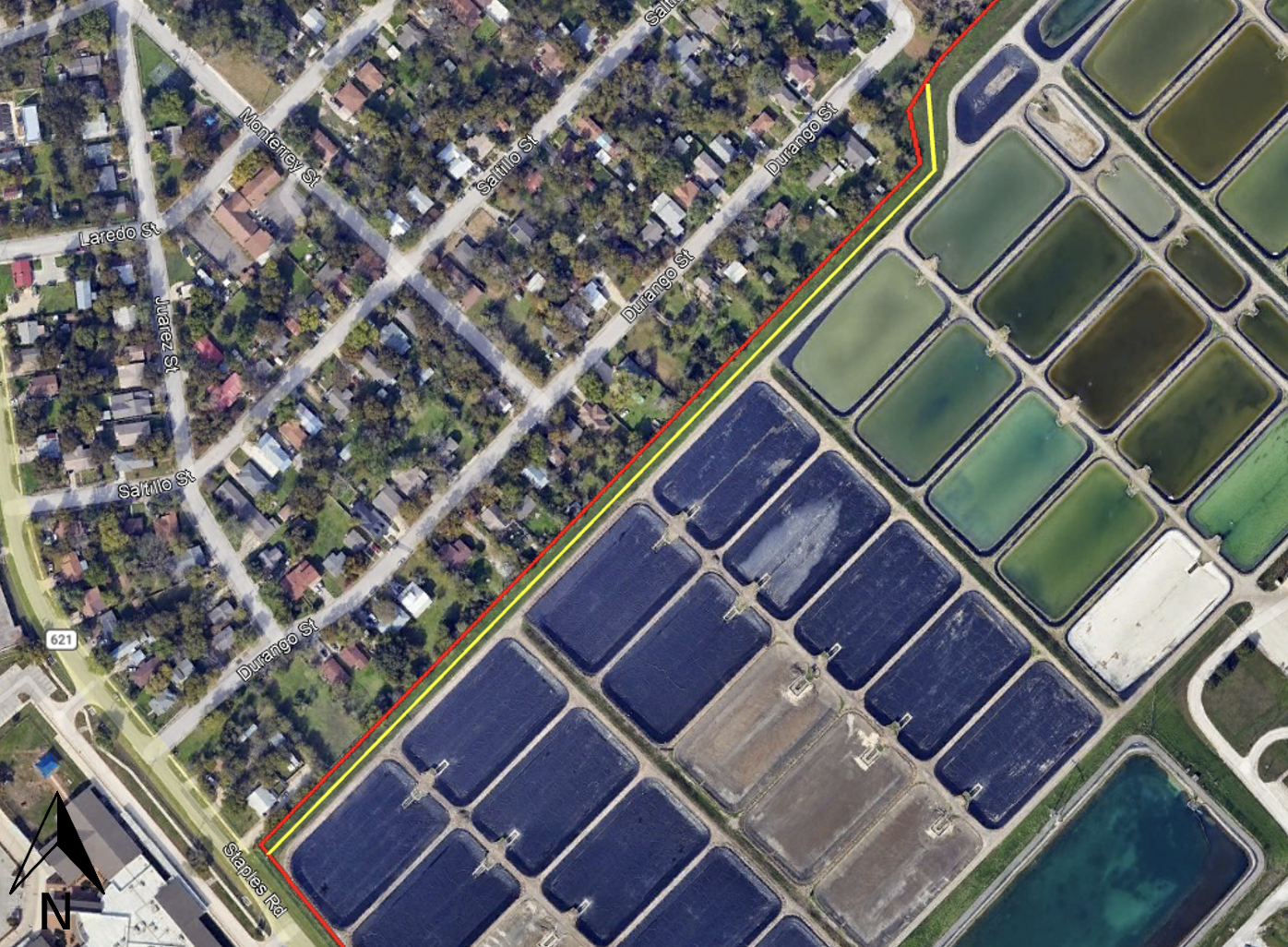
Work Session Agenda Item 19
Presenter: Stan David
Land Acquisition – Henderson County – Approximately 650 Acres – Request Permission to Begin the Public Notice and Input Process
I. Executive Summary: Staff requests authorization to pursue acquisition of a 650-acre parcel of land for a new state park from a willing seller.
II. Discussion: The property proposed for acquisition consists of approximately 650 acres located between Tyler and Athens and is on Lake Palestine, a 25,000-acre lake in northeast Texas. The property consists of wooded and pasture land and has small ponds and lakes. The property is suitable for overnight and day use areas; lake recreation; hunting and fishing, including waterfowl hunting access; hiking trails; and other recreational opportunities.
Staff prioritizes acquiring state park inholdings and new state parks from willing sellers to improve recreational opportunities, conserve fish and wildlife habitat, and ensure the conservation of existing Texas Parks and Wildlife Department public lands. Acquisition of this tract will add a new state park to the department’s public land system and provide greater outdoor experiences and opportunities for the citizens of Texas.
Staff requests permission to begin the public notice and input process.
Attachments – 3
Work Session Agenda Item 19
Exhibit A
Location Map for Subject Tract
Henderson County
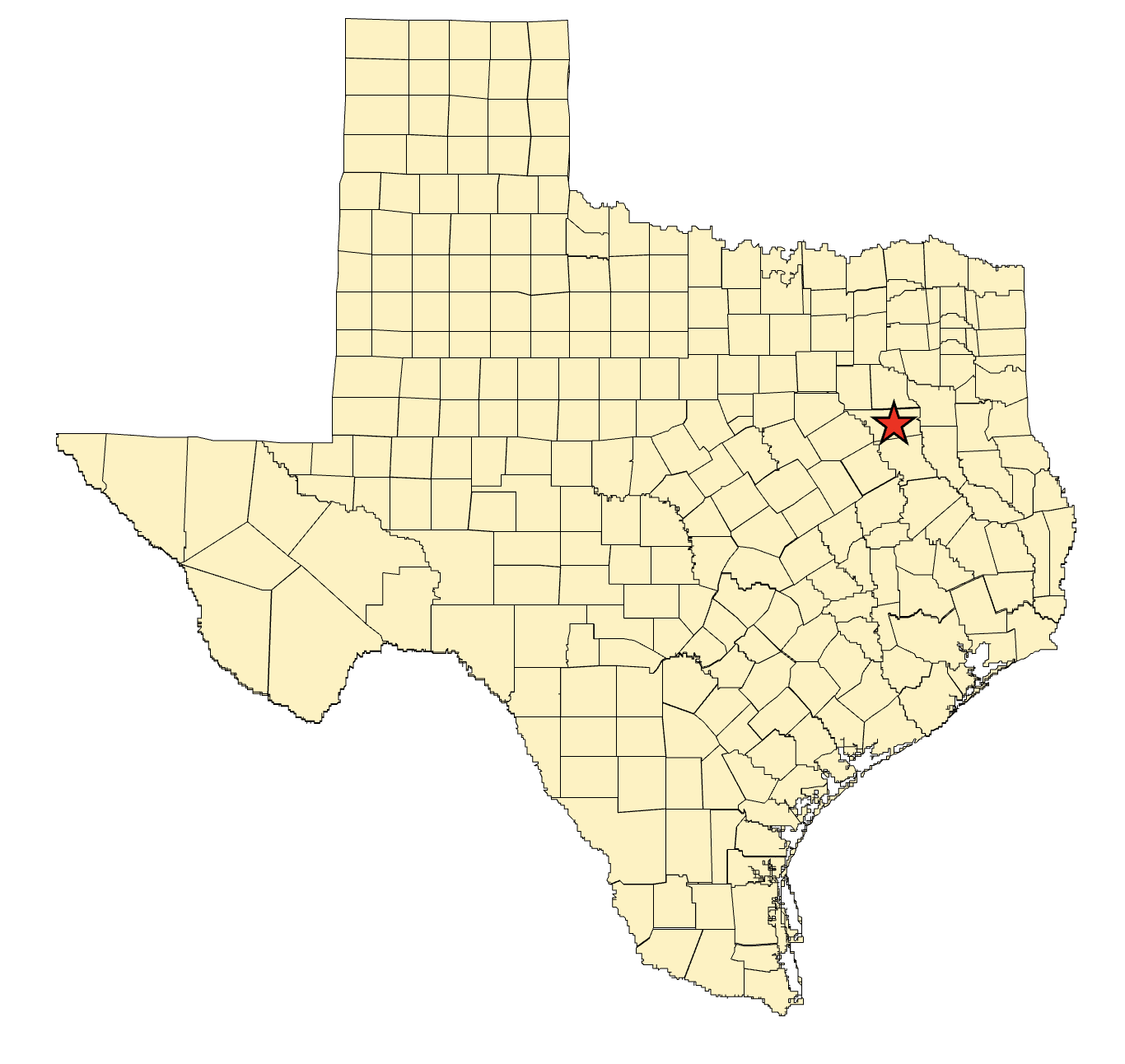
Work Session Agenda Item 19
Exhibit B
Vicinity Map for Subject Tract
Approximately 25 Miles East of Athens
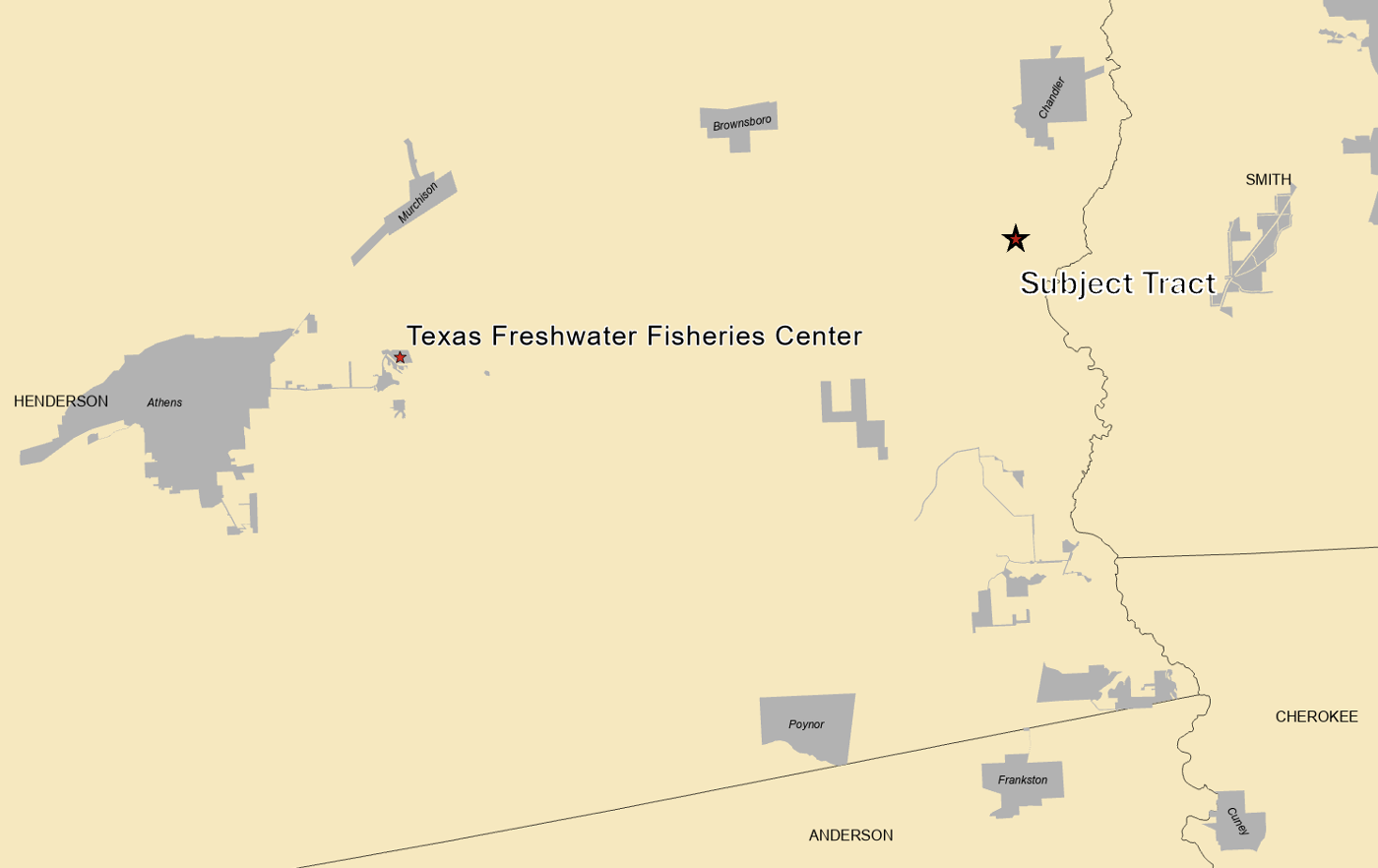
Work Session Agenda Item 19
Exhibit C
ite Map of Proposed Acquisition
Subject Tract Outlined in Yellow

Work Session Agenda Item 20
Presenter: Rodney Franklin
Centennial Parks Conservation Fund Projects
I. Executive Summary: Staff will update the Texas Parks and Wildlife Commission on the acquisition of real property from willing sellers for Texas state parks using the Centennial Parks Conservation Fund and other funding sources.
Work Session Agenda Item 21
Presenter: James Murphy
Litigation Update
I. Executive Summary: Attorneys for the Texas Parks and Wildlife Department will update and advise the Texas Parks and Wildlife Commission regarding pending or anticipated litigation.